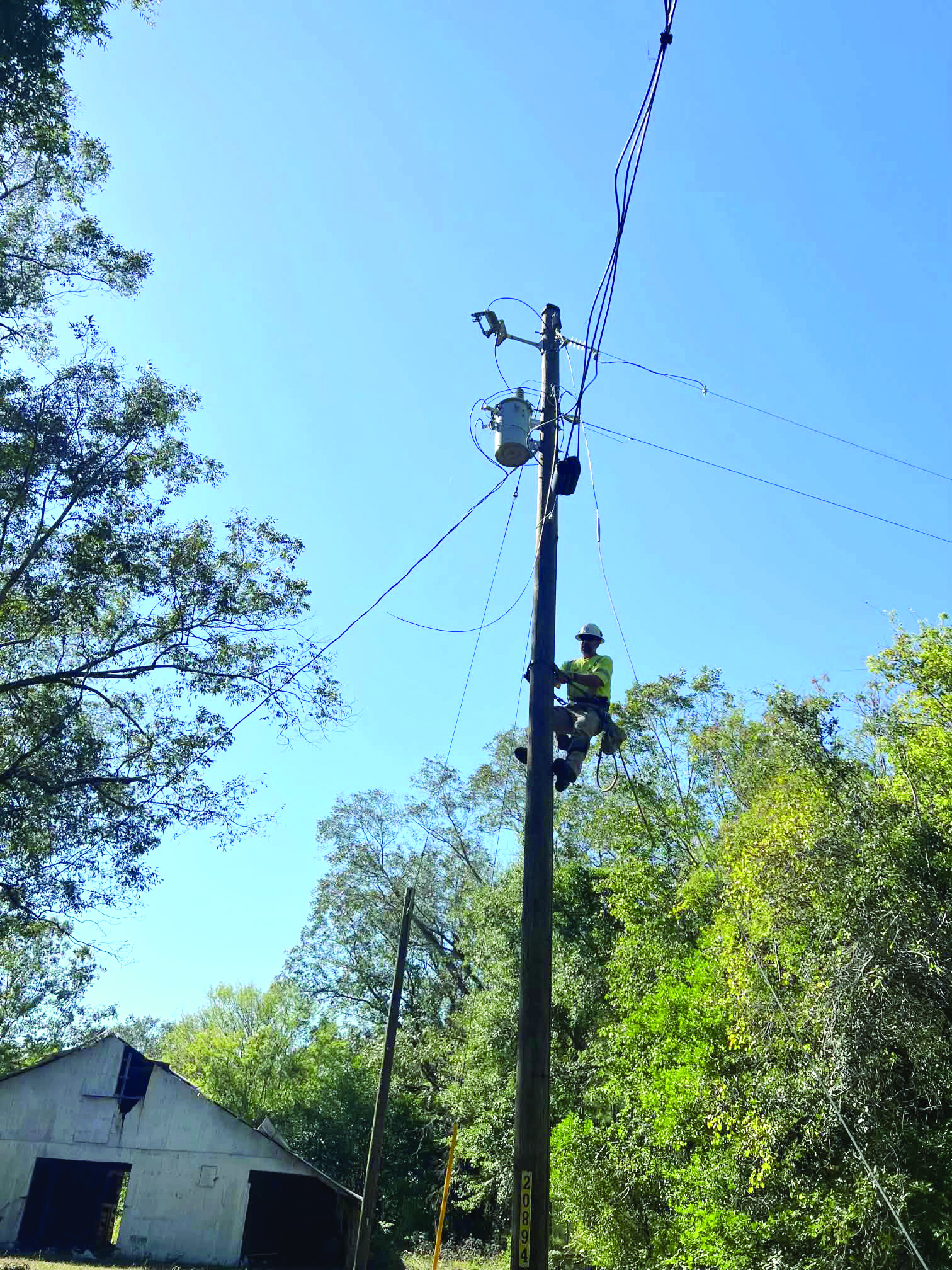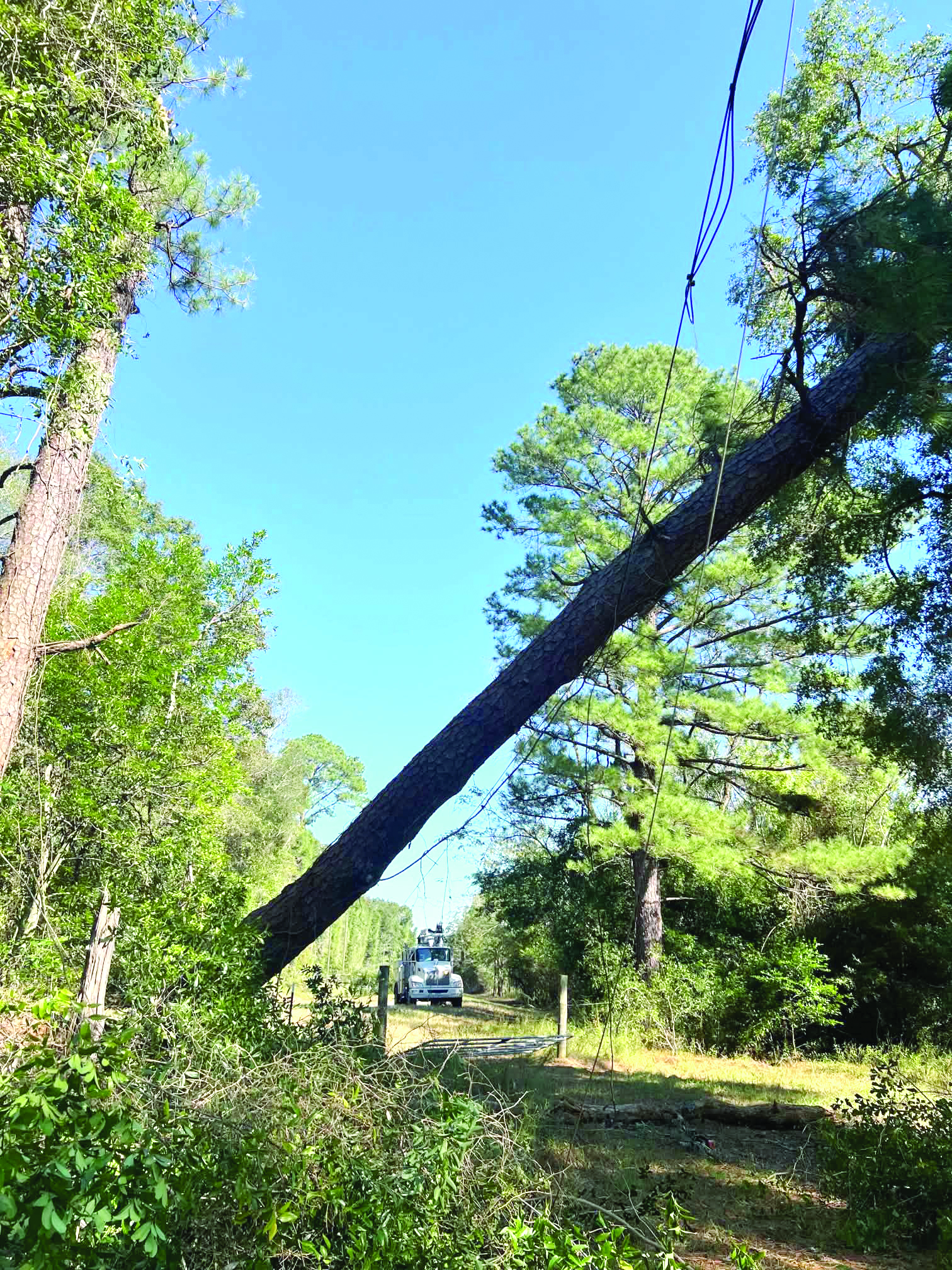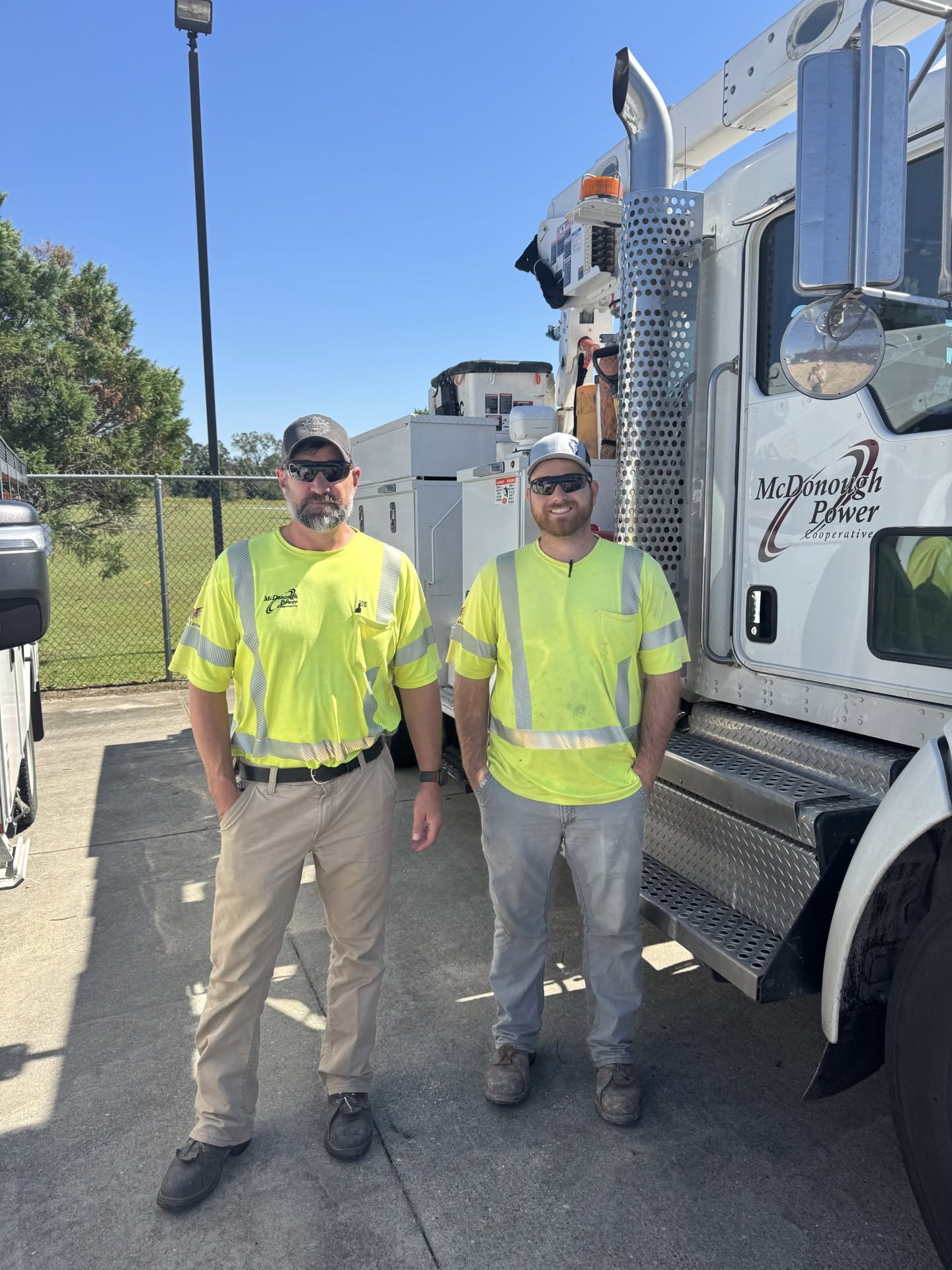
Earlier this month, Hurricane Isaias roared through the Gulf Coast, leaving swaths of destruction behind and power outages in a handful of southern states, including Florida, Alabama, Mississippi and North Carolina, before moving north along the New England coast. Nearly 10,000 residents of Hartford, AL were left without power, with many linemen from across the U.S. heeding the state's call for help … including two from the McDonough Power Cooperative (MPC).
Joe Wernsman and Riley Entwistle traveled to the Geneva County community Oct. 10, along with 72 other Illinois power cooperative linemen from across the state, as well as others from around the nation, to help restore power over a three-day stretch. Wiregrass Electric, Hartford's co-op, had 9,700 people without power when the crew arrived, Wernsman said. Those customers had been without power for three or four days before the Illinois crews arrived, Entwistle added.
The trip was the first storm-recovery job out-of-state for Wernsman, who has been with MPC for 16 years; however, he has done some linework more than halfway around the globe as part of his MPC gig. In 2025, he spent three weeks in Haiti, along with two other Illinois linemen, to build power lines for a newly-established power cooperative in two small communities about 150 miles from Port-au-Prince.
Entwistle, who has been with the McDonough co-op for six years, worked in Missouri previously for an electrical contractor and in that job, he went on long stretches – sometimes over a month – of storm-recovery efforts in numerous states during his time there. The two men, along with other linemen at MPC, have also assisted other cooperatives in Illinois, including Rural Electric Convenience Cooperative (RECC) in Sangamon County and Adams Electric in Adams County, with power restoration following major weather events such as ice storms, tornadoes and derechos/high winds.
The work comes through a mutual aid network among cooperatives. When a co-op's territory has storm damage, it can put out a call for help with the Association of Illinois Electric Cooperatives (AIEC), which then emails co-ops across the state to see who can send crews. Sometimes the request is for a four-man construction crew, other times, it's just for a couple of workers. For the Alabama job, it was for a two-man service crew from the local co-op, with employees volunteering to go. Why do they lend a hand when a call comes? It's simple … "You're helping people who don't have power," Entwistle said matter-of-factly.
Plus, as the McDonough Power Cooperative is a small operation, serving about 5,000 rural customers, the employees here don't often get a chance to go. But when they do, they want to return the favor that has been extended to them over the years.
"We've had several times in just the past few years where other co-ops have helped us," Wernsman added. "After severe weather hit our area a few years ago, five co-ops came to work in our territory, which runs from Littleton to Galesburg."
In Hartford, the crews worked from 5 a.m. to 7 p.m. Each visiting crew was assigned a "bird dog," a Wiregrass Electric lineman who served as the leader, taking Wernsman, Entwistle and others to outages and explaining what needed to be done. Two bird dogs oversaw four crews, including the McDonough County employees.
"Basically, they needed manpower and some trucks, and the bird dog took us to the problem, and then we fixed it," Wernsman said.
Entwistle estimated the crew worked 10 to 12 tickets over the three days. Sometimes the bird dogs knew the problem in advance. Other times, he said, the instruction simply said: "Hey, this line's out. Fix whatever you find, and call me when you're done."
One would think since water and electricity don't mix that would be the main danger they faced in the aftermath of a storm that dumped inches of rain in the region. In some instances, that is the case, but not so in Hartford, AL, which is in the thick of peanut season … which means rattlesnakes. Not only that, the area also is thick with copperheads and water moccasins.
"We didn't see any, but a lineman from another co-op had a snake crawl across his boot," Wernsman said. "We probably walked right past snakes, and didn't even know it."
For both men, it was about helping others in need, including their colleagues from other parts of the U.S. It's also a chance to see their colleagues from the Land of Lincoln who they don't get to see too often, Wernsman added.
MPC CEO Mike Smith shared that 'Cooperation among cooperatives' is one of the seven cooperative principles. When other cooperatives need help, MPC will do all it can to help them and they would willingly do the same for the local cooperative, he added. Over the last 20 years, Smith said that every MPC linemen has traveled throughout the state, as well as out-of-state, to help their fellow linemen get customers back in business after severe weather events.
“Outage restoration and emergency response is just one aspect of cooperatives working together. If another cooperative has come up with a program or procedure that others could benefit from, it is shared," Smith said. "Operation Round-up is a good example. It was started by a South Carolina cooperative, Palmetto Electric, in 1989. Since then, hundreds of cooperatives, including McDonough Power, have adopted their plan to benefit their own cooperative members. Palmetto Electric charges each cooperative $1 for the lifetime rights to their program which in turn, has benefitted thousands of organizations."
While out-of-state outage restoration is the most recent example of working outside MPC's service territory, most of the time it involves restoring power to Illinois cooperatives, Smith pointed out. If really bad weather hits, most members understand it takes time to get back to normal, but after a few days, outages can take a toll. People get frustrated and additional help is always welcome, he explained.
“As Riley and Joe shared, during the Derecho a few years ago, we needed help and several crews from other cooperatives in Illinois came in to assist. They worked daylight-todark several days to help get our lines back in the air," the CEO said. "Following the work they did here, those same crews went over to Carthage and worked on Western Electric Cooperatives damaged service areas. Linemen will just keep working until the last light comes on.
"We are always grateful to lineman that volunteer to go out of our service territory to work long hours in rough conditions. They have families at home and suddenly their families schedule is upended and readjusted without much notice," Smith concluded. "While it is hard on those doing the work, the people at home are adjusting to a new environment as well and they are carrying a much larger load."