“Ladies and gentlemen, children of all ages ! Ringling Bros. and Barnum & Bailey proudly presents… The Greatest Show on Earth!”
For the first 11 years of my life our family lived in Fulton County.
I remember the endless summers of continuous outdoor activities, in a tightly woven neighborhood of good solid farm families. Fulton County and McDonough County are, for good or bad, very different. In Fulton County, you refer to gravel roads by what they have been called forever and a day, and the road signs match that train of thought. For example, where we lived we were often times traveling on Seven Hills Road, Helle Road, Cucumber Hollow, Tator Hollow, Barnes School Road, Checkrow Blacktop, Checkrow Church Road - everyone knew how to tell someone how to get somewhere by common sense road names and descriptions of houses, trees, barns, windmills, ponds. It made sense.
Growing up on farms in Fulton County was a golden childhood. We were so blessed to have the chance to attend one of the last country schools, Checkrow, which closed in 1964. Checkrow had on the average around 35-40 students, grades 1-6, levels were combined so as to share just a couple teachers for all students. We thrived, even though the poverty rate must have been through the roof.
Just over three years ago we had the first ever Checkrow School Reunion, reaching out to find friends we had not in some cases seen since 1964. We have since had a second successful reunion and plan on continuing the get-togethers every three years until there is no one left to leave the lights on. It was during the planning of the first reunion that I was gathering information about the Checkrow history and neighborhood, that I stumbled upon something in a reference book.
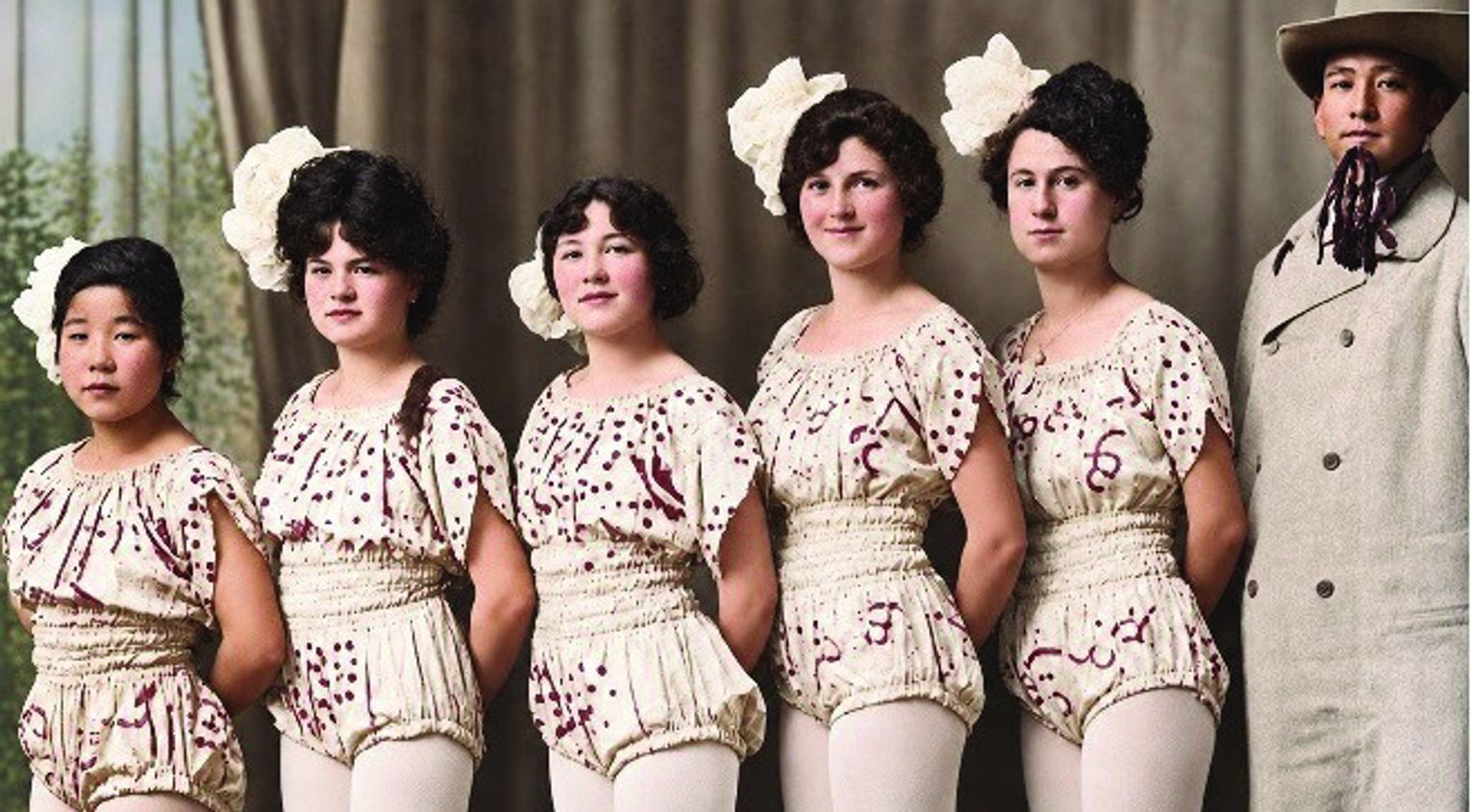
The picture was of a circus troupe, a man and five young women, and the article noted that these people lived during the offseason at Babylon Bend. I thought this was a mistake. I was a very observant child and I had never heard of a circus troupe just two or three miles from our school. Who were these people? And if a circus troupe lived at Babylon Bend, they would have had horses. And being a horse-crazed child, I would have known about those horses. I would have known their names, their favorite treat, their ages, and their exact color and markings. No, there could not have been a circus troupe at Babylon Bend. That was absurd. But guess what - there was.
I went on with my reunion planning, but I couldn’t forget this new revelation. The intrigue has brought me back to this story and it has turned out to be most fascinating. It is with great pleasure that I introduce you to the village of Babylon Bend and the Hubbell Family Circus Troupe.
I would be willing to bet most Macomb residents have never heard of Babylon Bend. I would be willing to bet the majority of Fulton County residents have never heard of Babylon Bend. While scenic Bernadotte in Fulton County is known for the dam and its popular restaurant, Babylon Bend’s claims to fame are both gone. Let’s start from the beginning.
Babylon Bend refers to a scenic and historic crossing point along the Spoon River in Fulton County, Illinois. From Macomb’s eastern edge, it is probably approximately 25 miles give or take. Not far at all. The name originates from a sharp, winding loop in the Spoon River. In the 19th and early 20th centuries, the small settlement of Babylon grew around this bend as a localized river outpost. Today this area is mostly known as a quiet, secluded spot consisting of fishing shacks and rural backroads. Before the turn of the century, crossing the Spoon River at Babylon Bend safely was a challenge for horse-drawn wagons due to a long hill and a blind corner approaching the riverbank.
In 1890, an iron and steel bridge was constructed to carry Babylon Road (TR-123/ Illinois Route123) across the river. It was built as a nine-panel pin-connected Pratt through truss bridge, stretching approximately 204 feet long. It became architecturally celebrated for its distinctive, attractive lattice portal bracing.
As transportation evolved and modern highways bypassed older iron bridges, Fulton County’s late-19th century river crossings became increasingly rare. On Oct. 29, 1980, the Babylon Bend bridge was officially added to the National Registry of Historical Places, and was recognized as a crucial part of the Metal Highway Bridges of Fulton County. As modern highway vehicles became heavier, strict guidelines regarding historical preservation meant the bridge could not be easily modified, and it gradually fell into disuse. It was officially closed to all traffic in 2007.
The nine bridges that made up the Metal Highway Bridges of Fulton County were all built between about 1880 and 1915. They were all built on county and township roads in rural areas. These bridges, which are mostly gone now, were important because they are early examples of truss bridges in Illinois. Together, the nine steel truss bridges in Fulton County were historically significant because of their close proximity to each other and their age. Back in the 70s and 80s people even took special tours by canoe or car to see them. The nine bridges were located at Seville, Bernadotte, Buckeye, London Mills, Babylon Bend, Elrod, Duncan Mills, Tartars Ferry and Indian Ford.
Babylon was the site of a famous old mill and the most celebrated area locally for picnics and holidays from the 1830’s on. Long before roads were laid out in the country Babylon and Bernadotte farther south were favorite stops for young and old. A musical, ‘Babylon Bend’, recognized the history of the sleepy little set of cabins and the poignant memories of Spoon River. A song that captured the essence of the feeling in Babylon told the story of the longing for the outside and was entitled “I Wonder What They’re Doing in Chicago.”
So what does all of the above information on Babylon Bend have to do with a circus troupe?
Meet the Hubbells, It’s the Craziest Thing “Hubbell” is a historical name in circus history most famously tied to Art and Edith Hubbell, who performed with major American circus outfits during the 1930s. Art Hubbell was renowned as a prominent sideshow performer known by the stage name “The Human Bellows.”
During the 1930 touring season of the Ringling Bros. and Barnum & Bailey Combined Circus sideshow , he regularly took the bally stage to perform acts involving the deliberate inflation and manipulation of his abdomen. Edith Hubbell, his wife, performed alongside Art as part of the touring acrobatics and performance staff listed in historical circus route records from the mid-1930s.
Another notable Hubbell circus performers that carried the Hubbell name into the big top was Alonzo Hubbell, a mid-19th-century strongman performer dubbed “the modern Hercules,” who performed ground acrobatics and feats of strength with Rockwell & Stone’s Mammoth Circus in the 1840s.
Harold, or “Hub” Hubbell was a legendary cowboy entertainer, trick roper and exhibition shooter. Based out of the famous circus haven of Sarasota, FL, he spent decades performing in Wild West shows, rodeos, and mid-century circuses alongside such stars as Roy Rogers and Gene Autry.
The Hubbells of early 1915 Babylon Bend acclaim were Jake Hubbell, his wife, and his nieces - his brother Ike’s daughters - Erma, Jessie and Mabel Hubbell. Also a member of the troupe was Osi, a friend of Asian descent. It is not clear how the Hubbells of Fulton County came to live in a house on a hillside overlooking Babylon Bend. An exact description of their property says they lived “about two-thirds up the south side.” Research shows that Jake’s father ran a mine in Middlegrove, another small Fulton County village. The Hubbell family sisters are listed as being originally from Canton. So they all were from the same general vicinity in Fulton County. One is led to believe the house in Babylon Bend belonged to Jake and his wife, though I could be mistaken.
While Art and Edith Hubbell never lived at Babylon Bend, other family members did. And it is most likely Art and Edith Hubbell visited Babylon Bend a time or two.
The reason this young Checkrow elementary student never heard about the Hubbell Circus Troupe wintering at Babylon Bend was simply a matter of birth and years: the Hubbells were about 40 years before my time.
The Hubbell sisters originally began their career touring and performing under the name The LeRoy Troupe. The sisters later joined forces with The Flying Wards, one of the most legendary and influential families of trapeze artists in American circus history. Another sister, Inez Hubbell Beares, joined her sisters in the circus at just 16 years old. She performed across the country with the Sells Floto Circus - which at that time was the second-largest circus in the U.S. behind the Ringling Bros. She eventually rose to become a specialized “catcher” in their high-flying trapeze acts. At that time the Sels Floto Circus was drawing more than 10,000 people each day.
The Flying Wards were a famous flying trapeze and aerial group led by Eddie and Jennie Ward, and later Mayme Ward, performing with major circuses like Ringling Bros., Barnum & Bailey and the Hagenbeck-Wallace from 1903 through the 1930s. They were based in Bloomington, IL where they built a dedicated practice barn on Emerson Street in 1915. Their success helped establish Bloomington as the “Trapeze Capital of the World,” training numerous prominent aerial acts like the Concellos.
Tragedy struck the Flying Wards in 1918, when Jennie Ward died in the infamous Hagenbeck-Wallace circus train wreck near Hammond, IN, though surviving members rebuilt and continued the act. This is reminiscent of an 1892 train wreck near Brainerd, MN, which destroyed the sleeping car of the Andrews Opera Company. It seems the travel in between performances could be as or more dangerous than the performances themselves. The Andrews Opera Company performed in Bushnell at the Randall Opera House on East Main Street.
The Hubbell sisters from Fulton County trained at the school in Bloomington and as part of the Flying Wards troupe, they achieved major acclaim, with Inez’s position as “catcher” being the most demanding, as she was responsible for securely catching the fliers mid-air. As dangerous as her job was, Inez Hubbell Beares lived to be 94 years old and died in a nursing home in Apollo, FL on Feb. 11, 2007. In addition to being a trapeze star, Inez also trained elephants and worked with thoroughbred racehorses, according to her obituary. Another talent mentioned was her ability to perform a handstand 100 feet in the air on a swaypole.
One surmises that the Hubbells used their home at Babylon Bend, just 25-30 miles from Macomb, as a place to live during the circus off-season. One has to wonder what other Babylon Bend residents thought of their unusual neighbors. Lilly Duntley Ball recalled watching the girls practicing their “butterfly” act on high wires strung between two trees up on the hill.
To make matters even more intriguing, Mabel Hubbell, one of the sisters, married movie star Tom Mix, who was an American film actor and the star of many early Western films between 1909 and 1935. He appeared in 291 films, all but nine of which were silent films. He was one of Hollywood’s fine Western stars and helped define the genre as it emerged in the early days of the cinema.
So in addition to the Hubbell Circus Troupe residing in Babylon Bend, the tiny village now had a visiting movie star. This must have kept the townspeople at full attention, looking to see who was up on the hill at the Hubbell’s place. In 1971 The Canton Daily Ledger interviewed a fellow named Harold Fouts, who knew the Hubbells. (Oh how this writer would have liked to have done that interview!) Fouts recalled Jake Hubbell hanging from his knees on a trapeze suspended over the Spoon River, waiting for his partner to complete a double flip. Jake was to catch him.
Fouts recalled watching Jake swinging out to the middle of the river as his partner came from the trapeze on the other bank. The partner’s trapeze reached its peak and the partner let go, completed a double flip and many times splashed into the muddy Spoon River. Fouts states that both men must have fallen into the river 1,000 times, but that Jake made his partner keep trying and eventually their hands clasped together and they were both suspended from Jake’s trapeze.
Fouts also remembered the folks of Babylon Bend thinking the Hubbells were “a little odd, as in screwballs.” He said the Hubbells of Babylon Bend pretty much kept to themselves up on the hill, and that some thought they were crazy. He remembers that while they were well-known in the area, they kept their distance. Fouts said no one would just pay a neighborly visit to the Hubbell house, it wasn’t like that. The Hubbells liked their isolation and independence. Which I am sure added to the intrigue of having a nationally known circus troupe living in one’s village on the banks of Fulton County’s Spoon River.
While I can’t find documentation, it is interesting to note that famous Spoon River Anthology (written in 1915) writer Edgar Lee Masters had a love of traveling shows and circuses. Within his poetry, circus troupes frequently captured his literary imagination and served as a powerful metaphor for escaping life’s rigid, judgemental confines of small-town Midwestern life. There is no doubt in my mind that Masters would have been familiar with the Hubbells of Babylon Bend.
Stay tuned for part two of this adventure, which will cover the story of the amazing and eccentric Hubbell brothers Jake and Ike. The story just gets better.
Credits: Fulton County Historical Society, Cathy Parsons History of Fulton County Canton Daily Ledger Chris Vallillo Photo from collection of Kelly Frederick, Avon, IL Word Count Babylon Bend and Hubbell Circus Troupe