WIU Magliocco Lecture Discusses AI In Higher Ed
A specter is haunting the Western Illinois University Department of English … ChatGPT.
Since their release to the public in 2022, generative AIs like ChatGPT, Claude and Gemini have radically changed university education, often against the will of the educators. Professors struggle to adjust to a classroom where their students can generate passable AI writing to complete assignments with just a few keystrokes. One discipline impacted is literary studies, which relies heavily on reading and writing skills. On Oct. 9, Mary Holland of The State University of New York at New Paltz visited WIU to talk about the state of the discipline. She discussed how AI has transformed teaching, how we read books and the fundamental way that human beings relate to text.
Holland was the keynote for the the 20th annual Magliocco Lecture, which was endowed by the late English Department Professor Emerita Maurine Magliocco, who passed away in August. The series is designed to provide a highlevel discussion on literature, film or media theory aimed at faculty, who Magliocco noted often have to neglect their own research interests in order to devote themselves to teaching and university service.
“I am hopeful that the lectureship will strengthen that connection [to their discipline] and energize faculty,” Magliocco said when she established the series.
This year’s lecture opened with remarks by David Banash, who introduced Holland and her most recent book, “The Moral Worlds of Contemporary Realism” (2020). Holland discussed her concept of what literary realism is and what makes it so enduringly useful. Literary realism is a style of fiction which attempts to represent everyday life in fine detail.
It is most heavily associated with the novelists of the 19th century, such as Mark Twain, Charles Dickens and Leo Tolstoy. Holland emphasized that the realist project did not end in the 19th century, but rather has continued into the present day and evolved into new variations. Holland isn’t exactly a scholar of realism, but of realisms: dirty realism, neorealism, tragic realism, speculative realism, capitalist realism, socialist realism, postmodern realism and post-postmodern realism are just some she named.
"These realisms remain in fundamental agreement with 19th century realism about the nature of reality and our relationship to it through language. Now, as then, we are embodied beings in a material world using language to connect us to it and to others through acts of representation," Holland said. "As long as that embodiedness forms the basis of our experience and our literature, we will remain in an ever-evolving body-based literary realism.”
In other words, literary realism helps us to connect to our world and to better understand it through language and the act of writing.
But what happens when the humans aren’t writing anymore?
“Today, half or more of all published articles are written by AI,” Holland observed.
“Humans increasingly use chatbots to brainstorm, research, analyze and write for them. Mainstream presses unknowingly publish AI-produced books, and social media is flooded by AI text and images . . . We remain in our bodies while language and literature emerge as if from within air, from the cloud.”
An anonymous survey conducted on graduating seniors by The Yale Daily News found that 91 percent admitted to using AI in some capacity during their college career, and 64 percent admitted to using it to write a college paper at some point, while nearly 49 percent admitted using it to write their senior thesis. This is pedagogically concerning because college writing assignments are often deployed as learning exercises, and overreliance on AI hinders students’ ability to retain information.
A 2025 experiment by MIT found that students allowed to use ChatGPT to write an essay barely remembered any information from it compared to students who wrote their essay themselves, and 83 percent of students who used ChatGPT in the experiment couldn’t recall even a single sentence from their essay. Lead researcher Nataliya Kosmyna also observed that ChatGPT users felt significantly less invested in the writing, commenting, “If you don’t remember what you wrote, you don’t feel ownership. Do you even care?”
In 2025, results from the National Assessment of Educational Progress showed that high school seniors’ literacy had fallen to the lowest levels recorded since 1992, and about one-third lacked basic reading skills. While the literacy crisis predates AI and includes other factors such as increased screen time and the COVID-19 pandemic, AI appears to have accelerated the trend by providing students test answers and ready-to-order essays that they would have previously had to read for. Many students now instead of reading assigned texts can read short AI summaries, some of which contain errors.
AI proves such a threat to the project of literary studies as Holland sees it because it disrupts the ability of language to connect us to the world—how exactly are students supposed to use the written language of great books in this way when they can barely read it and feel no emotional investment in it? Holland grimly acknowledged that AI could well prove fatal to this project.
“We may reach the end of many mainstays of literary studies,” she said. “Once AI-produced narrative outpaces human writing . . . literariness may no longer be an artifact of the human in its ever-evolving relationship to the physical world, language, other humans, and theories about all three.”
The challenges AI poses to student learning are widely acknowledged throughout higher ed. A November 2025 survey by the American Association of Colleges and Universities found that 90 percent of faculty polled believed Generative AI would diminish students’ critical thinking skills, and 83 percent thought it will decrease their attention spans. However, opinions by professors on how to address these issues vary widely.
Holland has taken a strong anti-AI position in teaching.
She described adopting an AI and screen-free policy for her classrooms in order to transform them into “attention sanctuaries.” She discusses with her students at length what AI is, how it works and what is gained by not using it in literary studies. She also organizes reading parties in order to cultivate literacy and a culture of analogue living.
Holland commented that “in these ways, I endeavor to create spaces for embodied teaching, learning, and literary studies that stay connected to the world and conversations being reshaped by AI technology.”
Other professors share Holland’s concern while coming to opposite conclusions. Jeremy Robinett, director of WIU’s School of Communication, Media, and Experience Industries, believes it’s necessary for his students to learn how to use AI. AI is becoming increasingly incorporated in the industries these students wish to enter. Robinett believes the classroom is the best place they can learn to use it responsibly and effectively.
“As I tell my students, the genie is out of the bottle.
They need to be smart about the wishes they ask of it and wise enough to question the answers they receive,” said Robinett. “One of my favorite classroom activities is having students complete a writing assignment and then compare their work to what AI produces. What I've found is that they often prefer their own work. This simple assignment is a great way for them to recognize that AI may be able to produce something quickly, but it doesn't necessarily capture their experiences, perspectives, or emotions. I want students to leave my classes knowing how to use AI to enhance their own thinking and creativity, not replace them.”
Holland also expressed some doubt that AI-free classrooms were the way to go.
“If we manage to preserve the classroom as a space for AI-free writing, reading, and thinking about human produced literature, will literature classrooms become anachronisms?” she asked.
“How do we keep arguing that what we do is relevant?
That literary studies empower students to critique ideology and change the world if literary studies become a world apart from the one students live in? How do we maintain literary studies as a humanist examination and valuing of the lives of human beings in a world made by technology that increasingly decouples the human mind from the language and representations that define us?”
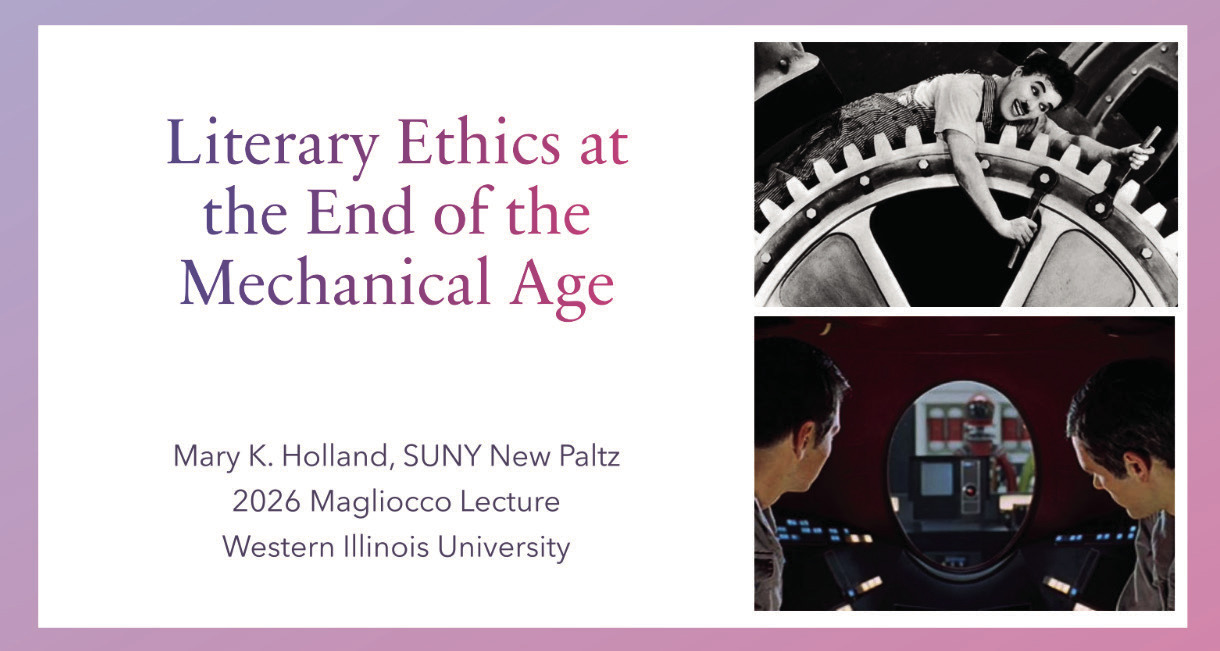
David Banash and Mary Holland
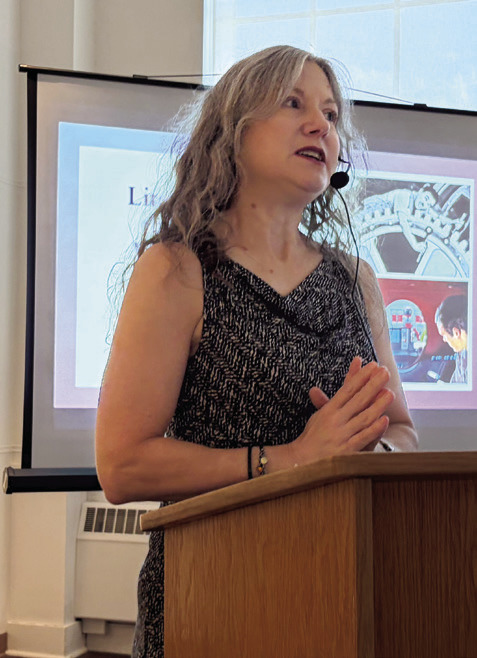
Mary Holland lecturing