“Bless the beasts and the children, For in this world they have no voice, They have no choice.”
- by Barry De Vorzon & Perry Botkin Jr.
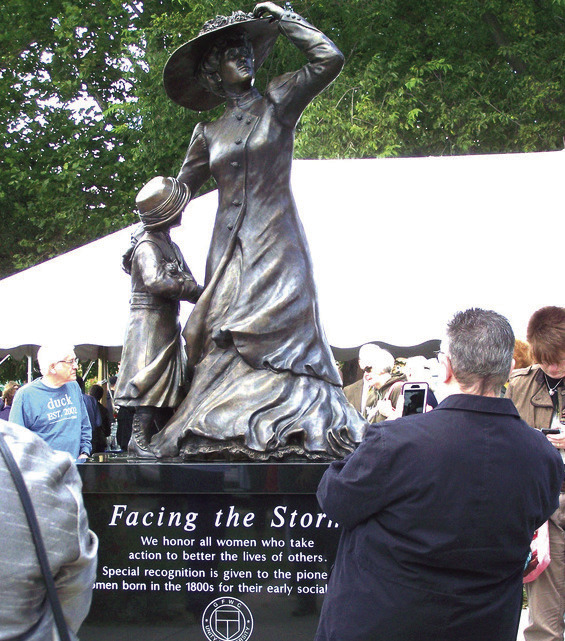
Standing on the west side of Macomb’s Chandler Park is a stunning statue dedicated to the pioneering women of social activism in McDonough County. The statue, named “Facing the Storm,” was unveiled in September 2015 and was the inspiration of the Women’s Memorial Committee, a part of the GFWC Macomb Women’s Club. Western Illinois Museum assisted with the project.
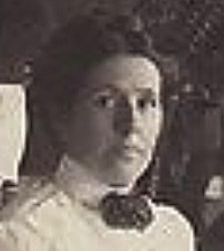
Josie Westfall, 30 year old matron of the McDonough County Orphanage and mother to over 500 children, is pictured here with a photograph of what the orphanage looks like today. After the orphanage closed in the 1940s, the Salvation Army took it over until 1950 when it was renovated and turned into a well-maintained apartment building.
The statue depicts a woman with a young girl holding a cat. They are dressed in period clothing from the early 1900s - a time when women fought for and gained more rights. The creator of the bronze statue was Jaci Willis from Peoria. The statue is stunningly realistic. The bronze likeness memorializes the contributions of eight women in McDonough County’s history and includes brief biographies explaining their work: Clara Bayliss, who crusaded for improved parenting and better home lives for children through writings, talks, and organizational work, and raised funds for the county orphanage.
Lida Crabb, who used her newspaper column “A Day at a Time”, to promote sympathetic appreciation for others and to foster a sense of belonging while also supporting a variety of community causes.
Rebecca Everly, who established a trust to build the county’s first retirement facility for the elderly with funds from the trust helping pay expenses.
Rose Jolly, who organized and led the county’s first social organization, the McDonough County Humane Society, devoted to the protection of children and animals.
Dr. Elizabeth Miner, the county’s first female physician, treated impoverished patients, promoted safe childbirth practices, and became a leader in the Medical Society.
Sadie “Mother” Moon. who continually reached out to provide food for the homeless, helped mothers care for their sick children, wrote regularly to local servicemen, and became an icon of neighborly concern.
Dr. Ruth Tuncliff, a published medical researcher on diseases like the measles, scarlet fever, diphtheria, and meningitis.
Josie Westfall, who raised money to create, expand, and operate the McDonough County Orphanage, serving as matron for 30 years, ultimately caring for some 500 children.
It is Josie Westfall who my focus is on with this article. Much of my information is taken from Western Illinois Museum’s Executive Director Sue Scott’s video which can be found on You Tube Josie Westfall.
The history of McDonough County’s orphanage is near and dear to this writer’s heart, as in 1997, I traveled to Russia and adopted two children from Orphanage N52. Until one walks into a real orphanage, regardless of where it is, one does not understand the overwhelming bleakness of the situation, but also the love and compassion the caretakers seemed to have for the children in their care. The caretakers of the orphanage I visited made a salary of the American equivalent of $7 per week. The children appeared well cared for and happy as children usually are.
The orphanage where my children were was run on a shoestring budget, not unlike Josie Westfall’s. And when it came time to leave with my two boys, who had lived there three years, there was not a dry eye amongst the caretakers, the director or anyone for that matter. I do believe they truly loved the children, as I truly believe Josie Westfall loved her children.
For me, the hardest time of all upon leaving the Russian orphanage was saying goodbye to the other children, who were staying behind. It haunts me to this day, as their eyes seemed to say “Why not me?”
A Mother to Many: Josie Westfall
In 1911, Macomb had no public facility for the care of orphaned children. As my previous articles about the county poor farms suggested, some of the children were housed there. The county farms were no place for children, but other housing at private homes and facilities was limited. Some children were even born at the county farm.
When two orphans became a focus of the community’s concern, Josie Westfall took on the task of caring for them. Within her lifetime Josie Westfall would be the protector of hundreds of the community’s orphans. Records show that Josie also helped out around 1907 at the Methodist Children’s Home in Normal, Illinois by donating her time and assisting with Christmas drives.
Josie Westfall was born in Macomb in 1874. Records show she grew up on East Carroll Street and had two sisters. By age 13, in 1888, she was attending the Central Normal School, which was a “subscription school,” meaning her family paid for her education. She was a skilled dressmaker.
She began her “career” as a mother in 1911 by taking the two above-mentioned children into her home. Within the timespan of one year, she was providing a home for 19 children. The county board of supervisors paid Westfall $25 per month to help her with expenses.
In 1913, an Orphanage Board was appointed, and the first chairman was John Graves, who was instrumental in establishing the orphanage. A local merchant by the name of Joseph E. Wyne donated a home at 415 N. Madison Street.
The number of children in Westfall’s care soon reached 34, and an addition was constructed as the number of children increased.
Here Comes the Judge With funding grossly inadequate, Josie ran for city judge, with the idea that she would donate the judge’s salary to the orphanage. She won the election, 839 votes to 577. Her opponent contested the race in McDonough County on the grounds that the election was illegal. Although the Illinois Women’s Suffrage Act was passed in 1913, the suit claimed that women did not have the right to vote in that judicial election. Josie’s opponent had received 430 votes from men to Josie’s 409 male votes. The county court found in favor of Westfall and women’s right to vote, but the Illinois Supreme Court overturned the election. It would be 1920 before the 19th Amendment was passed. Interestingly enough, one of the lawyers representing Josie’s opponent was a woman. Josie sat as McDonough County Judge for two years while the case played out in the courts.
The election was the first in which women in Illinois could vote - albeit only for non-constitutional offices. With the passing of the Illinois Municipal Voting Act, the women of Macomb had cast their first vote for a female city judge, another first. Unseating the incumbent Dean Franklin on June 1, 1914, an educated and practicing lawyer from a family of lawyers, and the efforts to overturn the election by Franklin, suggests that suffrage was alive and well in Macomb in 1914. In hindsight, the Illinois voting act is considered an important step in the country passing the 19th Amendment. The case was publicized across the country in newspapers and discussed in debates.
Crusading for the Children Not discouraged by the election, Westfall continued her crusade to obtain support from both private and public sources, and by 1925 the county board was appropriating $8,000 a year for the orphanage. That money was solely for operations, Josie received no salary. The need for care for orphans was widespread across the United States. The Civil War had left thousands of children homeless and/ or parentless, and by 1910 there were 1115 institutions operating in the country taking care of 150,000 children. Before child labor laws many underage children were put to work on farms or in factories.
In 1931, Westfall led a fund drive for the orphanage, which was very successful, and with those funds a new orphanage was built in the 800 block of East Jefferson Street. Lumber and materials were furnished at cost. An unusual gift for the orphanage came from the Stevens family, owners of Steven’s Hotel in Chicago (with ties to Colchester). They donated over 12 dozen new dishes. And the residents of Macomb, in their usual fashion, contributed to the cause by donating clothing, food, medical services and Christmas presents.
During her career of over 30 years as an orphanage matron, Josie Westfall provided guidance, food, shelter and care, and no doubt love, to hundreds of children. While she was provided a place to live, she never received any financial compensation.
As early as 1909, The White House Conference on the Care of Dependent Children promoted de-institutionalization, turning many traditional orphanages into foster care agencies. In 1935 the Social Security Act provided federal grants and formal aid for dependent children, expanding statelevel management. The era of the need for orphanages slowly drew to a close. Josie Westfall, a true heroine, bravely filled that gap in McDonough County from 1911 until her retirement from illness in 1940.
When she died on June 3, 1941, Macomb lost one of its fiercest fighters for the unfortunate.
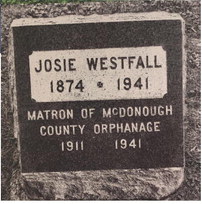
She is buried in Oakwood Cemetery, with her headstone inscription reading: “Josie Westfall 1874-1941, Matron of McDonough County Orphanage 19111941.” Josie Westfall changed, for the better, the lives of an estimated 500 children. One gets the impression that she was a quiet, humble woman and a true heroine of McDonough County.
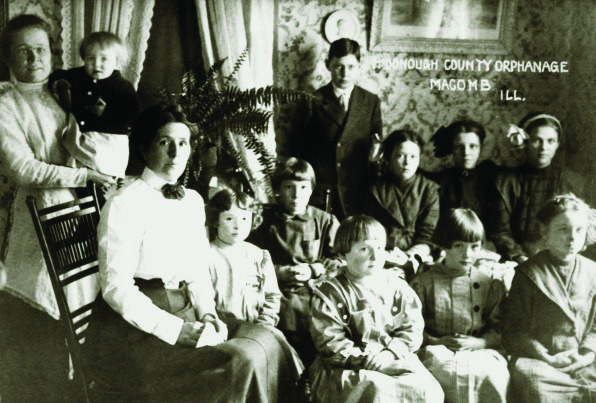
Even when this writer researched the county poor farms, I came across reports from the state inspectors which said that while the county home was in questionable condition, the McDonough County orphanage passed with flying colors. This is testament to Josie Westfall once again, that she ran a clean, safe and loving home for so many children.
Local historian Kathy Nichols, in a presentation to the McDonough County Historical Society in Winter 1997, stressed that Josie Westfall ‘had the touch.’ She was well-liked and respected in the community. And the community in turn rallied behind her cause by providing food, clothing and more. Community member James Hainline saw to it that there was always a Christmas at the orphanage. A.L. Hainline and his wife donated turkeys for each Thanksgiving. Knapp Orchards allowed Josie and the children to pick apples, which allowed them to have fruit throughout the winter. There are accounts of sledding parties, and The Child Welfare Club bought playground equipment.
The East Jefferson Street orphanage operation was taken over by the Salvation Army until about 1950, when it was then sold to be used as apartments. The building still stands and is well-maintained to this day.
I hope that after reading this article, community members will make a point to stop by the beautiful statue on the west side of Chandler Park and pay a tribute to Josie Westfall and the seven other women whom the statue was dedicated to.
“Oh I believe there are angels among us, Sent down to us from somewhere up above. They come to you and me in our darkest hours. To show us how to live, to teach us how to give. To guide us with the light of love.” - “Angels Among Us” by Don Goodman and Becky Hobbs Credits: McDonough County Historical Society Newsletter - Kathy Nichols Western Illinois University Archives and Special Collections Western Illinois Museum - Sue Scott, video and photos McDonough County Genealogical Society - Allen Nemec Marla Vizdal John Hallwas, Macomb: A Pictorial History