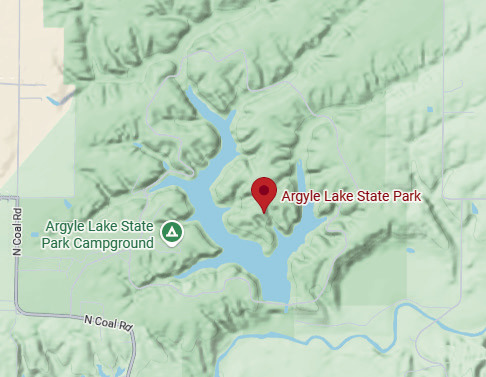
Quick. How many state parks can you name in west central Illinois? Probably, only one — Argyle Lake State Park. The other three are Delabar State Park near Oquawka, Nauvoo State Park, and Siloam Springs State Park in Adams/Brown counties. (Technically, Weinberg- King east of Augusta is classified as a Forest and Wildlife Area).
So, how did McDonough County work the magic to get a state park back in the late 1940s? What was it about the hollows north of Colchester that appealed to the Department of Conservation? Heritage
In the early 1800s, immigrants, particularly the Scotch, moved into the rugged terrain along Crooked Creek (officially name the Lamoine River in 1933 by the United States Board on Geographic Names). In the September 23, 1948, issue of the Adair Weekly Beacon, Eli Kinsey stated that these Scots recalled the "the hilly country with its numerous small streams that reminded them of their native Argyleshire in miniature." Naturally, these settlers would name one of the main tributaries of Crooked Creek Argyle Hollow.
At one time, a stagecoach line ran from Beardstown to Galena, passing just north of Colchester at a ford on the Lamoine, heading northwest toward Burlington, Iowa, and then on to Galena.
Community
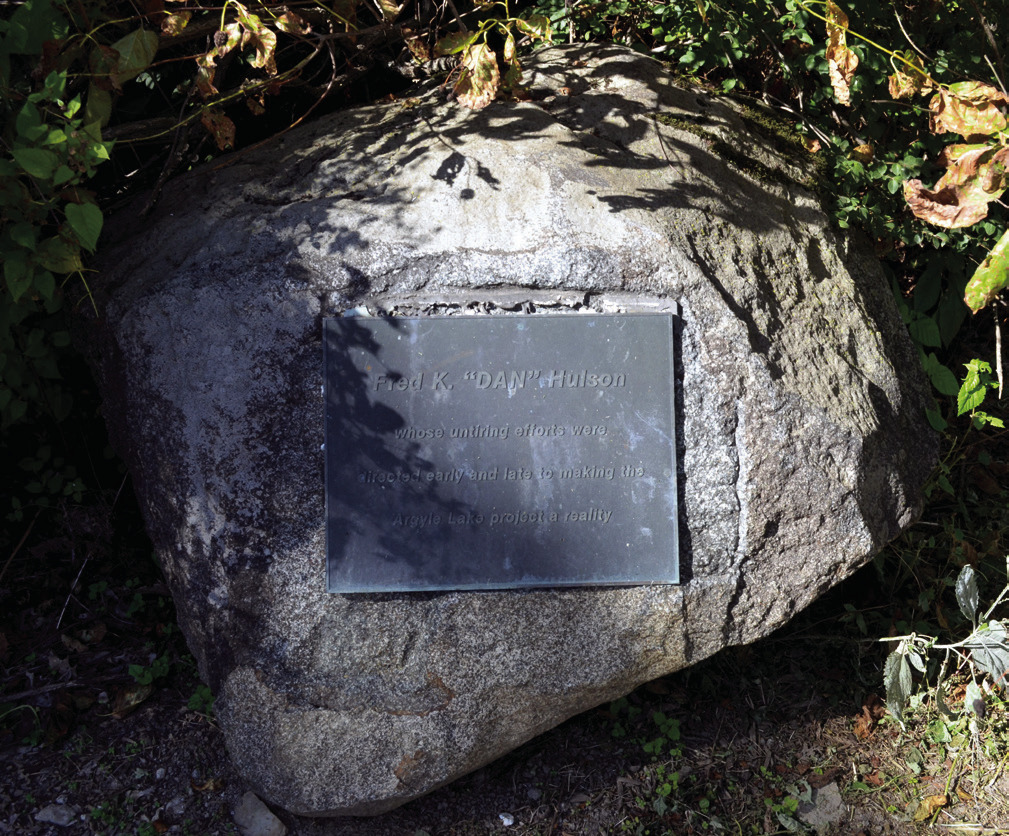
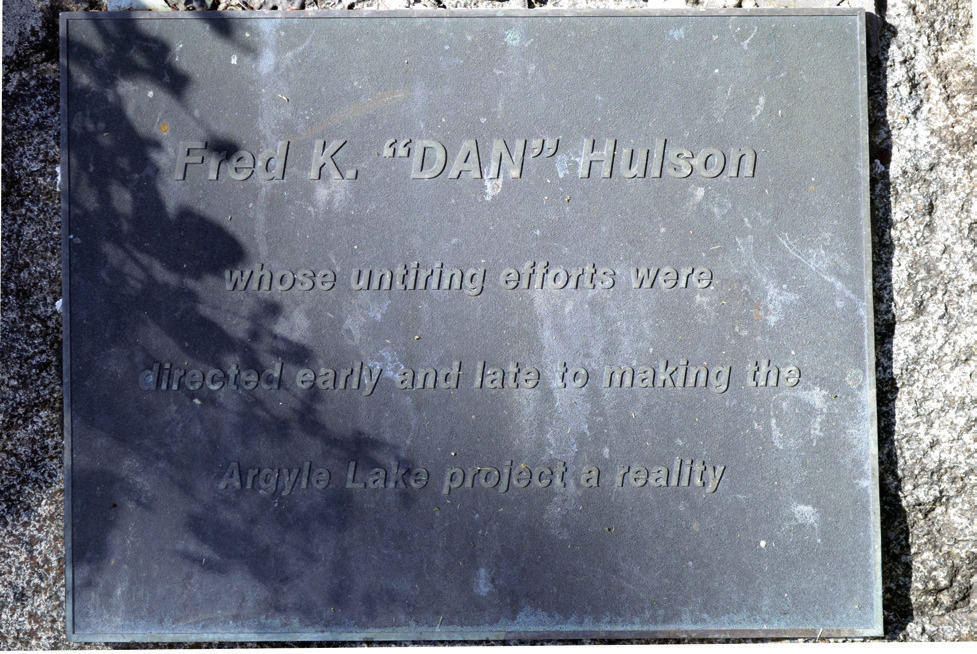
A century of development would go by, with extensive coal and clay mining, railroad building, and town development before a group of McDonough County sportsmen began to explore the idea of getting some type of recreational park in the area. Noted business man, auctioneer, and cattle rancher J. Hughey Martin recounted in a presentation to the McDonough County Historical Society on January 1975 that Dan Hulson, a mail clerk for the railroad, organized a Pole and Line Club. He convinced the railroad company to donate some land for the club down near the Pleasant Valley mill on the banks of the Lamoine.
Martin said that Hulson had a lot of free time, so he wrote many letters, especially to state representatives and senators. "He got pretty close to Governor Green and would travel to Springfield," recalled Martin. "There was about 20 or 30 of us. We went over there and Don had it all ready, had the ground laid, and it was just easy. ... (The state) started out to buy this land for a park. We didn't think it would go, but it did."
In November 1944, a meeting was held in Colchester to form a county Sportsmen's Club, as recorded in the 1947 Colchester Labor Day Souvenir Program. Officers were Fred Hulson, president; John Humes, vice-president; Russell Good, secretary; and George Gumbart, treasurer.
From that initial meeting, a number of communities created their own clubs: the McDonough County Fox and Coon Hunter's Association of Blandinsville; the Good Hope Sportsmen's Club; the Bushnell Sportsmen's Club; the Adair Sportsmen's Club of Industry; and four Macomb clubs — Lamoine Gun Club, Macomb Sportsmen's Club, Western Illinois Field and Trail Club, and the Macomb Pointers' and Setters' Club.
What started as a small fishing group from Colchester now expanded into a county-wide community of sportsmen.
Perhaps this initial push by local sportsmen prompted the state's conservation department to explore a number of park sites throughout Illinois.
Former Argyle park ranger Wayne White, who served in the role for 28 years, once spoke at a Colchester Area Historical Society meeting in 1994. He stated that the Department of Conservation had gathered quite a bit of money from the sale of fishing licenses and from fines levied against violators of game and fishing laws.
The plan was to create 11 lake sites in Illinois.
Ground Breaking
The Illinois Federation of Sportsmen's Clubs was charged with the responsibility of presenting prospective sites to the Department of Conservation. Six hundred sites were proposed, three of them in McDonough County.
After engineers inspected all sites, the number was narrowed town to nine, with the Argyle Valley site deemed the best. Eventually, only three sites were funded: Argyle, Wolf Lake (southeast side of Chicago), and Murphysboro State Park in Shawnee National Forest.
White indicated that the proposed site in McDonough County was not unanimously selected.
Sam Parr, Fishery Superintendent, thought Argyle Hollow was too remote from population centers and wouldn't draw enough visitors.
On July 19, 1948, Governor Dwight H. Green released $1,822,317 for the proposed parks, with $493,000 allotted to the Argyle project. Bids went out October 13, 1948, for the construction of a 575foot-long, 55-foot high earthen dam with concrete spillway to create a reservoir. The "lake" would be filled from the nearly 4,000-acre watershed draining into the Lamoine and "traveling through a small gorge only 800 feet wide," according to hand-written notes from Ranger White.
Original plans called for the park to consist of 1,050 acres and a lake with 14 miles of shoreline. The lake itself would cover about 160 acres. Initially, the state acquired 827 acres which eventually grew into 1052.89 acres at a cost of $70,000.
Some landowners sold their ground for a token $1 while others held out for a higher offer. The 1947 Labor Day Book even listed the individual properties purchased as well as their acreages and amounts received by landowners.
One of those property owners was J. Hughey Martin who stated that he received $50.50 an acre for his 190+ acres. However, there's more to the story of Martin's involvement with park expansion in later years, as will appear below.
Once construction began, trees and brush needed to be cleared along the three main valleys leading to the main channel. Ira Barker was awarded the contract of clearing the foliage for the shoreline at a cost of $18,000. Five years later, a system of roads around the lake was contracted for $95,000. In addition, the State Forestry Department was charged with the mass planting of trees on 10 acres of ground near the entrance to the park. White said that workers put in 10 hours a day, six days a week in order to complete the project.
Unfortunately, some misguided planting decisions were made by the Conservation and Forestry departments. Red and white oak trees were planted, but so were jack pines, a short growth, non-native scrub species. These trees quickly suffered from diseases, so a couple of decades later, they had to be removed. Likewise, in their great wisdom, conservations opted to plant lots of multi-floral rose, presumably to create natural fences, as well as lespedeza, another non-native, invasive plant that has some soil amendment traits but more often becomes weedy.
In 1950, July 4th to be exact, the park was formally dedicated. Colchester funeral director George Jones wrote in his dedication of the event, that the new park would be known as the Argyle Memorial Park.
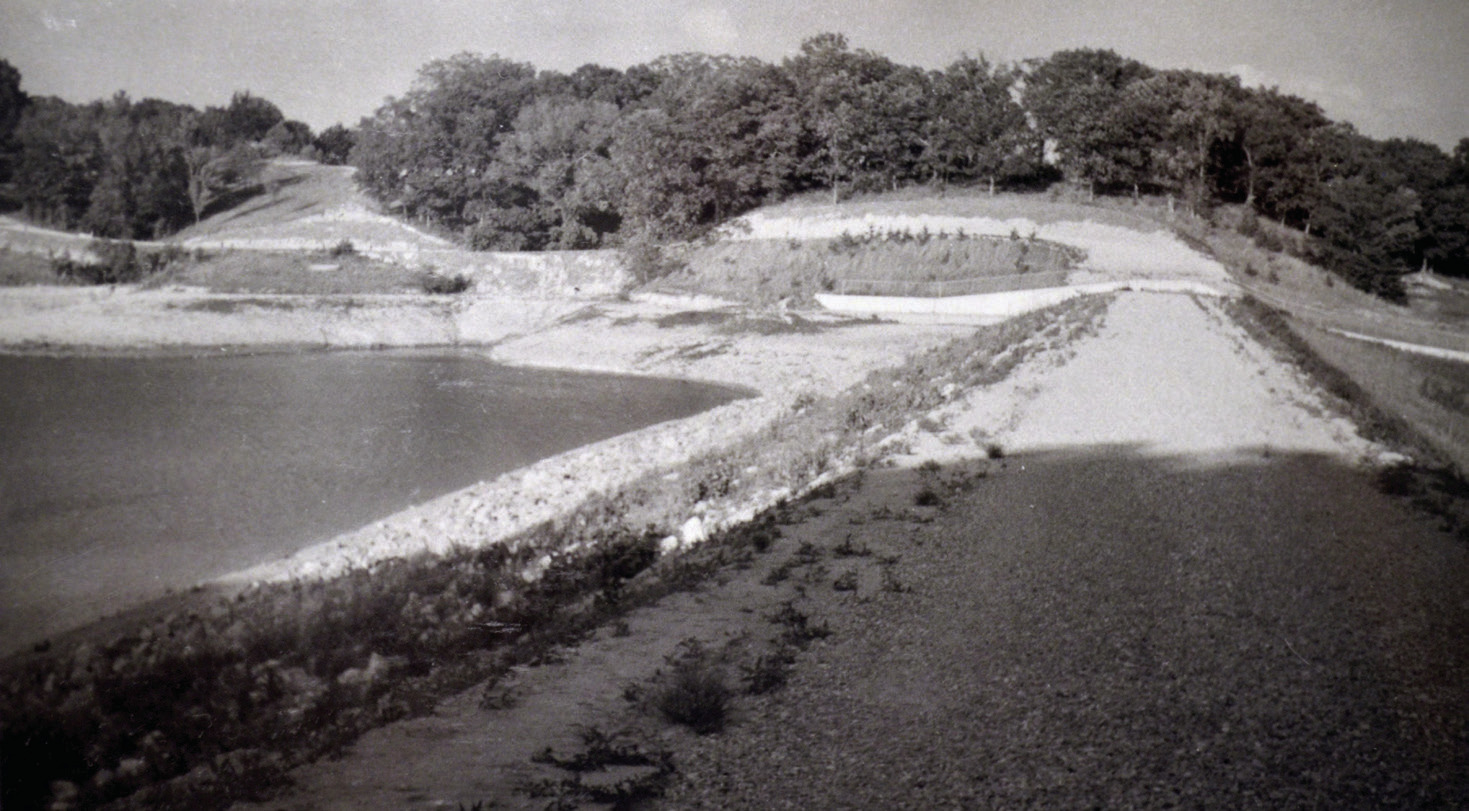
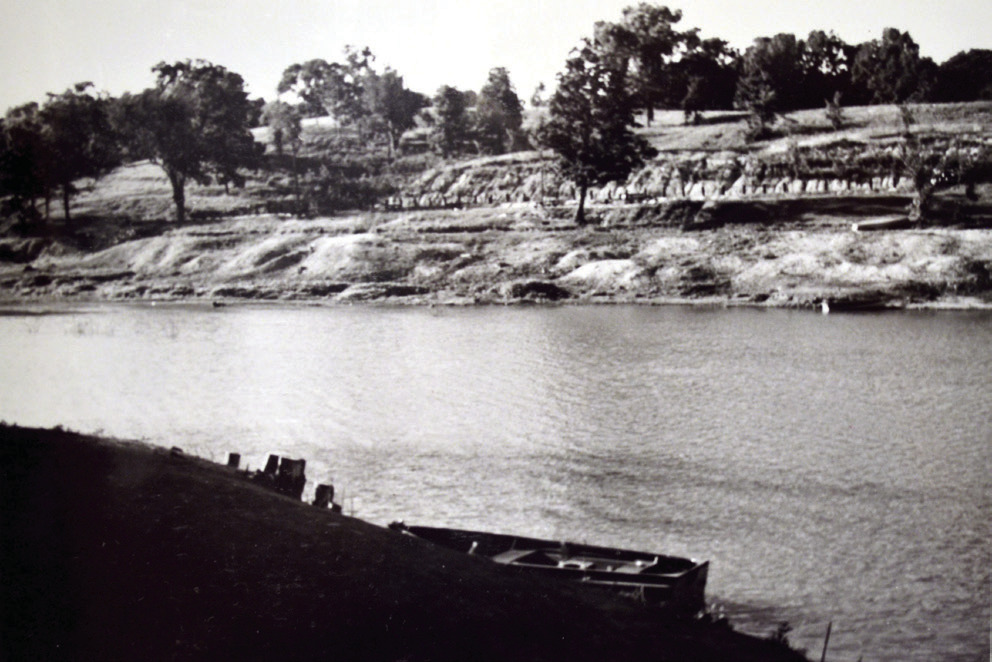
Early pictures of Argyle Lake State Park.
"Great interest was taken by Mothers and Fathers," he wrote, "whose sons and daughters were in military service, when they found out the park was to be dedicated as a living memorial in honor of those who fought for the principle of Democracy in World Wars I and II." He continued, saying, "The word 'Memorial' has a deep meaning within every home since the park is a living monument to all veterans of World Wars I and II. No greater sincerity of faith can be shown toward our boys and girls than July 4th when we dedicate this park with its beautiful lake surrounded by rolling hills covered with natural trees, a gift from our State government." Setbacks
Such an ambitious project of creating a park and lake couldn't escape a few hiccups. In the summer of 1951, the Colchester Chronicle reported that Governor Adlai Stevenson felt compelled to veto a House bill authorizing $100,000 of additional spending for park improvement. It wasn't originally included in the Department of Conservation budget. While he had no objection to the merits of the improvements, he felt this over-run would endanger the balancing of the state budget. It would take a few more years of persuasive efforts from the community before Governor Stratton and a revised request for appropriation of over $90,000 came through for lake improvements.
Politics dictated who would supervise the new park. Since the governor elected in 1950, Adlai Stevenson, was a Democrat, many state appointed employees were likely to be Democrats, too. The first "ranger" was Ira Barker.
A new governor in 1952 resulted in a new park ranger — Harold McLean.
After him came Dale Lewis, Wayne White, and Tom Levy. Current park ranger is Cuba, Illinois, native Robin Hinchee.
Park Expansion
Originally planned for 160 surface-acres, Lake Argyle began to suffer from siltation in the mid- 1960s, reducing its surface to only 93 acres, reported White in the transcript of his presentation. "I convinced the state to purchase some surrounding properties to hold the soil. As a result, the State began buying an additional 900 acres, the most vulnerable being west of park, owned by Hughey Martin."
He chose to challenge in court the amount the State was willing to pay. Sadly, on the day his case was to appear in a Decatur court, February 2, 1977, Martin suffered a fatal heart attack.
Ironically, when it came time to pay for the property (at the lower price), the State indicated that the monies had already been spent elsewhere. Thus, the property remained in the Martin estate.
But that didn't solve the siltation problem. White said that sparse population in west central Illinois equals weaker political power. Nevertheless, local citizens and groups once again pressured the State to find funds to deal with the problem. Land was purchased from several landowners adjacent to the park, thus adding 700 more acres to Argyle Lake State Park.
While western Illinois may be appropriately labeled "Forgottonia," the reason a state park and lake exists within a few miles of every McDonough County resident rests with the persistence and the willingness of a local community to unite for its common good.
Sources Adair Weekly Beacon, March 21, 1948 and September 23, 1948 George Jones, "History of Argyle Lake," Colchester Labor Day Book, 2004 Colchester Labor Day Picnic Souvenior Program, September 1, 1947 J. Hughey Martin, transcript of presentation to McDonough County History Society, January 1975 Wayne White, transcript of presentation to Colchester Area Historical Society, January 1994