Veto Session, SAFE-T-Act, Secession & More Discussed at Chamber Legislative Luncheon
Four area legislators took part in the annual Macomb Area Chamber of Commerce Legislative Luncheon, answering questions about bills, child care, higher ed funding, budgets, data centers, the SAFE-T-Act and more.
Sen. Mike Halpin, Sen.
Neil Anderson, Rep. Norine Hammond and Rep. Dan Swanson fielded questions that were submitted in advance, as well as those posed by members of the audience during the nearly hour-long Q & A session.
What major legislation could come out of the veto session or a lame-duck session that affects the Macomb area?
Swanson: Data centers.
People see them two ways.
As a lover, we can point to the property taxes on and to the private dollars that hire local construction workers and electricians. As a hater, there's the noise and power demand. I can expect the state to put some guardrails on data centers, but not hand-tying the local governments on them. Possible guardrails include requiring closed-loop cooling systems so centers don't draw from local water sources, and requiring them to supply their own electricity. He also suggested Western Illinois University could add classes to train workers if a center were built nearby.
Hammond: I agree. I think data centers will be at the forefront in the House.
My data analytics and cybersecurity committee would take up the issue because the governor has asked that we put in place some guidelines, if you will, including some regulations around these data centers.
Halpin: Fall and January sessions often revive bills that stalled in May. I will push the higher education equitable funding formula bill, though he called its chances a long shot this year because I want to pass that along with the actual money to fund it. Appropriations typically pass only in May, but a supplemental spending bill could open the door.
Anderson: Lawmakers will probably see legislation involving the Chicago Bears.
Small businesses here compete with Iowa and Missouri. What tax or regulatory changes would you support?
Anderson: Workers' comp costs are low-hanging fruit. A friend who runs trucking companies in four states pays $21 in workers' comp insurance per $100 in Illinois, compared with $5 in North Dakota.
Halpin: I am open to any proposed cut in regulations, fees or taxes, but each one serves a purpose and lawmakers must strike a balance. The state should shift incentives away from large corporations collecting record profits. We don't need to incentivize them as much as we need to incentivize the mom-and-pop shops.
For the bigger corporations, they're just a number.
Hammond: Illinois has the second-highest corporate income tax in the country at 9.5 percent. If you're going to talk about low-hanging fruit, maybe that's where you start picking. I'd also like to see exemptions for businesses with 50 or fewer employees from some regulations.
Swanson: Small businesses that call my office usually need $20,000 to $300,000, not millions, while the state offers billions in incentives to lure large companies. I favor more grants for small businesses.
The Family Farm Preservation Act, which would change the state estate tax, was left out of the budget.
Will it be revived?
Hammond: I'm going to take this as a 'yes' or 'no' question, and the answer is 'no.' Agriculture is the state's top industry but it is not respected in that position at all. The bills would raise the exemption from $4 million to $6 million, but other industries try to attach themselves.
Halpin: I do think it will be revived. The governor is willing and I've won support from Chicago and suburban lawmakers by explaining the bill's effect on working farmers, but it may not pass until the next budget season.
Swanson: As a farmer, I like to think 'yes.' Rising land and equipment prices mean that at a farm auction you pass that $4 million in the first hour of the auction.
I would like to match the federal exemption, but raising the limit to $6 million or $8 million would help.
Infant and toddler child care problems cost Illinois an estimated $4.9 billion a year. What would improve access in rural areas?
Halpin: We've moved child care licensing from the Department of Children and Family Services to the Department of Early Childhood, so DCFS can refocus on protecting children. I support more state funding to replace federal COVIDera child care money that has dried up.
Anderson: The key is not trying to make a fix with the government to a problem the government has created.
I want to ease licensing and mandates on businesses.
We need to bring churches and businesses in and rely less on the government. An employer in Sterling built a child care center inside his business for employees with children.
Why has public safety become a perceived partisan issue, given immigration enforcement and sanctuary policies?
Halpin: Both parties want safe communities. The federal enforcement tactics now in use could reach citizens and legal residents, and Illinois should push back. Public safety is not a partisan issue.
Hammond: The SAFE-T Act began as a narrow bail change and grew into a grotesque piece of legislation that has let repeat offenders commit more crimes. People accused of misdemeanors who cannot afford bail shouldn't be held, but judges should be able to hold those who need to be.
Swanson: Some ICE actions reported in the media are disturbing. They should not be happening.
But what's not being covered are the taking of the bad illegal immigrants. Many unreported arrests remove people with criminal records, and state law should allow local and state police to cooperate with ICE.
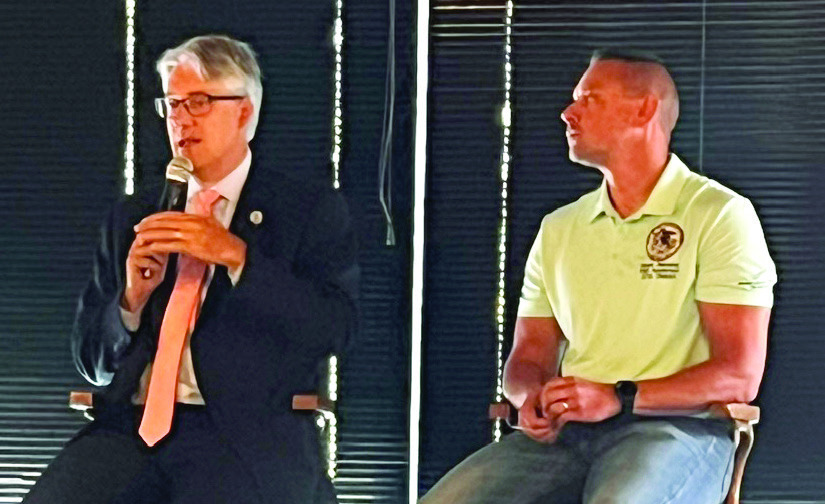
Pictured, from the left: Rep. Dan Swanson, Rep. Norine Hammond, Sen. Mike Halpin and Sen. Neil Anderson.
Our police departments' hands are tied.
Anderson: The SAFE-T Act passed without Republican votes, law enforcement wasn't consulted, and three or four follow- up bills because it's so Draconian. It should be repealed in its entirety. Only two state's attorneys out of 102 counties supported it. We've had open borders for a number of years and millions of illegals came in. We need to ensure that's corrected. Problems arose only in states that bucked the federal enforcement. Last year's budget in Illinois included $1 billion in health care for immigrants in the country illegally. When we incentivize illegal activity, it's no wonder why we have issues.
Halpin (in response to Sen.
Anderson): There's a little bit of revisionist history in Sen.
Anderson's account. I personally asked law enforcement representatives what reforms they could accept: And I was told at that time, 'No, it's all or nothing.'" I won changes from the sponsors, voted for the bill, and later backed trailer bills that law enforcement requested. Those conversations are part of why law enforcement has supported his current campaign.
What is the future of state funding for Western Illinois University and Spoon River College?
Halpin: I am a chief co-sponsor of the equitable funding bill. The proposal would add about $135 million in new money each year for 10 to 15 years and we need it.
Fewer high school graduates and years of underfunding are hurting towns like Macomb.
One large university, my alma mater, is resisting. I asked their president: 'What good is a state's flagship university when the rest of the fleet is sinking?.' I think the bill will happen.
There's immense pressure for it.
Hammond: The bill as written may raise constitutional questions. States with performance- based funding usually have a dedicated fund, and Illinois needs one so universities don't end up like community colleges, which receive half of what they should.
Swanson: I serve on a task force reviewing the model.
The state imposes $6 million a year in unfunded mandates on Western, including personal hygiene items, birth control pills, the list goes on. Whether its veteran scholarship, ROTC scholarship, special education, teachers, special education.
We require Western Illinois University to educate our veterans through the Illinois National Guard or the Illinois Army, and Western is willing to, but they're not funded for it. Western has $500 million to $600 million in deferred maintenance the formula doesn't address. The formula sends money in one pool without protecting maintenance dollars; my amendment to change that was shot down. Western was promised a 3 percent increase last year but received 1 percent after the governor withheld 2 percent.
Do you support secession of downstate counties from Cook County and Chicago?
Swanson: It's one of those questions, it's an interesting concept, and I believe it's going to be on your McDonough County ballot. I'm not going to state my position. I'm going to let the county make their mind up. I have my ideas and I have my position on that. It's going to be a challenge. It's going to be a major uphill battle.
Hammond referred to the attorney in their midst (Halpin) regarding the legality of the proposal.
Halpin: It is not binding, and it would be extremely difficult, if not impossible, to do through Congress and with the other states. I also think it's counterproductive given those facts to use as an issue to further divide us. The counties in western Illinois, will they really end up better if we don't have the northeastern part of the state with us? We are mutually dependent on each other.
Agriculture is a top industry in the state of Illinois, but we don't get our goods out without the financial markets and the economic engine that is the City of Chicago. Downstate depends on Chicago. We are a team.
Anderson: I am open to the conversation, but it would take the state and Congress, and a Chicago state would add two U.S. senators. Is it realistic at this point? I just don't think it is.
It's hard to find money for western Illinois. The state has raised a lot of money in the last four or five years through marijuana taxes. There have been some credit upgrades, as I understand, under these administrations. Where is the money going to come from for childcare, for the universities, for education? Where can we get the money?
Anderson: I'll go back to the old cliché, Illinois does not have a money problem, it has a spending problem. This comes down to we have to start prioritizing our spending instead of making new programs year after year after year after year.
We have to start prioritizing education, public safety, and people that can't help themselves. We should be funding those fully every year, and then we can argue about what is left over after that. Until we have the intestinal fortitude to start having that real conversation, we're going to keep just raising taxes and spending money.
Halpin: When I took office during the budget impasse, the state had $16 billion in unpaid bills. The state has since paid that down, ended interfund borrowing, made full pension payments and put about $2 billion into its rainy-day fund.
Revenue this fiscal year is outpacing estimates. What we've seen is that there's been some stability and, and certainty now. I agree with my Republican colleagues that the partial way out is growth. We are actually seeing that growth. It may not be keeping up with the chronic underfunding that we've seen in the past, but we're certainly on a better path.
Hammond: Prioritizing spending is the key. A bipartisan Medicaid work group this year sorted every bill red, yellow or green by cost, which is healthy for the state.
Swanson: The budget should not rely on revenue now being challenged in court, such as new taxes on crypto and streaming. The minimum wage rose from $8.25 to $15 and the budget from $40 billion to $56 billion during the current administration. I question whether the wage hike mostly raised income tax revenue. Was that a tax in reality? A bill this spring proposed a $27 minimum wage.
Addressing Hammond, who will complete her final term at the end of the year: What are you most proud of?
Hammond: First and foremost, the relationships that I have been able to build over the years with my colleagues, certainly on my side of the aisle, but also on the other side of the aisle. I learned very quickly, if you can do math and you're a caucus of 40 and you need 60 to pass any legislation, then you better have built relationships over the years with other folks that you can talk to and you can have discussions with.
And that also carries over to my colleagues in the Senate. I think that that's certainly been the biggest highlight that I can speak to. The other thing is I can tell my colleagues, "Don't get married to your legislation because divorce is ugly, and it's going to happen."
And I have worked on a number of bills, and some of them have taken almost four years to pass. But in the end, if you can do it, it's worth the effort. I've done a number of pieces of legislation dealing with folks in long-term care.
That has always been near and dear to my heart. Many of the folks in our long-term care facilities don't have family.
They don't have someone that can speak for them, so addressing their concerns and their issues is incredibly important. But I've also been able to pass legislation in the field of healthcare, particularly in cancer-related diseases.
This year, I passed one dealing with the CA-125 protein that many people are predisposed to. And now we will have a required screening for those folks that are predisposed to that. But I think most importantly, passing the proton beam therapy cancer treatment bill that I passed a number of years ago. We understand that they have some issues with that, so I'll leave that to some of my colleagues to continue to fight. But prior to passing that, it took 3.5 years of working with insurance companies and healthcare providers to finally agree that there are times when proton beam therapy is the best therapy for a number of cancers, particularly in pediatric cancers and women with some breast cancers. And I think that those are some of the issues that I'm most proud of. And I just hope that as the Illinois legislature moves forward, we can find a way to not be so partisan and find a way to work together and build better relationships.
The 2026 Legislative Luncheon, held at Park Place in Macomb, was sponsored by Comcast (event sponsor), Macomb Park District, Bridgeway, Western Illinois University, Grand Prairie, and United Community Bank.