Weekend-Long Event Showcases Battles, Victory Gardens, Camp Ellis & More
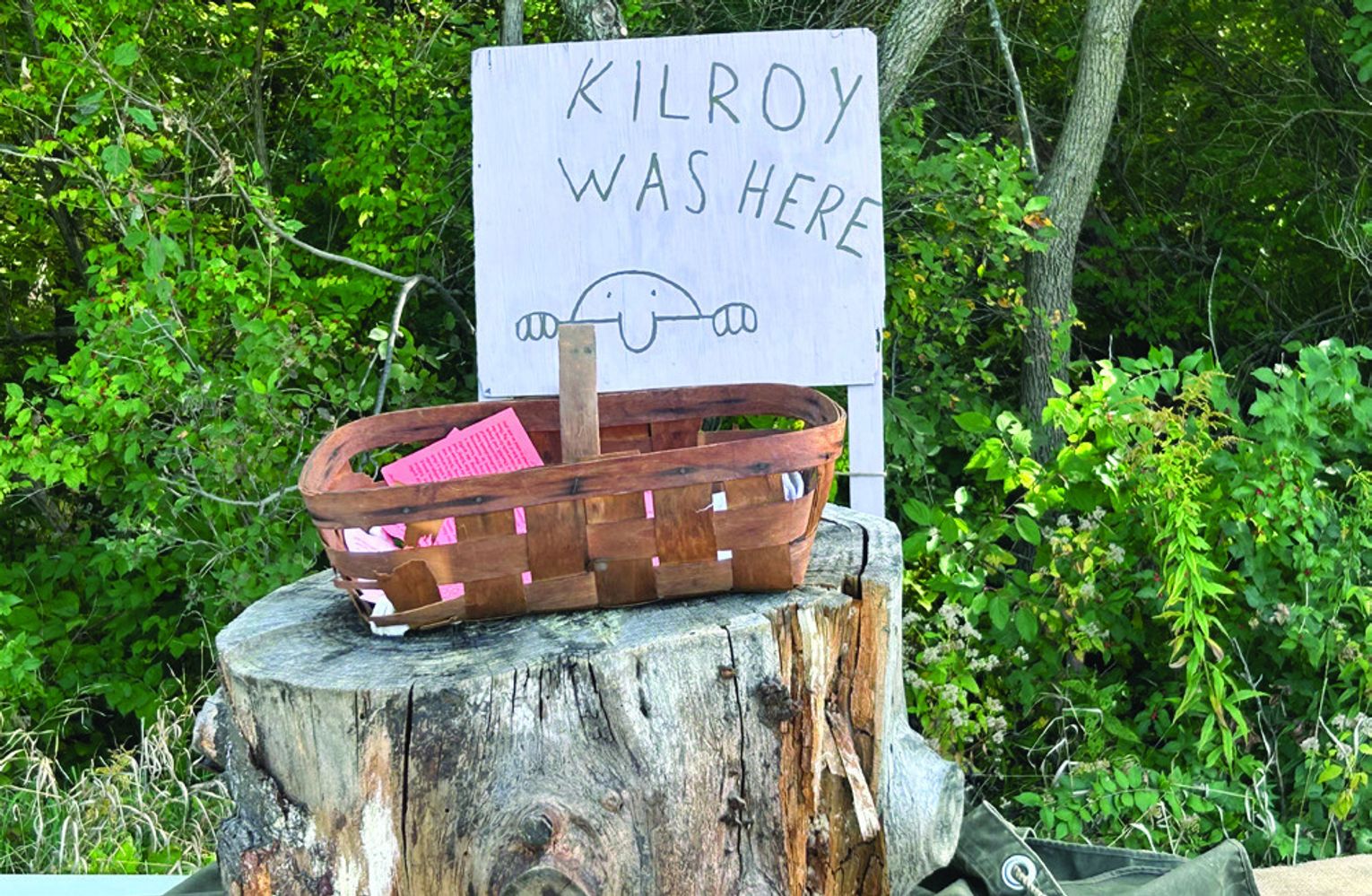
Kilroy Was Here (here being Veterans Park in Macomb) … all weekend.
Possibly the most popular graffiti in military history has uncertain origins, but folklore traces the saying to a WWII shipyard worker, James J. Kilroy. The “Kilroy Was Here” sign was just one of the many replica pieces on display during a special WWII-related event in Macomb.
The aptly-named Veterans Park transformed into a military encampment Oct. 9-11 when professional World War II reenactors returned to Macomb to showcase a crucial aspect of world history. Individuals portraying soldiers from American, British, German, Ukrainian and Polish armed forces, as well as civilians who grew Victory Gardens and staffed Camp Ellis in nearby Fulton County, brought the second world war to life. World War II, which began when Nazi Germany invaded Poland in 1939 and ended in 1945 after Japan’s surrender, is considered the largest and deadliest conflict in human history. An estimated 60 to 80 million people died.
Led by Western Illinois University history alumnus Adam Bednar, the event brought 75+ reenactors and hundreds of visitors – to the Macomb Park District property. The event was co-hosted by the park district and co-sponsored/organized by the WIU Department of History, WIU Veterans Resource Center, Unforgettable Forgottonia (dba Macomb Area Convention and Visitors Bureau) and various reenactment groups. In addition to the events at Veterans Park, the Western Illinois Museum, under the direction of Sue Scott, hosted a special USO-themed program Friday evening.
Bednar, a 2009 WIU history graduate, serves as executive board member and unit commander for the WWII Historical Re-enactment Society, Inc., a nonprofit with over 1,200 members dedicated to educating the public about World War II. The exhibit focuses on military life during the war — the day-to-day experiences and struggles soldiers faced — while offering perspective on reenactors’ political and cultural backgrounds: how and why did soldiers fight?
“Events like this are important because the generation that fought the war is disappearing,” Bednar pointed out. “We have fewer and fewer vets, and with them go the stories of people from the region who served. It’s important to understand what people went through, but also what people went through on the home front to support the war.”
Two Army veterans, Lloyd Thorman, 101, and Gerry McDonald, 96, both of Macomb, came out Friday morning to take a personal tour. Thorman served in WWII, while McDonald served in the Korean War.
“This brings back memories,” Thorman, who served in a small country off Germany, said.
McDonald remembers visiting Camp Ellis when he was 13.
“This event shows people that there are people who care and who fought for their country,” McDonald said.
Bednar, who has been reenacting as a hobby for over 20 years, first brought the re-enactment to WIU’s campus three years ago through a partnership with his former professor Tim Roberts, who chairs the history department. In 2024, the event expanded to one day on campus and one day at Veterans Park. This year, it was a full-scale, public event.
“I’ve always had a passion for history, and this hobby scratches that itch,” he shared.
His grandfather was a quartermaster, and during this past weekend’s event, Bednar was portraying his grandfather, Cpl. Jerome Milerowski. Bednar said his grandfather was typical of the specialists trained at Camp Ellis.
Camp Ellis
Camp Ellis, which was located on acres of former farm fields near Ipava, trained non-combat personnel, Bednar told a LIFE group during a special tour Friday morning. Those training at Camp Ellis included quartermasters, bakers, USO troops, Army nurses, logistics workers and engineers. Combat soldiers typically went to Camp Grant in Rockford.
“The government bought land from farmers to build the camp, which knocked down family farms and tore up fields,” Bednar stated. “The camp existed from 1942, with the last pieces torn down around 1947. By the end of the war, 200,000300,000 military personnel had trained at Camp Ellis. Local contractors built barracks, and local residents, many of them women, staffed taverns and PX stores on the base.”
During the reenactment, Duffy’s Tavern was set up to show visitors what the popular watering hole/ canteen looked like, and a tent with official Camp Ellis artifacts and large-scale maps on display was set-up nearby. There was also an obstacle course to run through to get an idea of how the soldiers still had to train at Camp Ellis, even though they were in non-combat roles.
Stan Cook of Walcott, IN, was set up in the Camp Ellis reenactment area as the base chaplain. Cook started participating in the reenactments as a chaplain three years ago. But he became a student of history before then when he realized just how much he didn’t learn years ago in school. Friends recommended several books on WWII, and from there, his interest blossomed.
“The war was about ordinary people stepping up and doing extraordinary things. I really liked the role of the chaplain because this was maybe an under looked, yet important, role,” Cook explained. “The chaplain provided support and a taste of home. They also, for example, if a soldier was Jewish, they’d help them find a service or a rabbi to serve them. The compassion for others really drew me to this role.”
Jeff Nelson of Random Lake, WI has been taking part for 13 years. He was staffing a 1941 slat grill Jeep in the Camp Ellis encampment, answering questions about the vehicle and its role in the war. Like many of the reenactors, Nelson’s family history drew him to his hobby. His grandfathers fought in WWI and WWII, with one of his grandfather’s being involved in the motor pool in the first world war.
“This is a living history lesson,” Nelson said.
Victory Gardens on the Homefront The first stop on Friday’s tours for local schools and other groups was the Victory Garden planted by WIU Agriculture Professor Joel Gruver and his students. The government promoted Victory Gardens during the war as a way to not only grow fresh food, but to lift morale on the home front. The standard garden plot, 20 by 50 feet, was meant to feed a family of five. Some vegetables, such as Swiss chard, were unfamiliar to most Americans until the program introduced them. Crops were showcased in small gardens, transplanted that morning, to show what wartime gardeners grew. Ellieana Walden, a WIU history education major, served as the Victory Gardens’ docent.
Into the Woods
Past the obstacle course, the gravel path led into the woods (the park district’s “Friendship Trail”), where reenactors portraying American, British, Polish, Ukrainian and German troops were encamped. Three battles also played out in the woods during the weekend so visitors could get a feel for what soldiers from all sides went through, both in their often-rugged living conditions and with the frequent battles taking place.
“Our goal is to show a whole scope of the impact of World War II and what soldiers faced,” Bednar said.
Michael Bala of Lake Zurich has been playing the role of a Polish soldier for six years. His great-grandfather fought for Poland in the second World War, and he takes part to help preserve his heritage and history.
“The Polish story is not really told much in the United States,” Balen pointed out. “The Poles were the first to fight fascism and to fight the Germans. They never stopped fighting. I do this to represent the Polish struggle for independence and freedom.”
Final Thoughts
“The weekend has demonstrated the impact that our collective past has on our lives in 2026. The excitement, curiosity and interactions between reenactors and spectators was impactful to experience first-hand,” Bednar shared. “I look forward to evolving this event in the future in lock-step with our community partners.”
Roberts echoed Bednar’s assessment of the weekend, adding that he was pleased to see the wide range of guests who came out to experience the reenactment, including Anna Lee Coakely, who worked at Camp Ellis during World War II.
“I hope our Victory Garden inspired folks to try gardening. Without glamorizing warfare, our reenactors, simulated activities, and local artifacts enabled the public a chance to honor soldiers and civilians who experienced the war, and see history firsthand,” he stated.
Macomb Park District Executive Director Blake Severs also said the event exceeded his expectations.
“It has been really exciting to bring this highly-engaging event to our community, and to collaborate with so many excellent organizations and partners,” Severs noted. “We’re looking into the feasibility of continuing this year-after-year as a capstone event for our fall activities.”
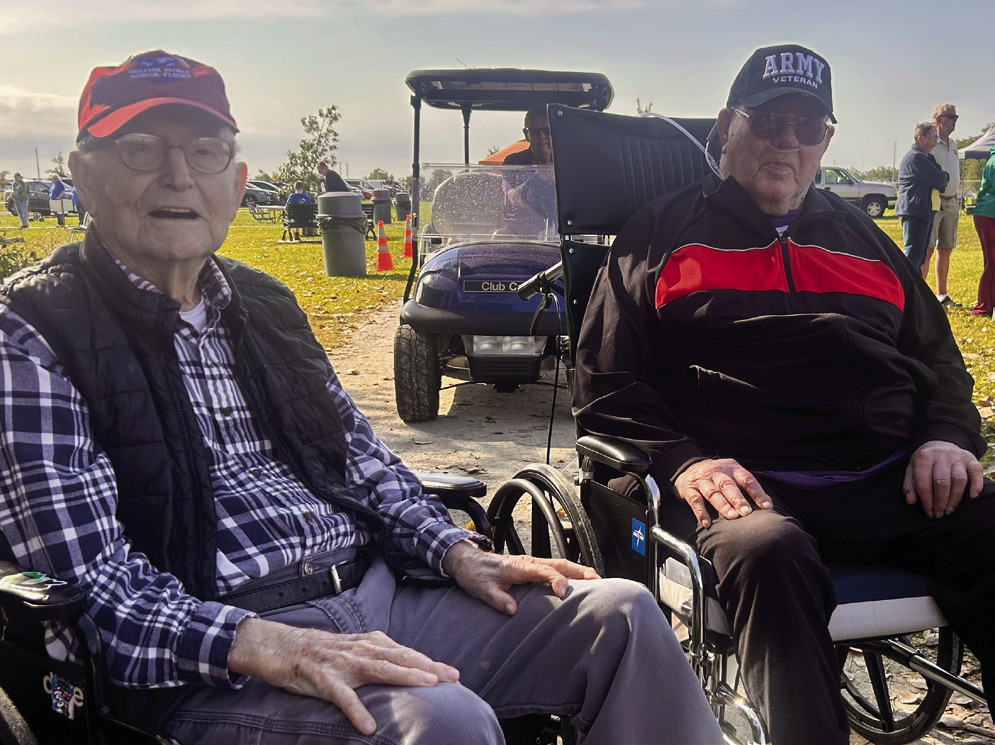
Gerry McDonald, Korean War veteran and Lloyd Thorman, WWII veteran toured the reenactment.