Pushing Back on Population Decline & Negative Narratives
Keynote Speaker at Tri-State Summit Focuses on Community Partnerships
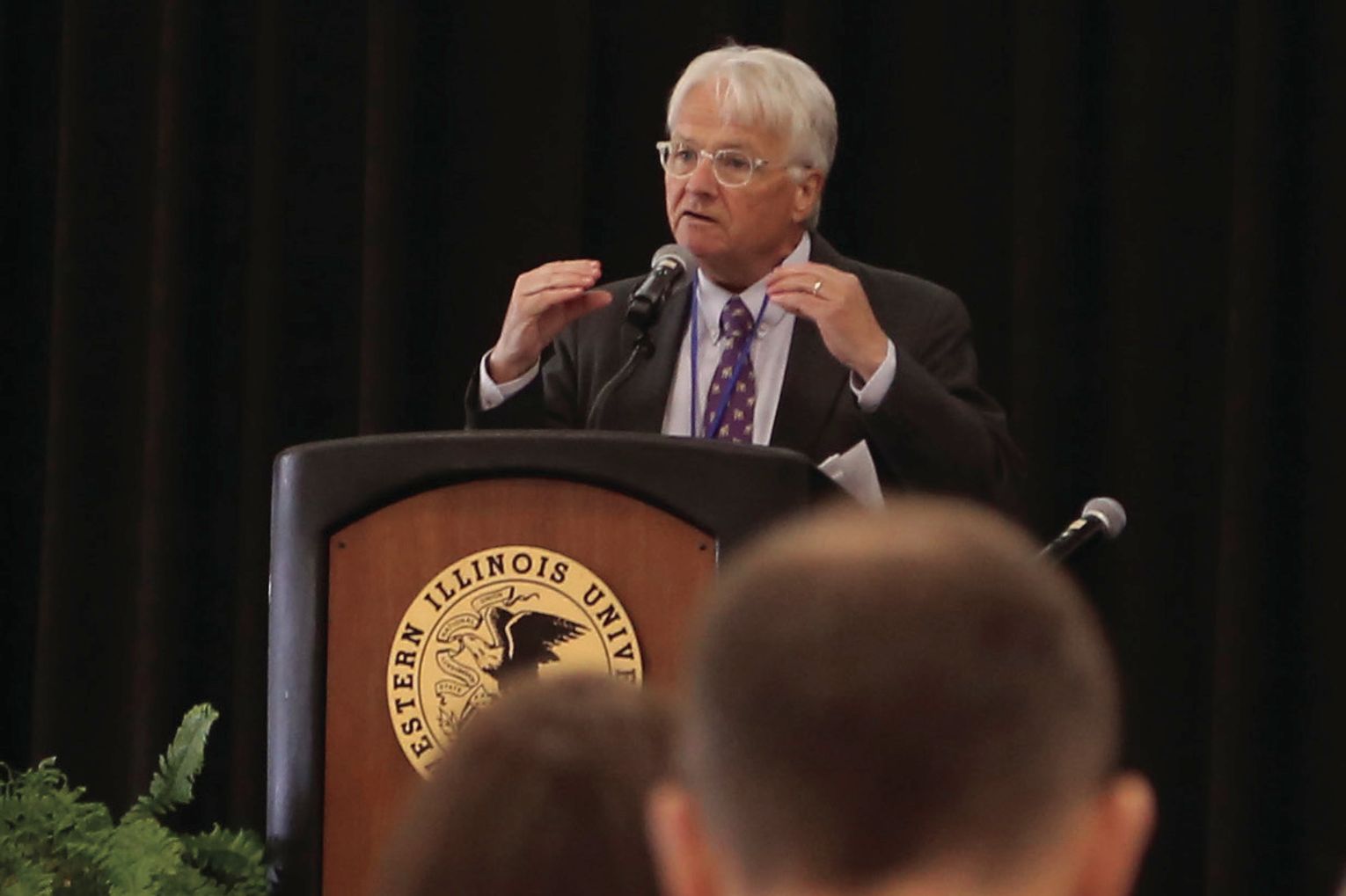
'How many of you have social media sites like Macomb After Dark,' Illinois Institute for Rural Affairs Executive Director Chris Merrett asked the audience during his keynote at the 30th Annual Tri-State Development Summit at Western Illinois University Oct. 8.
Members of the audience nodded their heads.
'If you read and look at these Facebook pages, people post so many negative things. 'Did you see the waiter at that restaurant? So rude to me.' 'The potholes are awful around this town and no one cares.' It's easy to point at the deficits, at the things that are wrong,' Merrett shared.
'That's where community and economic development comes in. It's about pointing out the assets and what's good about your community because for every community there are amazing assets.
They're just underappreciated.'
Pushing Back on the Negativity: Forward Thinking Plans for Positive Outcomes The institute's answer is asset-based community development, he explained, and an effort to counter what he described as a community's collective negative self-talk.
'It's so easy to be negative, right?' he said. But 'for every community, there are amazing assets. They're just underappreciated. What we do through our Community Mapping and other programs at the IIRA, and what your communities should be doing, is to combat what I would call a psychology of decline, and the attitude of things being 'wrong for so long, there's no way I can make a change.' My colleagues try to help the community change its collective mindset to empower them to think that change is possible.' Investing in a community goes beyond private developers, Merrett pointed out.
There are state and federal organizations and other entities that provide resources, grants and partnership opportunities for communities to manage their own destinies. From rural transit systems to independent, community-owned grocery stories to fitness centers and more, communities can help themselves thrive and grow, to push back against population declines and loss of services, he added.
'Thinking of mobility as a human right, so if you have somebody who's elderly, they should be able to get to their dentist appointment so a demand response transit center can create more opportunities for a community,' Merrett explained.
When the IIRA's Mapping staff, Linda Lee Blaine and Giselle Hamm, go into a community to begin the process, they ask three questions: where the community is now, where it wants to be and how to get there. They take the breadth of ideas presented, often at a town hall, and narrow to four to six goals that can be reached in three to five years. Then the IIRA staff bring the pertinent state and federal agencies to the table for a community resource meeting.
'Partnerships are essential to our planning process.
And then implementation is key. We think our secret sauce is that not only do we help communities make a plan, we help them implement the plan by putting a returning Peace Corps Fellow from our program into their community for an 11-month internship,' he said.
Pushing Back on Population Declines: Growing a Community 'Earlier I showed you those maps that talked about that decade when a county had its peak population. For many of the counties in west central Illinois, in southeastern Iowa and in northeastern Missouri, their population peaked in the late 19th century and through the first half of the 20th century, a plateau, and then for many of those communities, started to decline toward the end of the 20th century. And the question is: 'What's going to happen?' We know in Iowa, Missouri and Illinois, there are communities that disincorporate,' he pointed out.
Of the 42 tri-state counties, one – Kirksville, MO – peaked in 2010, six peaked between 1950-1980, including McDonough County, and the remaining 32 peaked well before 1950, Merrett added.
'But what we like to think and, there's a snowball effect.
If we go into a community for the Mapping program, and work with them to help them grow economically, that community gets excited about the possibility, and then, of course, like every small community, if there's excitement in the neighboring community, they want to know what's going on,' he said. 'Often, Linda Lee and Giselle will finish in one community, and then they'll be in one county over in another community because they heard about this planning process.'
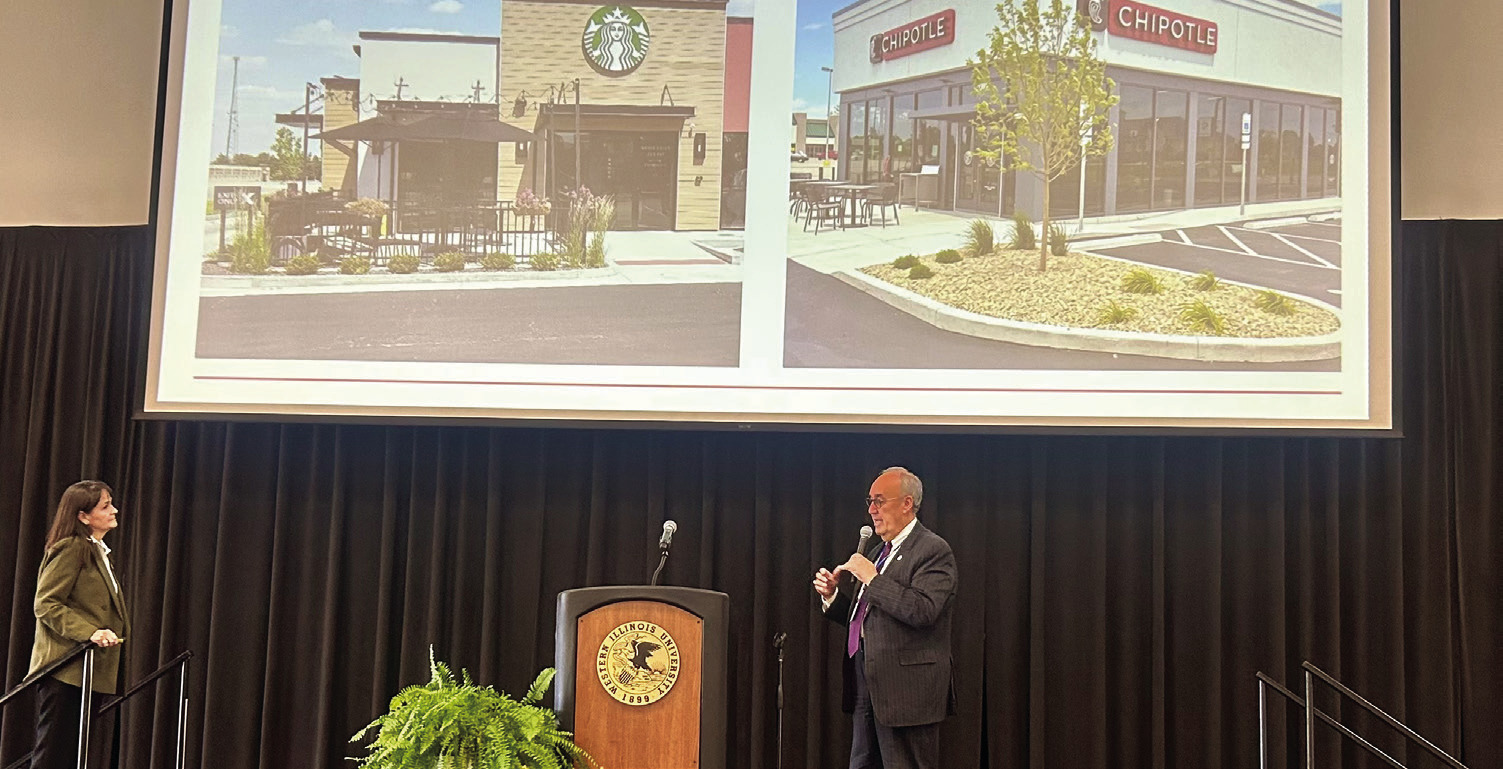
While the fastest-shrinking age group in rural Illinois is people under 20, Merrett told the crowd that there are opportunities to keep that age group thriving in communities. He gave Beardstown as an example of a community in which the under-20 sect is growing and thriving. The in-migration of individuals from Latin America and Africa have helped to revitalize the downtown. While school districts around Beardstown are consolidating due to shrinking numbers, the Cass County community is growing.
'Even though the downward trends in population are serious, local planning, along with state and federal partners, and a change in how communities see themselves can change those trends and move toward workforce development. We need to create a space for the next generation of entrepreneurs, doctors, lawyers, teachers,' he concluded. 'The fastest-growing age group is 65 and older, so services for this group are equally important.'
Rural & Agriculture-Driven: More than Farms
According to Merrett, the tri-state region is not only demographically diverse, it's economically diverse. The U.S. Department of Agriculture classifies 41 of the 42 counties in the tri-state region as rural; however, Merrett warned against equating rural with agriculture.
'Ten tri-state counties are agriculture-dependent, but an equal number are manufacturing- dependent, with two classified as government-dependent as they're both home to universities: McDonough County, where WIU is located, and Truman State University's home county in Missouri,' he stated. Farm numbers nationally peaked at 6.8 million in 1935, with the numbers coming in around 2 million, today.
'Recent federal farm bills have increased support for exports and production efficiency, while cutting USDA Rural Development programs, which fund rural water systems, housing and fire stations, only further accelerates our rural repopulation,' Merrett shared.
It was the 1980s farm crisis that created the IIRA, which is part of the Lt. Governor's Rural Affairs Council, when state leaders determined the farm crisis wasn't just about farms, it was a more general rural development crisis. Now, it's about coming full circle yet again, he declared.
'We're currently talking about a renewal of the Farm Bill, and the USDA has an enormous footprint and does fabulous work across rural America. A farm crisis isn't just about farms, it is a general rural development crisis because a healthy farm economy also needs a healthy rural non-farm economy. As we know, for many farmers, one spouse runs the farm, the other spouse may work somewhere in the community because that's normally where the health insurance is coming from,' Merrett explained. 'That may be where the retirement benefits are coming from. We were founded, in part, to address that rural non-farm economy issue. And that's what the USDA Rural Development programs are.
They don't target farms directly; they are for rural water systems. They are for affordable housing in rural areas, and a new fire station.
These are all the non-farm, yet essential elements, of a rural community.
'In recent Farm Bills, the money for programs that promote export and production efficiencies has gone up, but support for rural development, which is a non-farm rural development, has been cut. And I suggest that this only accelerates rural depopulation,' Merrett said. 'A quote The New York Times in 2011 from a Ulysses, KS mayor is pertinent now: 'Immigration is happening and the communities that extend a hand are going to survive.' Proactive efforts can make a big difference in the quality of life for all in rural America.'