Like most other Illinois counties that are not near Chicago, McDonough has many villages—communities with several thousand people or less. In recent generations, those small towns have been struggling to remain appealing and useful to local residents. And regardless of where we live in the state, we need to be aware of villages such as those—their heritage, values, and current conditions.
Like many counties in the nineteenth century, McDonough once had various small villages that disappeared. Among the early settlements and hamlets that have vanished as functioning communities, instead of growing, are such places as Carter’s Settlement (1826), Colmar (1858), Doddsville (1836), Middletown, or Fandon (1837), Gin Ridge (1830s), Hickory Grove (1835), Hills Grove (1830), Lamoine (1850s), Lynn Grove (1840s), Monticello (1839), Muddy Lane (1840), New Philadelphia (1858), Pennington Point (1828), Reedyville (1850s), Scottsburg (1870), Stewardsville (1836), Spring Creek (1832), Vance’s Settlement (1837), Vishnu Springs (1889), Walnut Grove (1870), and Wolf Grove (1830). There were also various rural neighborhoods that fostered a sense of community, such as Camp Creek, Chester, Elm Grove, Foster’s Point, and Tucker Town.
The villages founded in the nineteenth century that still remain active are Adair (1870), Bardolph (1854), Blandinsville (1842), Bushnell (1854), Colchester (1855), Good Hope (1869), Industry (1855), Prairie City (1854), Sciota (1867), and Tennessee (1854).
A good overview of the nineteenth-century communities in McDonough County was written by S. J. Clarke, as part of his History of McDonough County, Illinois (1878). Of course, at that time several of our county’s small towns were thriving. As he says of the agricultural community of Blandinsville, for example, “In the . . . business of this place we find represented two agricultural implement dealers, one baker and confectioner, one bank, three barbers, four blacksmith shops, two book and stationery stores, three for boots and shoes, two for hats and caps, one clothing [store], one jeweler, two dentists, three druggists, five dry goods stores, two furniture stores, two grain dealers, eight groceries, three hardware stores, two hotels . . . four lawyers, two livery and feed stables, one lumber yard, two meat markets, two millers [i.e., mill operators], one police magistrate, six physicians, three restaurants, three harness shops, one tailor, and three wagon shops. . . .”
Bushnell, located at the crossing of three railroads, and known for “quick distribution of manufactures”—including agricultural implements, wire fences, wagons, and carriages— did even better. It had no less than thirteen grocery stores, three hardware stores, five hotels, and ten “restaurants and confectionaries.” It also had five doctors and seven lawyers, as well as various contractors, painters, teachers, and realtors.
Another town that benefitted greatly from the railroad was the coal mining community of Colchester. As Clarke indicates, “Its most rapid growth was in the years 1856 and 1857, just after the completion of the railroad.” Then, it didn’t grow much during the Civil War years and post-war years, but in the later 1870s it flourished again. He reports that “We now find it rapidly improving; new houses of the most substantial character are being erected, and the supply of tenement houses does not equal the demand.” The tenement houses were occupied primarily by coal miners and their families, for the Colchester Coal Company and the Quincy Coal Company were then doing well there. As he reports, “These two companies do an immense business, the Quincy Coal Company in its mines employing one hundred and thirty men and sixty boys, and the Colchester company having forty men and ten boys.” There were also a couple hundred men and boys working in private “neighborhood mines.” (As those figures reveal, too, there was once significant child labor in Colchester, and that practice was soon discouraged in America during the late 19th and early 20th centuries as activists across the U. S. spoke out against removing children from school to do manual labor.) In any case, as a result of prosperous coal mining, Clarke also reports that “Colchester has several good-sized business houses, with firms doing a thriving business.”
He indicates, too, that other villages were doing well in the 1870s—even Industry, a town with 500 residents that was not served by a railroad: “The village is twelve miles from any railroad station, and four towns with railroad depots are situated that distance from it: Macomb, Table Grove, Vermont, and Adair.” Nevertheless, the town had three general stores, three groceries, two drug stores, two meat markets, two mills, and a variety of other businesses.
But of course, our county’s villages have been impacted by many economic and cultural forces over the generations. In 1860, for example, only twenty percent of Americans lived in cities (or their suburbs), but at the start of our current century, eighty percent lived in those well-populated places. So, during recent generations, most small towns have not grown much, and many have experienced a reduction in population. As Max Lerner said almost seventy years ago in his book, America as a Civilization (1957), “Everywhere, even in the most prosperous areas, the small town was undercut by the big changes in American life—the auto and superhighway, the supermarket and the market center, the mail-order house, the radio and TV, the growth of national advertising, the mechanization of farming—so that it [i.e., the nation] turned its face to the centers of technology. It was the city and the suburb—the cluster city complex—that became the focus of working and living, consuming and leisure.”
Furthermore, the loss of village and rural schools, through consolidation (which started after World War II), as well as the decline of job opportunities for local residents, have also had a negative impact on the population of small towns, in Illinois and elsewhere. County seats like Macomb have sometimes continued to grow, however, for they often became the convenient regional center for their area.
So, although some of McDonough County’s villages were busy places 150 years ago—with a variety of work opportunities for the men who lived there—no one anticipated the challenges that would come along for small towns in the twentieth century.
In any case, there is a need in our time to also increase public awareness of the positive features of small-town life.
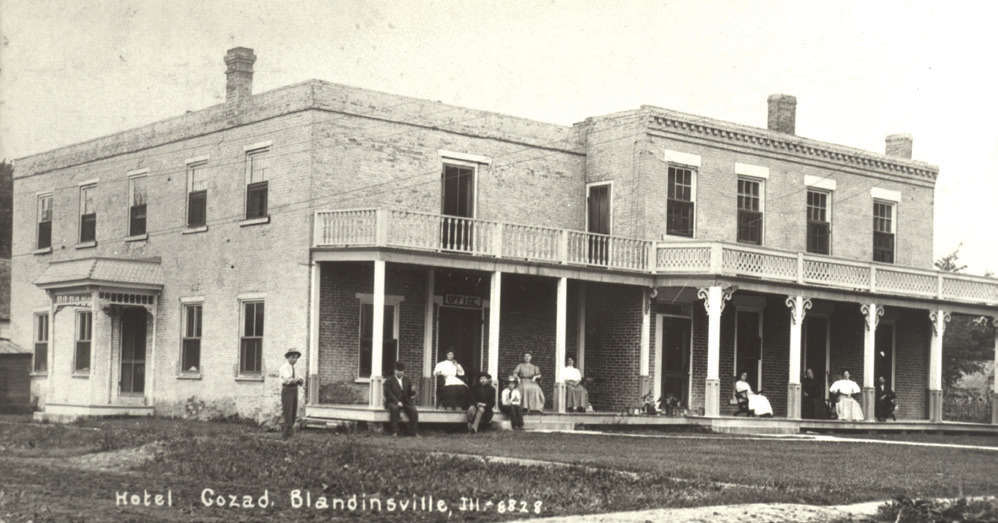
This turn-of-the-century post promotional post card shows the imposing Cozad Hotel on Main Street in Blandinsville, with its inviting verandah. It was then owned by Martin W. Cozad. Originally known as the Meyers Hotel, the structure was built, on Main Street, in the 1850s.
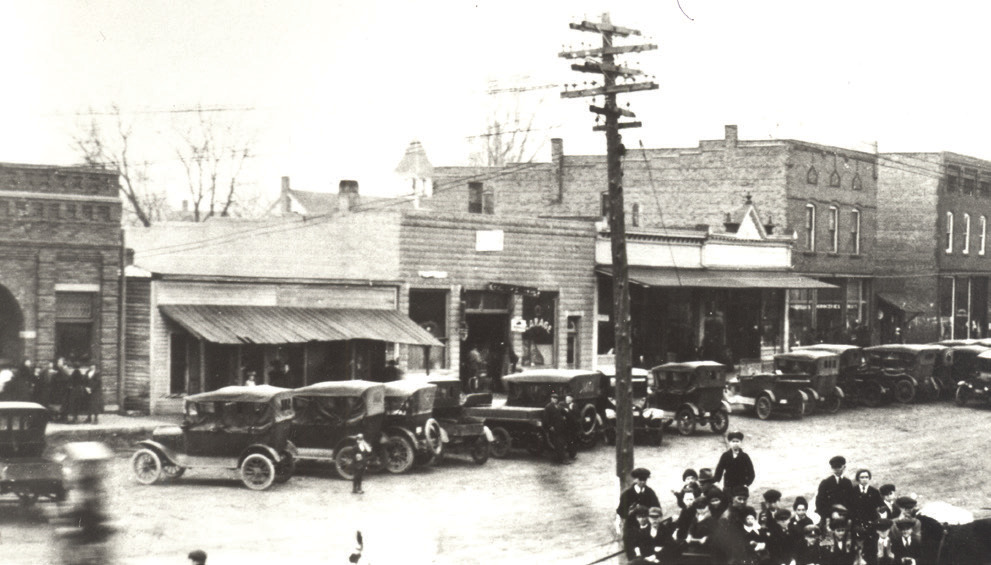
This photograph, as recorded in McDonough County Historic Sites, shows a thriving Adair downtown community in the 1920s. “Businesses shown are the Farmer’s State Bank, a cream station (which bought poultry, eggs, and cream), the post office (in the same building, with the awning), the Coplan garage, Gillam’s grocery and dry goods, H. A. Oldfield and Son’s grocery and dry goods, the Herndon and Brothers hardware store, and a frame building for Herndon implement sales.
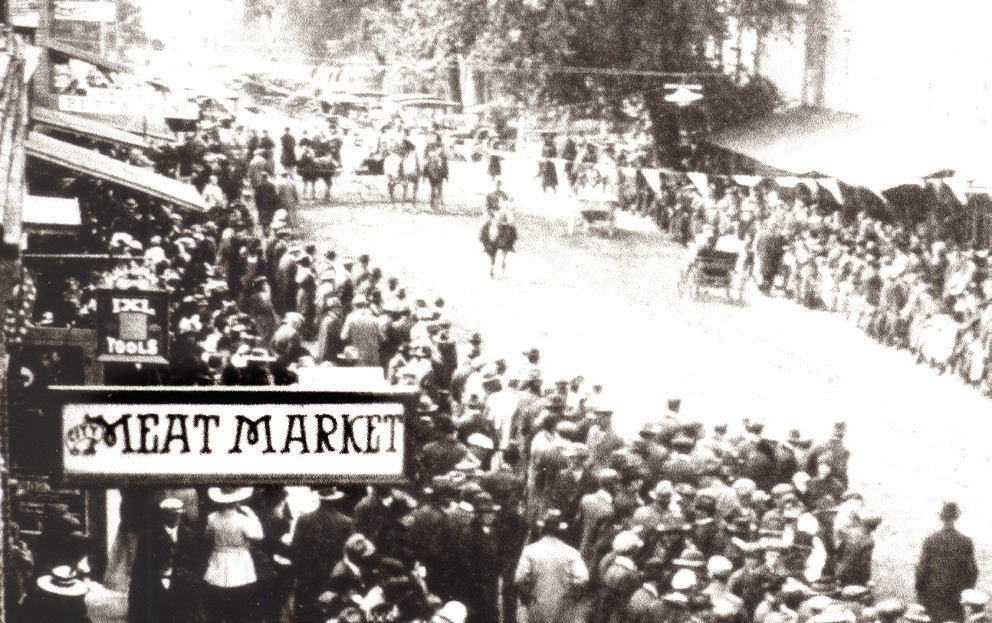
This photograph was taken of a parade on Main Street during the Industry Horse Show, which annually drew sizable crowds to the community. By the turn of the twentieth century, Industry had nearly 800 residents, and it was known for its thoroughbred horse stables.
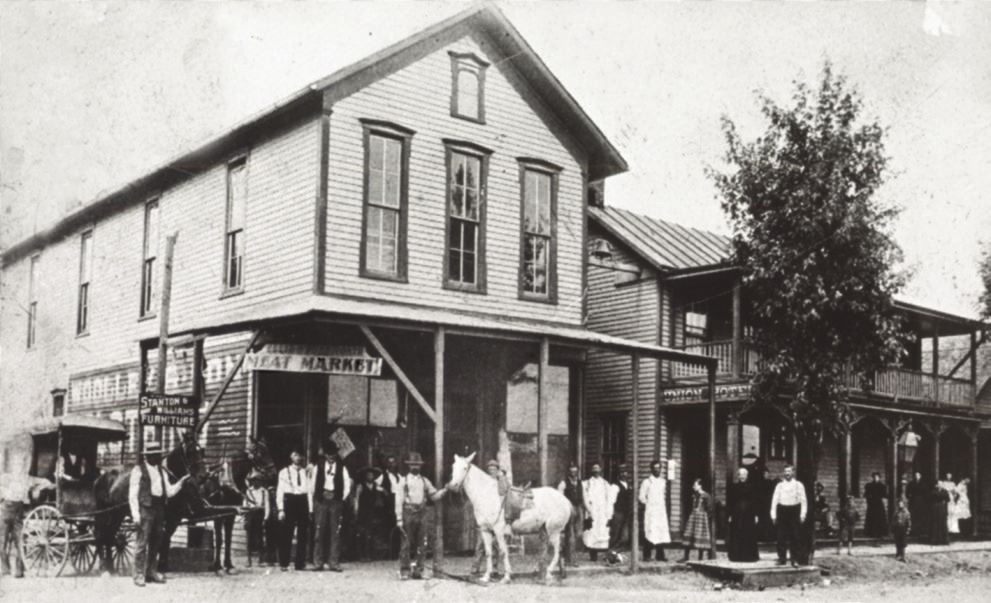
This 1889 photograph, as the accompanying caption from McDonough County Historic Sites reveals, shows the Ellis and Dunsworth Meat Market and the Union Hotel. The hotel, built in 1869, had “a dining room, a sample room (for salesmen to display their goods to retailers), a dozen guest rooms, and a second-story verandah.”
After all, villages are inexpensive and safe environments, where residents commonly have a meaningful sense of belonging—based on continuing interaction with other local people. Those communities don’t have the disorienting growth and change that typifies city and suburban places— which often makes some residents regret moving to such an unstable environment. Beyond that, in an American culture that has a booming senior citizen generation, the ability of older people to get out, walk around in non-congested streets, and safely drive a car is fostered by the slow-paced, uncrowded, familiar atmosphere of a small community.
And indeed, residents in villages should plan and work together now to make their communities more appealing, with residential and business building upkeep, popular and committed civic organizations, and occasional activities or events that foster a sense of community. The forces that have contributed to the decline of smaller towns, such as those in McDonough County, are here to stay, but response to those cultural realities can vary significantly from one community to another.