Local, State Candidates Appear to Answer Questions, Share Views
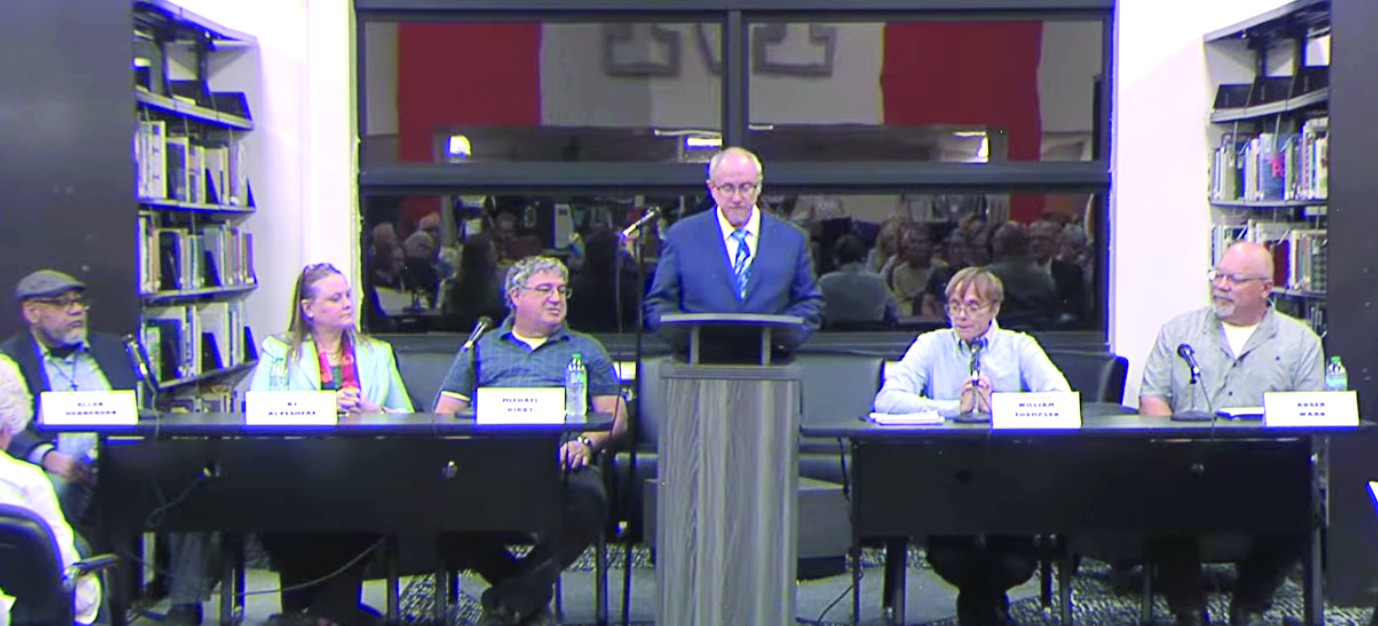
McDonough County voters heard from candidates across several contested races Tuesday evening at the local League of Women Candidates Forum held in the C.T. Vivian Library at Macomb High School. Topics covered included the Illinois separation referendum, data centers, funding for higher education, the Safe-T-Act drawbacks and other issues facing voters.
The forum, which was moderated by Rich Egger, news director for Tri States Public Radio (TSPR), was recorded and will be broadcast on Macomb's public access Channel 15 starting Oct. 3 (the schedule can be found on the League's Facebook page), as well as on TSPR. The pre-election event featured candidates for county offices, including the McDonough County board, the Ninth Judicial Circuit and state representative and state senate.
County Treasurer, Sheriff, County Clerk
Dana Moon, the current county treasurer who is running for re-election, and Joe Moon, who secured the Republican nomination for sheriff in the March primary and is running unopposed, opened the forum by introducing themselves. As these candidates are running unopposed, no questions were asked.
Joe Moon outlined his nearly 27-year Illinois State Police career, and promised 24-hour coverage and policy review upon taking office Dec. 1.
Dana Moon highlighted office improvements, such as credit card and ACH payments, remote deposits, a cash counter, new accounting software, a dog and cat registration program, texting alerts, refined tax payment processing, social media presence, investment diversification and internal security cameras. She announced plans for partial payments, prepayment plans and monthly automatic payments for tax bills.
Current County Clerk Jeremy Benson was unable to attend the forum.
McDonough County Board: Five Candidates Weigh in on Separation, Data Centers, MDH
Of the 19 candidates running for county board seats who were invited to participate, five showed up for Tuesday's forum. Newcomers Roger Ward, who was appointed earlier this year to temporarily fill a vacancy, and William Thompson, are running for three open seats for a two-year unexpired term in District 3, while incumbent Michael Kirby and newcomers Allen Henderson, who was appointed earlier this year to temporarily fill a vacancy, and AJ Alveshire are running for the six open seats in District 1.
Those not present included District 1 incumbents Larry Aurelio and Eric Blakeley and newcomers Mitchell Markey, Nate Young and Tim Frier; District 2 incumbents David Cortelyou, Clayton Murphy, Eric Chapman and Travis Hiel; and District 3 incumbents Vicky Kipling, Mike Cox, Jared Royer and newcomers Tiffany Ketchum and Riley Smith, who was appointed earlier this year to temporarily fill a vacancy.
The candidates who attended answered questions on such topics as the nonbinding Illinois separation referendum, a proposed moratorium on data centers, attracting businesses to the region and the county's most pressing challenges in their opinion On the referendum, which asks voters whether the county should explore separating from Illinois to form a new state, most of the candidates agreed they don’t support secession from Cook County. Henderson, Kirby and Thompson cited financial harm to the county.
'The referendum is not legal, it's a waste of voters' time and approaches hate speech,' Kirby said. 'The county receives $1.80 for every tax dollar paid, while Chicago suburbs receive only 90 cents. A separation would create an instant financial crisis.'
While Ward noted he had no strong opinion on the referendum itself, he stressed it was important to let voters have a voice by placing the nonbinding referendum on the ballot. Ward pointed out that 85 percent of the county's motor fuel tax money is diverted to Chicago for mass transit, which affects local road maintenance.
Recently, the majority of the county board voted 'no' on a resolution for a temporary moratorium on data centers in the county. The question was posed to the candidates if they supported a moratorium. Henderson and Ward, who was one of the few board members who voted in favor of the resolution, supported a moratorium, though with different reasoning. Ward said the county lacks sufficient information about infrastructure needs. Henderson called data centers 'the future,' but said restrictions are needed.
Kirby, Thompson, and Alveshire support a moratorium, with Kirby adding there are climate concerns, and if data centers should even be 'switched on in the first place' if they accelerate damage to the environment. Thompson cited the need for careful consideration of AI's 'greatest opportunities and greatest dangers.'
On attracting business, all of the candidates emphasized Western Illinois University as the county's anchor, with Ward adding the 'magic bullet' is WIU recruitment and that the county and the city should be doing all they can to help.
'Bring more students here, and businesses follow organically,' he stated.
Regarding keeping the county's hospital up and running, the candidates expressed deep concern because of cuts to Medicaid and other issues. Henderson and Ward said the county must do 'whatever it takes' to keep McDonough District Hospital open. Thompson warned that rural hospitals will close due to Medicaid changes and called for fighting to preserve federal revenue. Alveshire said the hospital issue 'keeps me up at night.'
On the biggest challenge facing the county, candidates said the county's poverty level, WIU's enrollment decline and Medicaid cuts, which will negatively impact the local hospital. Henderson also called for better community communication before major decisions go to ballot.
Ninth Circuit Court: Bryant and Long Debate Discretion, Political Affiliation, Criminal Justice Reform
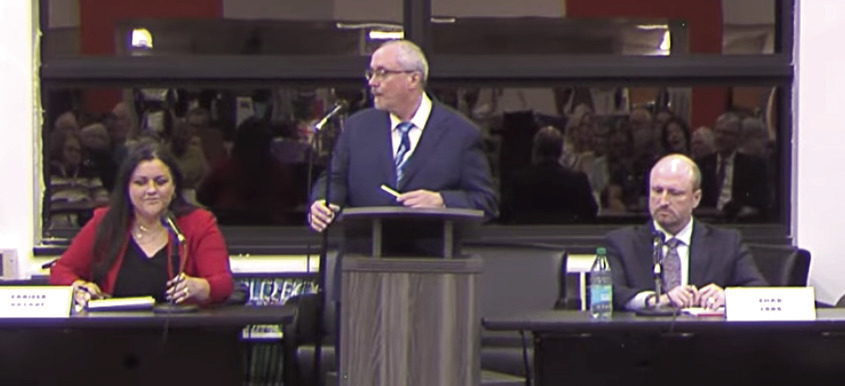
Carissa Bryant and Chad Long are vying to replace retiring Judge Raymond Cavanaugh in the Ninth Judicial Circuit. Bryant, a 13-year litigator born and raised in McDonough County, emphasized her farm roots and values of keeping her word and treating people fairly. Long, an associate judge since March 2024 with 18 years of legal experience, highlighted his background in private practice, administrative hearings and public guardianship.
A question was posed on how the candidates stay current with legal developments, with both Bryant and Long explaining they read appellate decisions, take part in professional forums and review case law. Long noted he chairs the judges' family law committee, while Bryant pointed out she serves on the Illinois State Bar Association's Civil Practice and Procedure Section Council, which includes reviewing proposed legislation before it becomes law.
On running on a party ticket versus as an independent, Bryant, who is the Republican candidate, said the two-party system is familiar and allows voters to understand her convictions. Long said running as an independent is harder as it requires over 3,600 signatures versus 500 for party candidates.
'I'm attempting to become the first independent candidate in the entire state of Illinois to win a contested judicial election,' he added. 'But it shouldn't come down to what party we are with. We must follow the law and the Constitution, not our personal beliefs and convictions.'
A question was posed regarding their support of criminal justice reform, particularly the Safe-T-Act, which both Bryant and Long criticized. Long said the law removed judicial discretion and created unsafe conditions, and that the list of non-detainable offenses should be shortened.
'The Safety Act doesn't work for anybody and as a judge, I would use my discretion to the fullest extent and anytime I have the chance to detain repeat offenders, who create a burden to the taxpayers and create enormous case backlogs,' she declared.
Long rebutted, stating that using discretion to detain 'anytime we have the chance' is 'dangerous' and amounts to legislating from the bench.
An audience member submitted a question regarding conflicts of interest, particularly if a case came before them in which they knew the individuals involved. Both said they would recuse themselves if there's any appearance of impropriety. Long added he recuses almost weekly due to former clients and law firm relationships.
District 71: Swanson and Thomas Discuss University Funding, Data Centers, AI
The District 71 House race puts Republican incumbent Rep. Dan Swanson up against Democratic candidate Kermit Thomas. During Tuesday's event, the men, who are both veterans, talked about university funding and data centers, as well as the Meta settlement money and bipartisanship in the House.
On the Equitable Funding Act for higher education, Thomas pointed out that WIU is funded at only 46 percent of adequacy, which is the lowest in the state, and called the legislation a priority. Swanson shared that he spent nearly three years serving as part of an equitable funding task force, stressing the state needs to find $136 million annually for the act. He also detailed WIU's funding requests over five years and the shortfalls, and calculated potential increases under different funding scenarios.
Of the $700 million Meta settlement Illinois received for social media addiction in children, both candidates agreed the funding should be used on mental health funding. Thomas added education and digital literacy are critical, given his work with middle schoolers. Swanson added the state should develop AI protection programs for children.
As with the local governmental candidates, data centers were a topic for the 71st District candidates, most notably if the state should impose a moratorium on data centers.
'Yes, I think there should be a moratorium. Data centers create only 20-30 permanent jobs after construction and bring noise, light pollution and health concerns,' he said. 'We need regulation, transparency and corporate responsibility for infrastructure costs.'
Swanson also supports a moratorium but urged open-mindedness as technology improves.
'The property tax revenue from a several-hundred-million- dollar facility could benefit communities,' he added.
When asked how they would work across the aisle, Swanson cited his record: 40 pieces of legislation passed in a Senate composed of 40 Republicans and 78 Democrats, and he's the only Republican House member chairing a committee. Thomas, drawing on military experience, said 'one team, one fight,' and that he'll work with anyone with a good idea for the district.
Both candidates oppose the Illinois separation referendum and concept.
36th District: Data Centers, Higher Education Funding Topics for Halpin and Beekman
The District 36 race pits incumbent Sen. Mike Halpin against challenger Brad Beekman, a retired state police officer, against one another for the State Senate seat. Like the candidates before them at Tuesday's forum, they answered questions about university funding, rural hospital survival and data center regulation.
Halpin, who has served four years, emphasized showing up for the district.
'I've demonstrated that I've shown up for this community,' he said, citing work with Western Illinois University, the Chamber of Commerce, and the regional Office of Education, despite living at the northern end of the district in Rock Island,' he said.
Beekman, a 28-year law enforcement veteran who retired from the Illinois State Police in 2023, stressed leadership and building relationships.
'It's not about me. It's not about my credentials,' he said. 'It is about District 36.'
When asked about the Equitable Funding Act for higher education, Beekman admitted he hadn't read the bill entirely, but recalled when WIU offered needbased aid.
'We need to get back to a place where that is done, where it makes college and universities accessible for everyone, and it needs to be measured by their ability to pay,' he stated.
Halpin, a chief co-sponsor of the equitable funding bill, called equitable funding for the state's regional universities, like Western, overdue.
'Western is one of the most seriously affected universities,' he stated. 'Public universities have been underfunded drastically for years. We need to adequately fund all of our four-year public universities.'
Beekman countered that Illinois has the revenue to fund schools properly, the issue is prioritizing those funds.
'We have the revenue to properly fund the schools,' he said. 'We just need to make it a priority in our state spending and our budgets.'
Bipartisanship was also raised with both Halpin and Beekman, with Halpin explaining that around 90 percent of legislative work happens on a bipartisan basis, though divisive issues complicate things during campaign season.
'I have a track record of working with my Republican colleagues as well as my Democratic colleagues from all over the state,' he said. 'No one party is monolithic.'
Beekman emphasized leadership through relationship- building.
'By building relationships and being respectful and giving people a voice from District 36, and giving people a voice from both parties, both Republican and Democrat, so that we can have bipartisan discussions, and we can find bills and laws that work for the majority, not just a few or for an agenda,' he said.
Rural hospitals and their needs was a continuing theme for nearly every candidate who took part. To help MDH, Beekman stressed community involvement and fundraising, noting McDonough District Hospital 'does a phenomenal job in interacting with the community.'
Halpin acknowledged the federal government's role in the crisis.
'Rural hospitals face risk because the federal government has decided that Medicaid rates and participation need to go down,' he said. He also talked about the law addressing the pharmaceutical rebate program, currently under litigation, to help hospitals like MDH, noting the state needs to do more.
Beekman countered, pointing out that the state must take responsibility.
'It's not up to the federal government to look out for District 36. We need to do that for ourselves,' he said. 'We have the numbers, we have the revenue in the State of Illinois to meet the needs of people in District 36.'
The candidates for the 36th District Senate seat also discussed job creation, data centers and the Meta settlement, which brought forth differing answers and some pushback. Beekman favors using the $700 million for the state's debts, while Halpin wants to see it used for mental health purposes in schools.
'The first thing we need to do with that money is properly invest it in the state of Illinois, pay down our debt, and put away money for a rainy-day fund,' Beekman stated.
Halpin responded, noting he usually doesn't push back too much in a forum.
'This money was hardfought,' he said. 'We shouldn't be putting it in a bank. We shouldn't be using it to pay down other debt. This is money that needs to go to that purpose.'
Additional Candidates
Other candidates who were invited, but did not attend included Joshua Higgins, Illinois Representative House District 94, who secured the Republican nomination in March; incumbent Neil Anderson, Illinois Senate District 47; U.S. House of Representative District 15 incumbent Mary Miller, who secured the Republican nomination, and Jennifer Todd; and U.S. House of Representative District 1 incumbent Eric Sorensen, who secured the Democratic nomination and Dillon Vancil.