Since getting appointed to replace Gretchen DeJaynes as McDonough County clerk, Jeremy Benson has administered two local consolidated elections. The midterms in November, however, will be the first federal election he’s taken on.
I caught up with Jeremy in his office at the McDonough County Courthouse to ask him how goes the election prep. We discussed President Trump’s executive order mandating changes to mail-in ballots, which was only definitively blocked by the Supreme Court Sept. 14. We also discussed methods of voter verification and how the election judge scandal from earlier this year has impacted their training for this upcoming election.
(This interview has been edited for length and clarity.)
Before the Supreme Court order came down, you mentioned being very stressed about President Trump's Executive Order 14399, which would have placed several additional requirements on mail-in voting. Can you walk me through why this order would have been such a problem for you?
The biggest concern we had was timing. It was just getting down to such a short period of time for us to make any changes. We were well into our process of preparing our packets to go out to voters. The executive order would have required us to change some of the materials that we had already purchased from our election vendor. And we were also struggling to get questions answered by the postal service on exactly how we needed to go through the process. We were working with our local post office, and they were very willing to talk with us, but they just didn't have a lot of answers.
The executive order would have required that envelopes for mail-in ballots be redesigned with a special logo and barcode—what would have been so difficult about implementing those changes?
It was a couple of things. One, we had already purchased supplies. So we’d already spent a sizable amount of money on supplies based on the vote-by-mail process as it is, and the potential was there for us to have to scrap those supplies and start over. We weren't sure if our vendors were going to be able to produce the new material for us in time to get them out to voters. There were just a lot unanswered questions, and we couldn't really pull the trigger on anything.
When do you feel you should have been informed so that you could smoothly implement this order?
Well, we really start preparing for each election generally two to three months ahead of time. The planning is all year long, but that’s when the work really starts. That’s when we make sure that we have our supplies in place and all of the different pieces start to come together. So, I would say at a minimum, if we knew three to four months ahead of time, that would have given us a lot more comfort in the process. As it played out, this thing was still working its way through the courts all the way up to early September, and so much was still completely unknown.
Executive Order 14399 was premised on the persistent claim from the current administration that there is widespread voter fraud. Have you personally seen any evidence to the claims that mail-in voting is vulnerable to fraud? What about other forms of voting?
I can only speak for McDonough County, but my staff and our election judges work very, very hard to make sure that we’re running a good and secure election. We have many, many, many layers of checks in place. I can confidently say that we have not seen election fraud.
What are some examples of checks you perform to ensure election security?
First and foremost, whenever someone comes in to vote, we check their signature against their voter registration signature. They are not given a ballot until the election judges confirm that signature. And, you know, the other benefit of being in a small rural county is that our election judges know their voters. Like if you came in to vote, A.J., I’d know you. If I go downstairs to work to cover a lunch hour or something in our election office for early voting, I probably recognize nine out of ten people who come in. And that’s a huge benefit.
What about mail-in voting where you don’t see voters face-to-face?
So, mail-in voting requires several steps. First of all, the voter has to register, and that requires them to provide ID. Then, they have to sign an application form, which is mailed to their home address. They have to sign that and return it to us. Then they have to fill out their ballot and they have to return it with a signed affidavit form. That affidavit includes their signature, and the election judges will verify that signature to their application signature and to their registration. And we do have instances where a signature doesn't match, and we will reject that and require the voter to either come in or to provide us some method to contact our office to discuss some method to validate their signature. Some of them are very harmless situations. For example, sometimes an elderly person who applied a few years ago might have some health issues, and their signature will change. And we will work with that individual to try and figure out how to get their registration updated.
You mentioned this will be the third election you've administered since getting appointed county clerk in December 2024. What are some lessons you learned from those previous elections, and what new challenges do the Midterms bring as your first federal election?
The federal election does not necessarily bring any new challenges. Actually, the general election is one of our more straightforward elections because there are fewer different races across the ballot. One of our more complex elections is actually the consolidated election. It happens in the offyears because there are so many local races. And so that just involves a lot more moving parts: you have library districts, you have school districts, you have villages and townships, and all those different districts overlap in different ways.
Tell me about election judge training.
We’re stepping up our election judge training. That's been something we've been working on. We've included more information for the election judges to learn and making sure they’re well informed and that they have all the resources and tools they need to do their job. We're hoping in the coming years to roll out electronic poll pads. That's a kind of a minor issue, but we currently use printed poll books, and the electronic poll pads do help the speed up the process of checking in voters. We've been testing those here in our office and had very positive responses.
What are electronic poll pads?
Basically, during early voting or on election day, the election judges will have a printed list of registered voters for their precinct. And they have to match individuals who come to vote with that list. Voters have to sign in, and then they're given their ballot to vote. The electronic poll pad essentially will replace the written book for all that, and it has live up-todate information. The poll books are printed on Sunday or Monday before the election, so if someone comes in and votes early, then we have to reach out to the judges and say, ‘hey, so-and-so just came in. You need to write next to their name that they voted.’ But with the electronic poll pads, it just gets updated automatically.
Speaking of election judges, I want to talk about the election judge you dismissed last March after a threatening comment was made to a voter who requested a Democratic ballot. What else have you done to address this issue and ensure that election judges in the future conduct themselves with impartiality and respect?
Well, first and foremost, that happened during the primary election where voters had to identify their party. So that was, I think, what drove this particular incident. We have not experienced that kind of thing in any other location that has been reported to us, and immediately after the event, we made sure to communicate with our election judges that under no circumstance are they to make any comment about party affiliation. That’s part of the election judge training: there should never be any discussion about party affiliation except during the primary, and then they shouldn’t do more than ask voters their party to assign them a ballot.
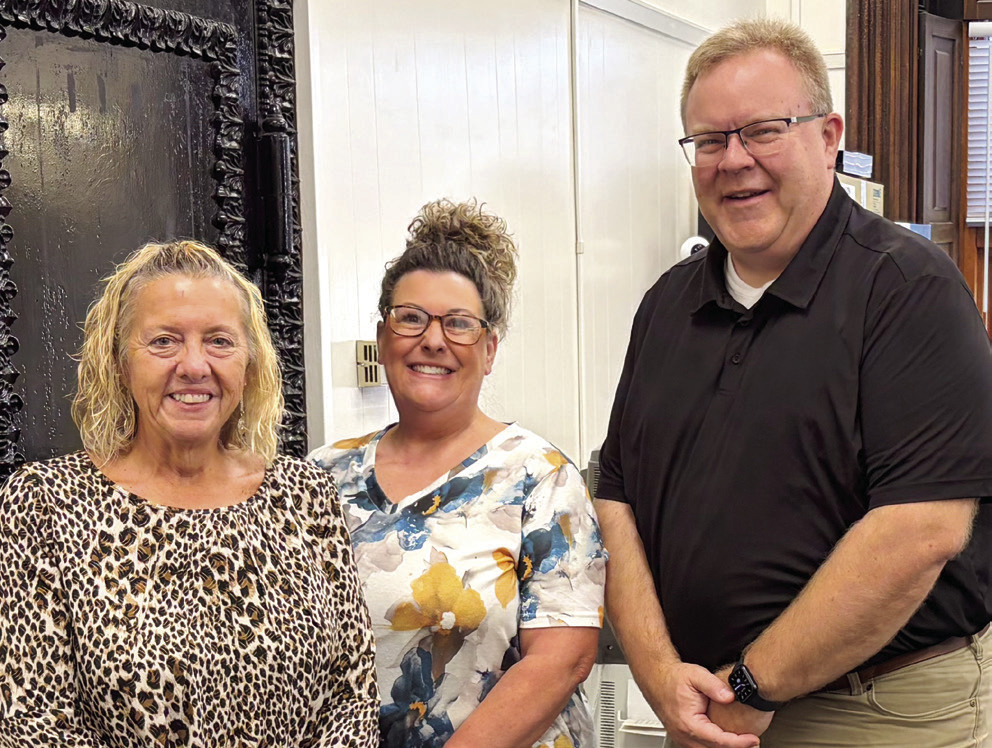
Jeremy Benson and staff in county clerks office
Are there any changes you’ve made to the training of election judges in response to that situation?
Nothing beyond what we’ll already be discussing at each of the trainings with them. It was an individual who made a bad choice, a very poor choice. And that individual is not working for us any longer. It’s definitely not something I want to have happen ever again.
You yourself are on the ballot this year, and for the first time since you were appointed in December 2024. Even though you're running unopposed, is there anything you'd like to say to residents of McDonough County as to why you deserve their vote?
When I stepped into the office, I brought a different kind of experience. I was not previously in government, so I bring kind of an outside view on how we operate. I try very hard to listen to anyone who brings concerns to me, and we’re doing our best to be responsible with taxpayer funds. We’re trying to stay on top of new technology but also being cautious not to just assume technology is always the right answer.
Technology is a great tool, but we want to be careful with it.
What did you do before getting into government?
My wife and I owned a business—Terrill Title Company— and after selling that company in 2019, I continued to work for the successor company for another five years. I had a pretty lengthy background in real estate: document recordings and tax processes within counties, records, research, and those kind of things. That was my main background.
Obviously you must enjoy your new line of work since you’ve put your name on the ballot.
I do enjoy it. And I've got a great staff. Absolutely couldn't do this without my staff.