And God said, “Let the waters bring forth swarms of living creatures” . . . So God created the great sea monsters.
—Genesis 1: 20-21, New Revised Standard Version Updated Edition …but you wouldn’t know that from reading the New International Version (NIV).
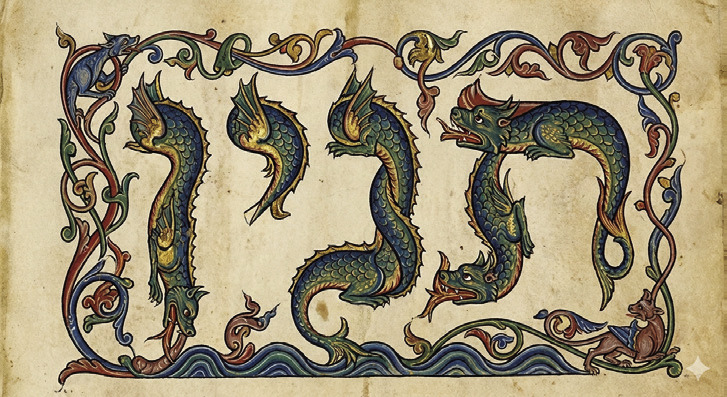
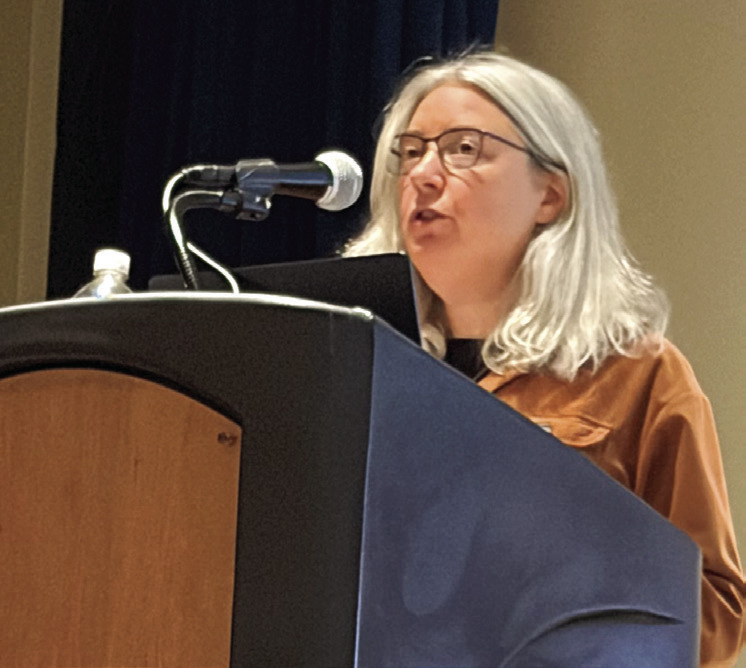
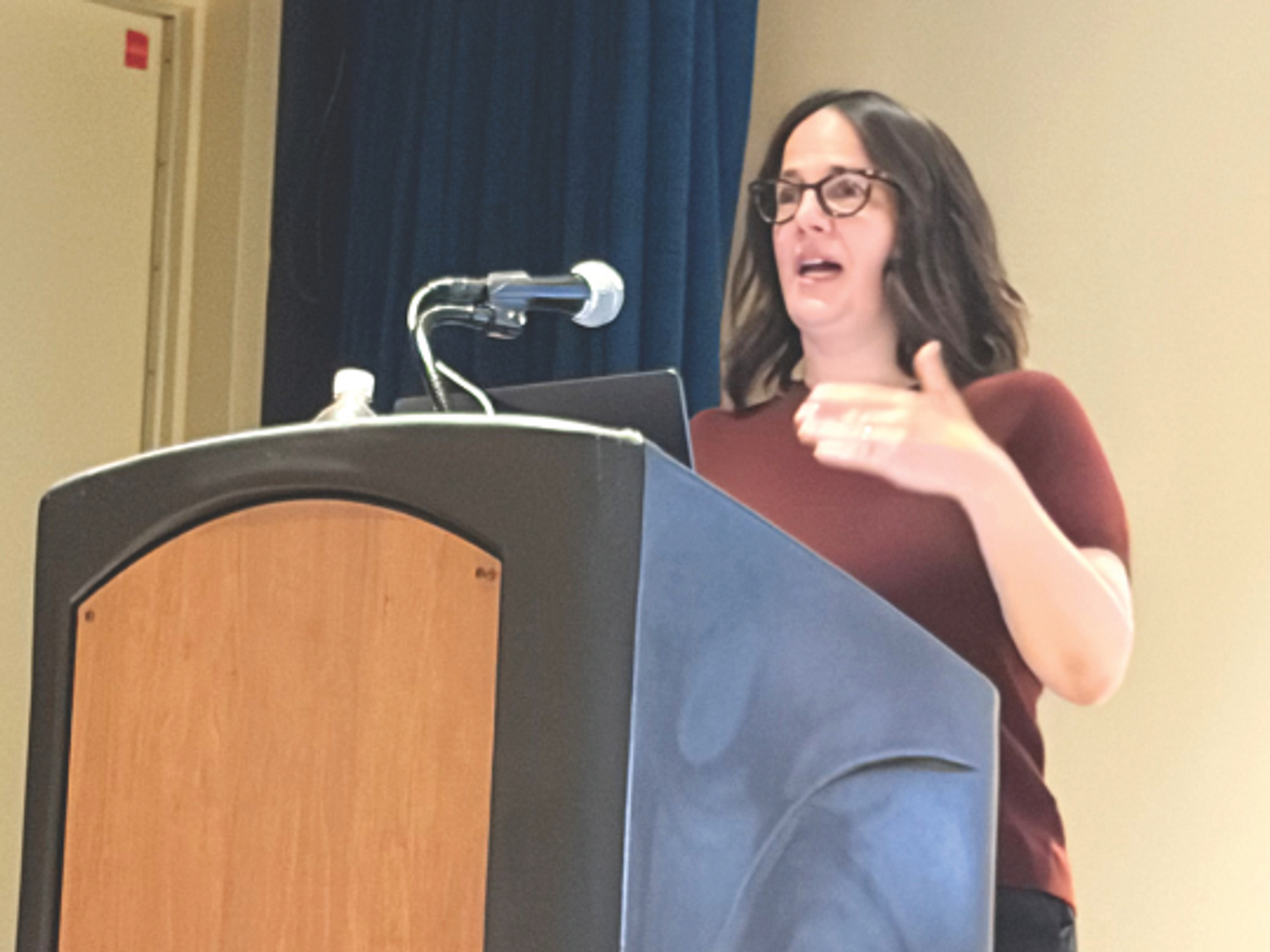
Biblical scholar Esther J. Hamori came to visit Western Illinois University Sept. 23 to discuss monsters of the Bible, and the first thing she emphasized was how much of what’s disturbing in scripture often gets smoothed over in translation. She began by examining different translations of the Genesis creation account of the Hebrew word “tannin” (Hebrew:
ןיִּנַּת ). In the King James Bible, this word is translated as “whales.” In the New International Version, it becomes “great creatures of the sea.” Most scholars today, however, agree that the NRSVUE’s version quoted above most closely matches the sense of the original Hebrew: on the fifth day of creation, God created sea monsters.
“This is not a flukey modern translation,” Hamori said. “The main meaning of this word tannin when it shows up in other biblical texts is ‘sea monster.’ To render that as ‘whales’ or ‘great creatures’ is just a way some translations have tried to tiptoe around the monsters in this text.”
Hamori was invited as the key speaker for the 39th Annual Mary Olive Woods lecture, named for Woods, who died in Macomb in 1956 and willed her estate to the United States government on the condition that it should become a theocracy. U.S. courts ruled this unlikely to happen in the foreseeable future, and after spending 29 years in legal limbo, it was finally decided to bequeath a portion of Woods’ estate to WIU with instructions from the court to use it to “provide a curriculum of religious studies and to support speakers on religious topics.” Hence began the yearly tradition of inviting either a scholar of religion or a philosopher to come speak at the university.
“Our goal with the Mary Olive Woods lectures is to bring in excellent scholars who are exploring important issues in the field of religious studies,” commented Betsy Perabo of WIU’s Department of Race, Religion, Gender, and Multidisciplinary Studies. “We try to identify lecturers who, like Dr. Hamori, are also good teachers, able to pinpoint and illuminate ideas that students and community members will find intriguing and want to discuss long after the lecture. It’s not always easy to have conversations about texts that for some people and communities are sacred, or even inerrant, and for others are fascinating objects of scholarly or literary interest. But I think it’s worthwhile to make the effort.”
Hamori is professor of Hebrew Bible at Union Theological Seminary in New York. She earned her Master of Divinity from Yale Divinity School (1997) and her Ph.D from New York University in the Department of Hebrew and Judaic Studies (2004). She has written two books: “Women’s Divination in Biblical Literature: Prophecy, Necromancy, and Other Arts of Knowledge” (2015) and “God’s Monsters: Vengeful Spirits, Deadly Angels, Hybrid Creatures, and Divine Hitmen of the Bible” (2023).
In “God’s Monsters,” Hamori runs through the entire biblical gamut of monstrosities. She discusses the cherubim, which before they were cute baby angels were “menacing, winged animal guardians” and the seraphim, which were originally “multiwinged creatures with serpentine bodies and humanoid hands.” These strange creatures were only later identified with angels; the actual angels of the Bible are even more terrifying, powerful shapeshifters who often bring destruction and mass death (there’s a reason why the angel in Luke’s Gospel has to keep telling people “be not afraid”). Hamori’s project in her book is not simply to more accurately translate these creatures, but to ask, “Who are the monsters skulking through the pages of the Bible, and what do they tell us about their God?”
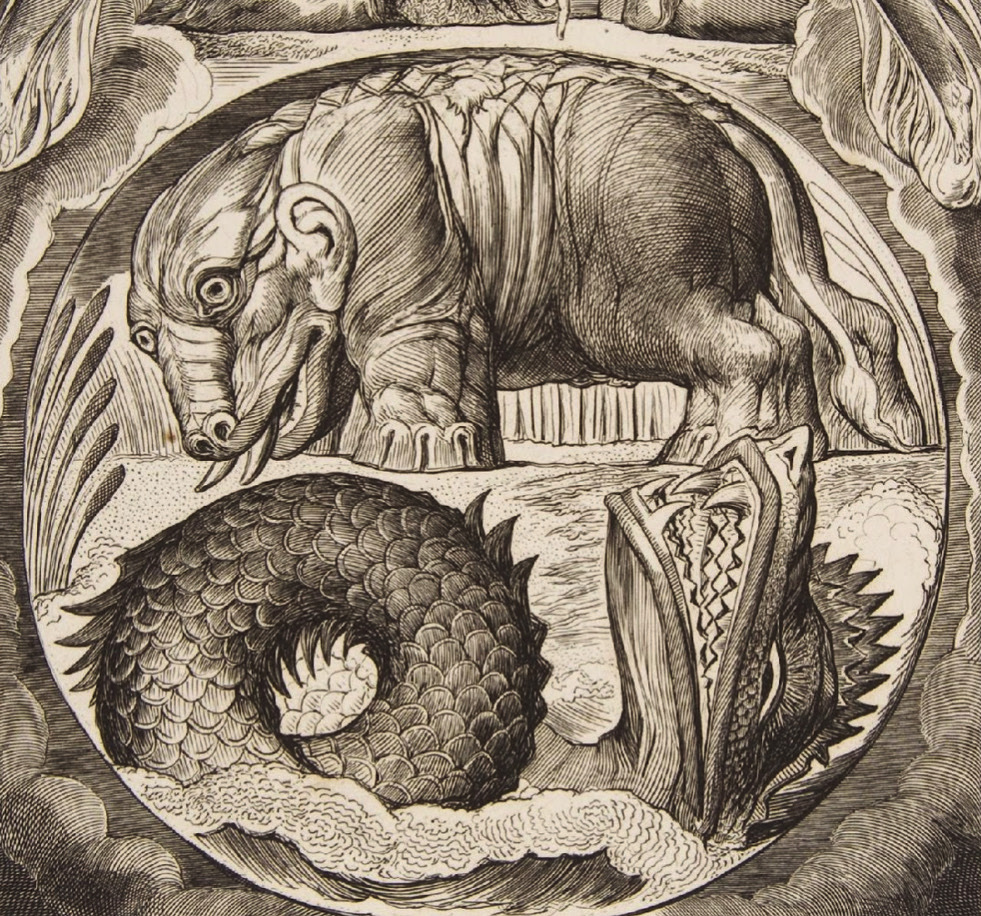
For the Mary Olive Woods lecture, Hamori presented on Leviathan, the greatest of those sea monsters that God created on the fifth day. Unlike the seraphim, cherubim and angels which form God’s entourage and follow his orders unquestioningly, God’s relationship with Leviathan is more complicated. In some parts of scripture, Leviathan is God’s enemy and he fights it. In the poetry of Psalm 74, for example, he crushes its heads and then feeds its body to the creatures of the wilderness. In other places throughout the Bible, however, Leviathan is praised. Psalm 104, reads off a litany of all the amazing things that God created, and it culminates with “the sea, great and wide; creeping things innumerable are there, living things both small and great. / There go the ships and Leviathan that you formed to sport in it.” (Psalm 104: 25-26, NRSVUE).
“‘To sport’ here is an absurd translation. Nobody says this,” Hamori commented, criticizing the strangely anachronistic translation choice from the NRSVUE. “But ‘to sport’ means ‘to play.’ At a minimum in Psalm 104, God created Leviathan to play in the sea. In the original Hebrew, it’s every bit as likely that the sense isn’t just that God created Leviathan to play, but for God to play with it.”
The implication here is not only that God likes to play with monsters, but that perhaps it is Leviathan, not human beings, which is the pinnacle of God’s creation. Hamori argues that this theme is carried into the Book of Job to even more devastating effect. The Book of Job asks why bad things happen to good people. Job is an upright man whose children are killed and who then is struck with terrible illness. He demands to know why these things have happened to him, but he never receives an answer. Instead, God comes out of a whirlwind and delivers a monologue about all the glories of creation meant to humble Job. Human beings are nowhere mentioned in this grand index of all the great things God has made. Instead, similar to Psalm 104, God’s litany ends with a recitation about the wonders of Leviathan.
“I will not keep silent concerning its limbs or its mighty strength or its splendid frame” (Job 41: 12, NRSVUE) God begins before reciting what Hamori identified as a waṣf, an ancient form of Hebrew poetry in praise of something’s beauty or splendor: the double coat of mail, the flaming torches of its mouth, the underbelly sharp like potsherds. As a description of a sea monster, it’s beautiful; as an answer to Job’s questions, it’s devastating. Hamori argued that God’s answer tells us humans are simply not that important in the grand scheme of his creation, and bad things happen to us because God is not especially concerned with us.
“It’s like God is saying ‘I made creation for this monster, not for you,’” Hamori said.
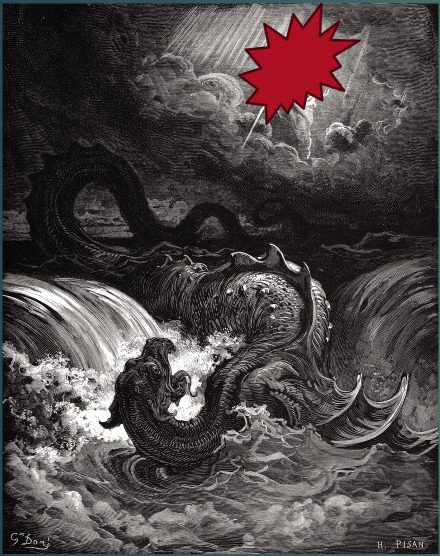
Hamori, who is a practicing Jew, takes religion very seriously. During her PowerPoint presentation, she blocked out the face of God from a famous picture of him fighting Leviathan, observing Judaism’s prohibition against showing the divine. Hamori writes that she explores these darker aspects of scripture because they are an important part of faith for her. In “God’s Monsters,” she describes how she found meaning in the Bible after her brother’s suicide: “I tried focusing on the many biblical passages of comfort and hope, but taken alone, they fell short. Maybe that’s why they’re not alone. The Bible is rich with comfort, but also chock full of macabre stories, and with their recognition of a troubled reality, they offer something that the safer, prettier texts can’t. Hope is all well and good, but acknowledgement of the grim has a comfort all its own.”
Amy Carr, a Lutheran theologian and professor of religious studies at WIU, commented that Hamori’s more cynical perspective of scripture is not unprecedented in either Jewish or Christian thought.
“Martin Luther’s commentaries on Genesis and Isaiah do not shy away from naming and trying to make sense of the difficult faces of God encountered in the texts and in our own lives,” Carr said. “Luther says that faith is the process of learning to live with the many faces of God, including those that seem inscrutable or unsettling.”
Gordon Pettit, a non-denominational Christian and professor of philosophy, held a more critical perspective on Hamori’s project. He questioned whether God’s account of Leviathan in Job was even truly a description of a supernatural creature and not simply a very elaborate and metaphor-laden description of a crocodile. He also had broader problems with Hamori’s harsh description of God.
“She describes God as easily offended with a quick temper and absolutely vicious in treatment of humans,” Pettit said. “When you are enamored with the compassionate God, you see compassion throughout the biblical text, and when you are enamored with monsters, you see monsters.”
Despite his criticisms, Pettit did acknowledge that Hamori’s project counteracted what he sees as a harmful tendency in modern religious thinking: domesticating the figure of God.
“She presents God as a being to be feared and who is not simply a magic genie who wants our lives to go well in a worldly sense,” Pettit said. “In the 21st century U.S. Christian culture, God is too often treated as a personal assistant whose main role is to find us parking spaces, to keep us from illness, or to help us avoid any pain, rather than the almighty creator of the universe worthy of veneration. Some correction of that theology is needed, and I might add is occurring by various Christian leaders.”