Anyone who has spent over 40 years working and then retires probably has earned a well-deserved rest. This is especially true for anyone who has spent those years in the same job, doing on their last day of work exactly what they did on the first.
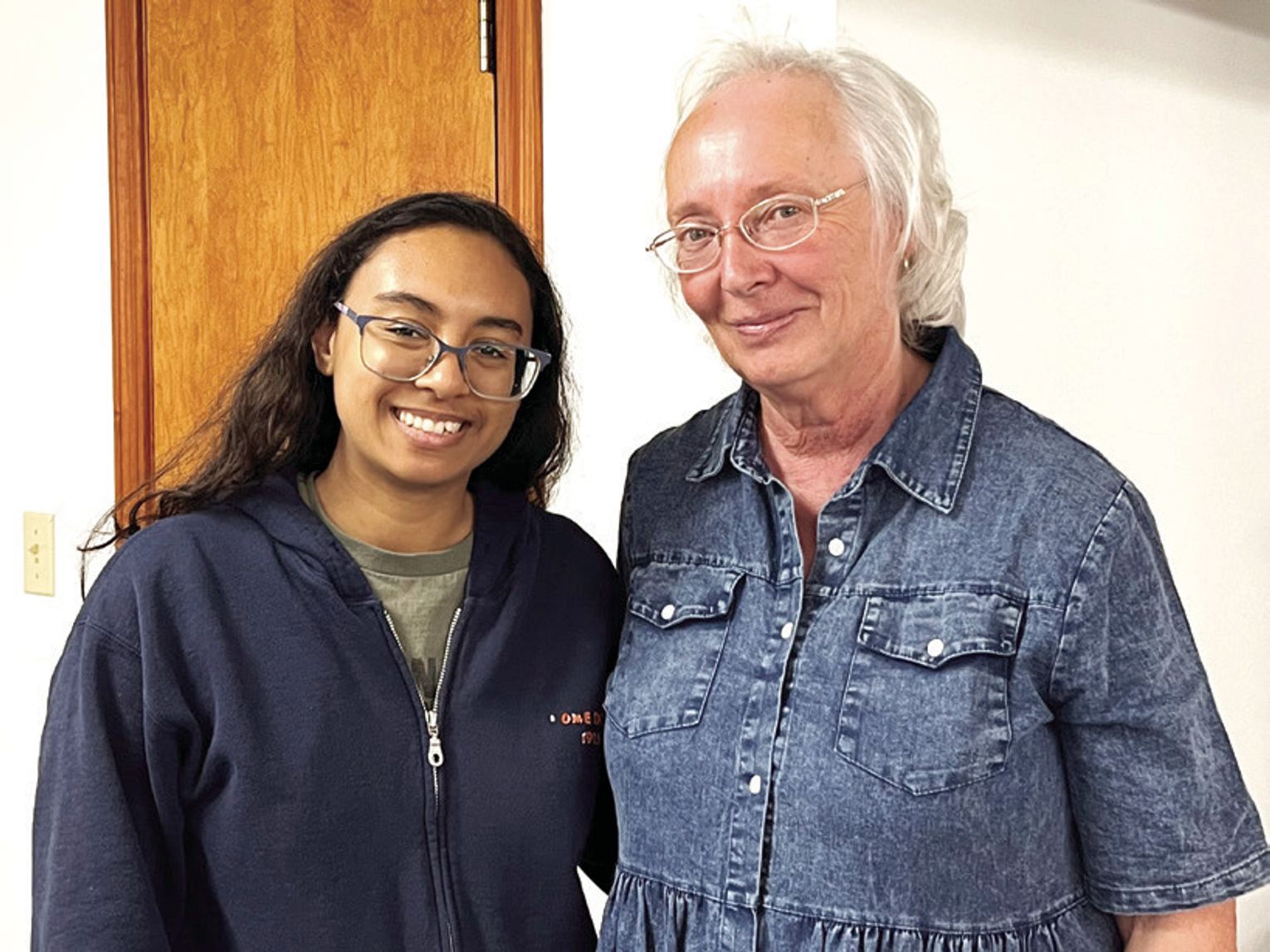
For rural mail carrier Betty Fross, a near half-century of driving rural roads and delivering the mail surely has earned her recognition. However, she does not like surprises. That's why the members of the Bethel Baptist Church in southwest McDonough County wisely chose to invite her to a retirement party at the church Saturday, Sept. 19, in honor of her 44 years of service to the U.S.
Postal Service. The event was integrated with a program celebrating the 250th anniversary of the formation of the United States.
A Day in the Life
Work for Fross begins at 7:30 a.m. at the Colchester Post Office. She picks up her flats of pre-sorted mail that has been dropped off and then combines it with the 'raw' (local) letters, cards, and ads. Then, she starts the process of pigeon-holing all this mail into a sequential 'case' for her Route 2 deliveries.
'We don't get as much as we used to,' Fross said, 'because a lot of people do electronic stuff now. But we'll still get one to three, two-foot long trays a day to sort. I can get a thousand pieces of mail to deliver each day.'
Then it's time to hit the road to cover the 93 miles that make up her assigned route south and west of Colchester. She starts first in one section of Colchester, works her way through a designated pattern of roads, some worse than others, then ends her day with deliveries back in another section of town.
Learning the Route
Fross started out as a substitute driver in 1982, back when the price of a first-class stamp was 20 cents (today, it's 82 cents). In the postal system, a substitute is assigned one and only one route; in Fross's case, Route 2 out of Colchester. There was a time when her brother, who was a mail carrier, served the Route 1 area. If a sub were needed for his route, she learned his as well. In fact, sometimes she served as substitute for both Colchester routes. 'Those are the only two routes I ever learned,' she said.
However, today's substitutes may be called on to cover a wider area. In fact, Fross's assigned substitute is currently delivering mail down in Browning, Illinois, and has subbed for routes in Rushville, Augusta, and Plymouth.
Years ago, people were not the most thorough when addressing envelopes. Fross said that during Christmas time, she'd get a lot of cards to deliver. She might get one with only the words 'To the Carson Family' on the envelope. There may have been four or five Carson families on the route, so she'd start at the first one, put a note on the card saying 'Is this yours?' and give it to them. If it weren't, the family would give it back, and Fross would pass it along to the next family.
'It got easier when we started using ZIP Codes and more specific street and road designators. But in the beginning,' she admitted, 'I learned names rather than addresses. I didn't know my streets very well. I just knew my people's names.'
Tricks of the Trade
The logistics of mail delivery hinge upon determining the most efficient driving route with a minimum of backtracking; dead-end lanes and driveways are the exception. For Fross, her route was already mapped out when she first started. 'The postmaster said this is where you go first, this is where you turn, this is where you go next,' she explained. 'Some stops might be added or taken out because of new houses or abandoned addresses. Sarah McDonald, my current postmaster, asked a couple of times if I wanted to redo the route. I'm like, no. Just leave it alone.' It's her routine and has been for nearly half a century.
When asked how many vehicles she's gone through, Fross appeared stumped for a moment. 'When I first started, I took a picture of the car, but I don't do that anymore.' But then she figured she's delivered mail in at least eight different vehicles. At 93 miles a day for six days a week and for, on average, 50 weeks a year, that's about 30,000 miles a year on the road.
What about the actual process of driving? We've all seen rural mail carriers sitting in the middle of the front seat (mainly in cars with bench seats rather than center consoles). They'd be steering with the left hand and operating the accelerator and brake pedals with their left foot. 'I don't know how long it took me to get used to it, but I drive that way all the time now, even when I'm not delivering mail. I just can't get rid of it,' she joked.
Given the dramatic increase in fuel prices, rural mail carriers catch a break in that they are reimbursed for mileage, even though they provide their own vehicles. In fact,
See Fross on page 11 according to the postal service's website, the agency spends about $500–$700 million a year on vehicle fuel, usually averaging 171 million gallons a year.
Driving 93 miles a day may not seem like a burden, but with the frequent stops and low speeds, Fross said she relies on the radio to occupy her mind. 'In the morning, I turn on my preachers and listen to sermons. In the afternoon, I'll switch over to talk shows like Dave Ramsey. Then I'll switch over to Christian music. Sometimes I'll just shut it off and listen to the quiet.'
Being a mail carrier also means that a driver can function as a mini post office. Carriers can sell basic postage stamps and manage temporary mail holds or forwarding services. They can also handle certified, registered, and insured mail items. All it takes is the proper forms and payments by check, and they can handle these roadside special services right at the mailbox.
Hazards
With all these starts and stops along rural roads, Fross surprisingly has had only a few close calls with local animal life. She's been bitten by dogs twice in her career and likely encountered other critters scurrying across the road. Even though most of her road miles take place during daylight, the occasional deer hit is inevitable. In her case, the one time she suffered a deer encounter, the deer was running in the ditch alongside her car. Then it decided to turn and slammed into her back door. There was no car damage except for a few bits of embedded deer hair. Another time she had a tame deer that was in someone's yard come up to her window and stick its head inside.
Bad weather, especially snow and ice, is Fross's nemesis. 'That's one reason I'll be glad I'm retired so that I don't have to worry about sliding into ditches,' she lamented. 'I just don't want to be out in the country in the winter time anymore.' And then there's the massive snowfalls and blocked roads. 'Many years ago when we used to have the big storms, a huge snowblower went down one of my roads and made a one-lane path. We took a picture of the car in the middle of the road with the snow piled up on each side. It was like driving through a tunnel.'
When asked about locating the mailboxes, she said, 'Sometimes if they're buried, you don't see them. You can't do anything about it.'
More of a burden than a hazard are the busy mail seasons at Christmas and on Amazon Prime days. 'Sometimes I have to make three trips a day to deliver all the packages,' she recalled. 'I'd load up as many packages that would fit in my car for the first part of the route. I'd get them delivered, then go back to the post office, load up again, and set out on the second part of the route. One time I had to make four trips. We're not supposed to go past 7:30 p.m., but that one was an 8 o'clocker.'
Changes
After 44 years of service in one job on one mail route, one would expect changes. Fross mentioned some efforts several years ago to change route directions. 'The higher-ups wanted to simplify it,' she respectfully recalled, 'so that we wouldn't do any backtracking. Well, everything they were doing only made it worse. It wasn't gonna work. So, I said just leave my road alone.'
On more recent management decisions, she said in her diplomatically reserved way, 'Sometimes you think that the uppers are just out there for the money. It's like push, push, push instead of trying to do your best at what you're doing. Hurry, hurry, hurry. You gotta get this done. Just, like, let me do my job.'
Retirement Plans
Members of the Bethel Church included Betty's retirement party in their celebration of America's 250th birthday. The outdoor pedestal church bell was rung, pledges to the American and Christian flags were offered, and the national anthem was sung. Marilyn Shelley recounted the history of the Bethel Baptist Church while Beth Crabb shared records and history of Bethel Township.
Then came time to honor Betty's retirement. Terri Frisbie conducted a postal trivia review of Betty's career and of the U.S. Postal Service while Evelyn Hagan shared a poetic tribute to Betty. All the while, she sat in quiet contemplation, knowing that her road ranger days were coming to an end.
Fross is also a quilter and a knitter, and she loves doing puzzles. She also likes gardening and tending to chickens. She and her husband Tim have 29 grandchildren, 13 of them in the local area, so she'll soon be able to spend more time with them and their activities. Most of all, however, she plans to sit by her wood stove in the winter and just watch the snow and not have to worry about driving in it.
Technically, Fross won't be off the roads until the end of the year, maybe even into the first week of the new year. She'd like to make her last mail delivery on Christmas Eve and then turn over the keys to her substitute driver and eventual replacement, Nina Benitz. She'll use up a few accumulated vacation days to finish out the year.
'I've enjoyed my job. I enjoy getting out there and seeing my people.'
Notice that she's been saying, 'my route,' 'my road,' and 'my people.' To mail carrier Betty Fross, delivering mail has been more than just handling letters and packages. It's been a form of connection to others by serving as that eagerly anticipated messenger — 'You've got mail!'