When the McDonough County Board of Supervisors decided in 1884 to replace the existing almshouse north of Macomb with a new one southeast of Macomb, it was met with some resistance.
The Commissioner of State Charities had made their belief perfectly clear. In the last report, the Commissioner had said; “The house is old, ready to fall down, with plastering off, and rat-holes in every direction. It is impossible to carry on an almshouse in such a rookery.”
While the county board admitted a new building was necessary, questions still remained. Should it be built on the same site as the existing almshouse north of Macomb? Should that farm be sold and another farm be purchased that was more advantageous to the county? It was pointed out that 50 to 60 acres of the existing farm, which comprised 85 acres, had never been turned by a plow and was too wet for successful farming.
Supervisor Hartung, of Emmett Township, gave a list of all the farm products and stock on the farm taken from the last inventory in March of 1883. The entire farm had only produced 150 bushels of corn, 125 bushels of oats, 26 tons of hay, 3 tons of straw, 500 head of cabbage, 5 bushels of parsnips, 3 cows, 2 calves, and 23 head of shoats. Hartung emphasized that the county farm was purchasing goods from Macomb and Good Hope merchants because the farm itself was not efficient.
Arguments went back and forth about the cost of improving the existing county farm by draining and tiling the land. It was even mentioned that if the board decided to build on the south side of Macomb it would limit the superintendent to where he could do business such as buying groceries, coal and meat, and that Colchester would reap the benefit of that as opposed to Cuba or Good Hope.
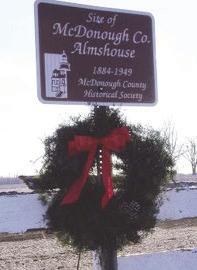
It was ultimately decided in early 1884 to purchase 160 acres southeast of Macomb for $10,000. The land was located on the SE quarter of Section 7 in Scotland Township, and was said to be a model piece of property owned by local physician Beverly Westfall. Today that location could be referred to as the intersection of Candy Lane (1300th St.) and 1050 N.
Road. (Local historian John Carson explains that back in those times, 1050 N. Road may have been referred to as 750 Road. The latter designation was not the number of a county road. Instead, it was an IDOT designation for funding used before the county’s later numbering systems.)
This same parcel of land had been awarded to Benjamin McCleary on January 1, 1818 by President James Monroe as a bounty for military service in the War of 1812.
Architect F.M. Ellis of Marshalltown, Iowa designed the new structure, and William O. Thomas earned the building contract.
Thomas was well-known in the Macomb area having built the high school in 1865, the Chandler Opera House block in 1872, and the jail in 1876. Born in Logan, Ohio, he came to Illinois in 1852 settling in Macomb. In 1858 he moved to Kansas City and in 1861 moved back to Macomb. He lived in Macomb until 1886 when his family moved back to Kansas City. Every county building in Macomb was erected partially or wholly by him.
The large and imposing Queen-Anne style almshouse was meant to house the growing number of persons in McDonough County who needed help; the destitute, the elderly, abandoned and orphaned children (in 1913 McDonough County would have a separate orphanage), the infirm, those with mental disabilities and women escaping abusive situations.
The magnificent new almshouse would be used for 65 years. It was 144 feet across the front and had 85 rooms, including 50 bedrooms and two dining halls.
Counting the basement, the building was three stories tall, with the lower floor having a ten foot ceiling and the upper two floors 12 foot ceilings. A six foot wide corridor ran the total width of the 144 foot building.
The basement of the new almshouse was a beehive of rooms including: 2 large dining rooms A large kitchen A huge laundry A drying room A vegetable cellar A boiler room Four “insane” rooms 7’x10’ Four insane cells A milk room A screen room Closets And pantries by the dozens The Macomb Journal reported on August 7, 1884: “The basement story and the first story of brickwork on the new county almshouse is finished, and the rest of the brickwork is rising rapidly”.
On December 19, 1884 the Macomb Journal reported: “The new almshouse will be ready for occupancy this week. New iron bedsteads will be put in all of the rooms. Superintendent Knowles will move his large family there about January 1st”.
On January 8, 1885 the Macomb Journal reported the following: The board of supervisors met yesterday, the purpose being to receive the new county almshouse from the builder’s hands. In the afternoon the members went in as a body and examined the building, and this forenoon heard the committee’s report and virtually received the new structure. Mr. Thomas was allowed $500 for extra quality of stone put in the foundation, but some other claims for extras were denied. (Another report this writer found stated that Mr.
Thomas felt he was shorted $1000 and left Macomb after this project, not to return.)
Those who were able-bodied often worked on the farm producing grain, raising livestock, and growing gardens and orchards. But like many underfunded county institutions of the period, the second almshouse too struggled with maintenance and staffing resources.
The underfunding made it nearly impossible to hire and retain qualified supervisors and competent staff.
Once again the McDonough County Almshouse began to draw the attention of state inspectors. The State Board of Charities in 1907 made the following report to then Governor Deneen. Relative to McDonough County, the report said: “The almshouse is in bad sanitary condition generally. Open traps are in the basement floors, the closets throughout the building emit rank odors, and the bath tubs, toilet rooms, and basins are filthy. The plumbing is out of repair.
The water supply is dependent upon a windmill and is often out of service. One room in which an insane person is locked has an open closet beside the bed.
There is no ventilation and when the door was opened a stench came forth into the hall. Several of the rooms, unoccupied at the time of the inspection, have these open closets, one of them being in a most filthy condition.”
Another inspection in 1915 noted the following: “The bedrooms are very small. The floors are of old wood, soft and worn. There are high wainscoatings.
From the walls the plaster is breaking. The walls are cracked and great smears of new plaster show where the old material has been replaced. Some of the walls are scaling and are especially unsightly.
The inspector stated that bedbugs swarmed in every crack of the walls. The odors of disinfectants were strong in all parts of the building.
The bedrooms are very dreary. The cleaner inmates have white sheets and pillow cases. Many of the small iron beds need painting.
The windows are dark with dust. The cracked and scaling walls increase the desolation of the rooms. The bathrooms on the women’s side are very foul smelling.
The plumbing is out of order. In one room the toilet could not be flushed. Few of the rooms were clean. The windows of nearly all of the rooms were closed”.
During the 1920s the conditions at the McDonough County Almshouse improved under the leadership of Superintendent William Jones, with increased funding from the county. However, use of the almshouse decreased as alternate means were introduced by government agencies for caring for the indigent at state and national levels.
The Macomb Journal reported the following on July 27, 1945: “The building and grounds committee of the McDonough County Board of Supervisors was meeting at the courthouse here today to discuss requirements for converting the county home into a convalescent home.
Such a change would create a home available to old age pensioners as well as the paupers who are kept there now. (The KEY WORD there is PENSIONERS.)
The requirements and recommendation for physical improvements to the home were submitted to County Clerk Herbert K.
Hulson and Superintendent Edgar Watson, building and grounds committee chairman, by William J. Downer, chief sanitary engineer for the state department of public health. The changes necessary before the state health department gives its approval of the place as a convalescent home include improvements to the water and plumbing facilities, lighting improvements, new floor and wall improvements, and some new equipment.
The major recommendations included: Reconstruct well 2 by the buried-slab method.
Replace the split base pump with a one-piece base pump with a stuffing box around the pump rod. Disinfect the well and submit samples for bacteriological examination. Re-install the bath tub fau- cets and lavatory faucets so they will be above the rim of the tubs and lavatories.
Replace some of the toilet tanks with porcelain walltype flush tanks. Provide one water closet for each 10 ambulatory guests.
Provide hand washing facilities in each toilet room. Decorate all bedrooms., dining rooms, kitchens, etc. with wallpaper or paint.
Recover the floors with linoleum of a light color.
Provide artificial lighting in each room occupied by guests to be equivalent to not less than one-half watt per square foot of floor space. Provide 50 watt lights for reading lamps. Provide artificial light in the kitchen equivalent to not less than one watt per square foot of floor space, Provide an additional refrigeration unit for the kitchen. Install a two-compartment sink with drain boards and hot water facilities in the kitchen. Improve the steam heating system so that all parts of the home occupied by guests can be heated to 60 degrees in the coldest weather. The letter also recommended 70 square feet of space to be allowed for each guest in the sleeping rooms and the space between beds not less than three feet”.
Needless to say, to transition the county almshouse into a nursing home was going to be a daunting task.
Stay Tuned for Part Three - The almshouse transitions to “The Elms”, Then Moves to Bushnell Credits: Western Illinois University Archives and Special Collections Macomb; A Pictorial History by John Hallwas John Carson Macomb Journal McDonough County Historical Society Newsletter - Kathy Nichols Illinois Regional Archives Depository (IRAD) WIU Library Alan Nemec Genealogical Society