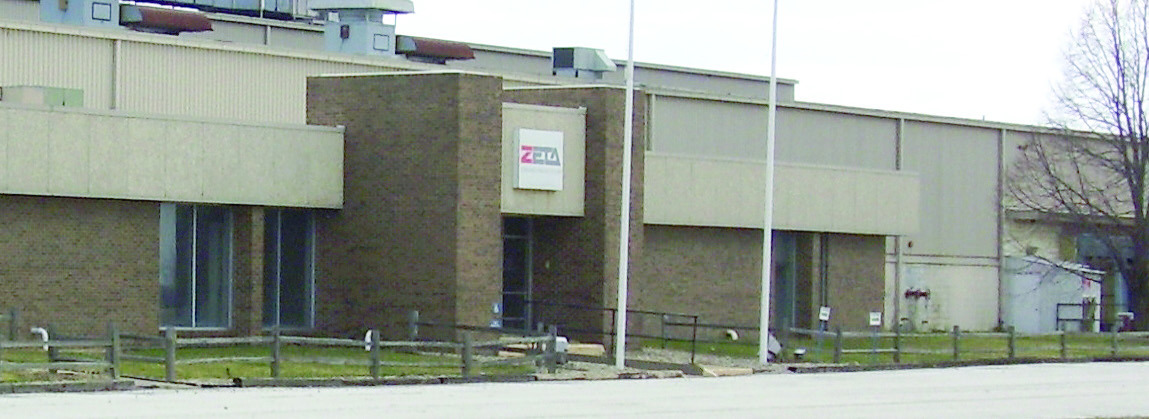
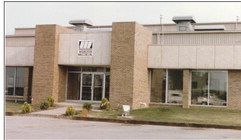
The company on University Drive that once employed anywhere from 150-200 people in Macomb, producing plastic bags, including trash bags, for the masses, now serves as a general warehouse within Macomb's Industrial Park.
Webster Manufacturing – aka Webster Industries and Webster Plastics – opened its doors at 1805 E. University Dr. in 1980. The Macombbased factory primarily manufactured plastic products, specifically focusing on recycled plastic trash bags, grocery bags, kitchen bags, and food bags. As one of the nation's largest plastic recyclers at the time, the company used recycled polyethylene film feedstock to produce mass-market institutional and consumer waste bags. They were well-known for producing certified ecofriendly product lines like 'Renew' and 'Good Sense' garbage bags, which were engineered to incorporate high percentages of recycled materials.
About 10 years after opening, the facility was taken over by Zeta Consumer Products Corporation.
Under Zeta's management, the plant primarily manufactured plastic goods, including food bags, trash bags, and Tucker Housewares. In April 2000, Zeta Consumer Products Corp. filed for bankruptcy and announced the permanent closure of all four of its U.S. manufacturing plants, including Macomb, putting over 200 individuals out of work in McDonough County alone. Plastic News reported in April 2000 following the announcement that Zeta's Acting President Alfred Teo blamed 'brutal pricing by mass retailers, resin price hikes, GE Capital's move to pull out financing and a union organizing drive that disrupted production.'
'The last straw that broke the camel's back was Tucker's inability to pass along higher resin costs to mass retailers such as Wal-Mart and Kmart,' he added. Tucker Housewares was the third-largest U.S. plastic housewares manufacturer that sold through mass retailers, behind Newell Rubbermaid Inc. and Sterilite Corp.
The People on the Line For former Webster employees Mike Matthews, Barb Arvin and Scott Hainline, the best part about the job at the Macomb factory were their co-workers. The most challenging aspect? The long hours and the extreme temperatures that employees endured in the plant.
Matthews worked at Webster's from the time it opened, around 1980, to 1996, following the transition to Zeta. When he left the plant, he was in the top 10 percent of those with seniority, and over the years, he worked in almost every department but maintenance, including serving as a machine operator, in quality assurance, as a forklift driver and in the recycling department. In his 16 years, Matthews witnessed a drastic increase in the work produced at the Macomb plant.
'When I started, there were three trash bag production lines, but we didn't have a lot of orders coming in so only two were going at a time,' he explained. 'But as time went on, we ended up having a lot of lines. When I left, we were making kitchen bags, trash bags, drop cloths, freezer bags, bowls, cups, plates and Ziploc baggies and they started a small line of plastic flatware.'
According to Matthews, the places to work at that time, besides the University, were NTN Bower, McGraw Edison and Webster's, as King Seeley had recently shuttered its doors. Matthews left Zeta a few years before the plant closed to take a job with better pay, better benefits and better hours at WIU. He stayed at Western for eight years before moving to Missouri, where he continues to live today working as a school bus monitor for a post-retirement gig. While the hours were long and the pay wasn't substantial at Webster's, employees did have the chance to add a lot more to their paycheck with overtime.
'Because the turnover rate was so high, we had unlimited overtime. If you wanted to work seven days a week, 12 hours a day, you could,' he added.
It was also at Webster's that Matthews met some of his best friends, including one of his very best friends that he remains in touch with today. While the co-workers made it a good place to work, it wasn't without its challenges. Besides the turnover rate being very high, Matthews explained that the company wasn't 'employee oriented.'
'You were replaceable and they told us so. We were told if you don't like it, McDonald's is always hiring,' Matthews added. 'And take a day like today, for example. It's almost 100 degrees. We had no climate control. My late wife passed out due to the heat, and people were always having heat-related issues. In the wintertime, if you went anywhere near the warehouse, you had to keep your ink pen in an inside pocket because it was so cold there it wouldn't work.'
Arvin worked at Webster's for 15 years, first as a packer for about three years, followed by working as a shift material handler. She moved to the day shift in the warehouse loading and unloading trucks and picking orders. Arvin said everything was 'really good,' in spite of the 12-hour shifts, until the company was sold to Zeta.
'I can still remember my supervisor having to tell each of us who was going to stay with Zeta and who was going to lose their job. It was a terrible day,' she said. 'Before that, it was a good company. We had great health insurance and regular pay increases based on merit. So, if you worked your tail off, showed up on time, and did a good job with your team, you were rewarded.'
Arvin left the company two years before it officially closed to take an office job at Methode Electronics in Carthage as a production scheduler.
'I was very young when I started and the job taught me great work ethics. The last 10 years in the warehouse were the best. We were a small group- maybe 10 or 12 people,' Arvin said. 'Besides having great teamwork, we were friends. We took breaks together, ate lunch together, and did things outside of work together. Those were years I’ll never forget!'
Hainline didn't work at Webster's as long as Matthews or Arvin, but for him, it was one of the 'most fun' jobs he's ever had. He joined the team in February 1985 until he joined the Marines in September 1985. But his supervisor, Dick Wiggins, held a spot for him after his enlistment came to an end, so Hainline returned on Sept. 16, 1989, just a few days after the shooting. However, he had another opportunity become available so he left the factory for good a few weeks later. In spite of the length of time between his years of service, and the tragedy that took place, Hainline, who worked the packing line, said that working at Webster's was among one of his best jobs because of the people he worked with and that his supervisors were good to the employees.
'The people I worked with were some of the best people I've met, and working at Webster's was one of the best times of my whole life,' he added. 'The people were so nice. I've thought a lot about them over the years, and would love to see a reunion happen.'
While Hainline left the factory to take a job driving a grain truck in Blandinsville, he never forgot his time at Webster's.
'The staff were so awesome. It was a very personal job – you knew who worked beside you,' he added. 'My co-workers meant a lot to me. We took care of each other. The people made the job.'