In previous articles, we’ve focused on specific aspects of WW II Camp Ellis in Fulton County. But what lasting impact did the camp have on McDonough County? Camp Ellis operated as an Army camp for three years. Although its post-war uses continued to provide employment, the camp never again had the impact it did during the war.
150 Farm Families
Roughly 150 farm families were displaced when the government purchased or condemned 17,500 acres of farmland between Table Grove and Ipava. A few families moved to nearby farms, but many left the county to purchase farms in McDonough and surrounding counties.
It was a precarious time. The government didn’t make payments to the farmers immediately, yet many of them were trying to purchase new farms on credit after coming through the Great Depression. There is no doubt some farmers moved to McDonough County. My own grandparents and some of their siblings were among them.
Employment
When the jobs at Camp Ellis disappeared, local workers had to look elsewhere for employment. Jobs that had been previously left open because so many men were serving in the military were now needing to be filled. Macomb offered steady factory jobs within driving distance, as did Peoria.
McDonough County farms were also looking for workers. The closing of Camp Ellis affected the local economy by adding more people to the pool of available workers.
GI Bill and WIU
After World War II, returning soldiers could take advantage of the GI bill, which provided education, home loans, business loans and job assistance. For McDonough County, the education benefits were especially important.
The government paid tuition, books, and living expenses for veterans attending college, vocational schools, and approved training programs. Western Illinois State Teachers College, as WIU was known at the time, had reached its wartime low of just 545 students in 1945 – 1946 school year.
The institution changed its name to Western Illinois University in 1947, and enrollment more than doubled. There were 1,345 students enrolled for the 1947-1948 school year. It is impossible to know how many of those students had served at Camp Ellis and then chose to attend WIU, but the postwar increase clearly contributed to the growth in enrollment.
Some of those soldiers may have found housing in the married student housing section and had a certain sense of déjà vu.
Barracks from Camp Ellis were used as student housing at postwar WIU.
Police
Coincidentally, Camp Ellis also played a role in the early adoption of two-way radios in Macomb police cars. In April 1944, the Macomb City Council authorized the purchase of radios to help deal with problems for those stationed at Camp Ellis who came to Macomb on leave.
Prisoners of War
When Camp Ellis closed, its prisoners of war were transferred to other camps. Under the Geneva Convention, the United States was required to return the prisoners to their home countries, but a few former Camp Ellis POWs eventually returned to the United States.
Kurt Pechmann and his wife returned to Madison, Wisconsin where they established a memorial business. Before the war, Kurt had been a stone mason in Silesia.
Reinhold Pabel escaped from the Washington, Illinois satellite camp of Camp Ellis.
He remained in the United States until 1953, when the FBI discovered him. With the help of a United States Army acquaintance, Pabel eventually returned to the United States.
At least one former Camp Ellis POW returned to McDonough County to farm.
He farmed near Adair in the mid-1970s before moving his family in the late 1970s.
Relationships
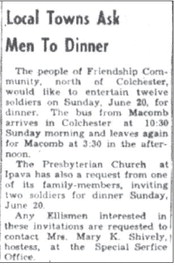
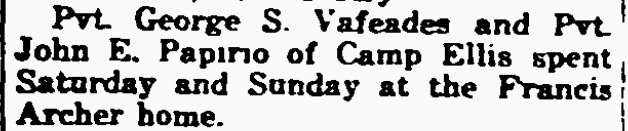
A look through the Camp Ellis News shows soldiers marrying local women. Many from McDonough County worked at Camp Ellis and no doubt met their future spouse there. Local families often hosted soldiers for Sunday dinners to help ease their homesickness.
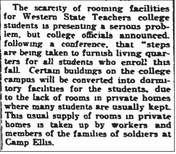
Rooms, apartments, and houses were rented to Camp Ellis officers and their families. General Maxwell, commander of Camp Ellis, rented the Harry Holmes house in Compton Park in June 1943.
These relationships changed people’s lives. My own great aunt and uncle rented rooms to soldiers during the war and remained in correspondence with them until their deaths.
A Lasting Footprint
The impact of Camp Ellis on McDonough County is difficult to quantify. But during a time when the country was deep in a world war, McDonough County did its part to support the wartime effort in many ways.
Camp Ellis may have disappeared, but it left a lasting footprint on McDonough County.
Rushville Times, July 21, 1943