Furniture styles before the 20th century are often named after the rulers or governments of the time. It follows that furniture styles, like their namesakes, are usually particular to the country or region. However, contemporary styles from different countries often share similarities.
Take the style of the Second French Empire, which lasted from 1852 to 1870, the reign of Napoleon III. It drew inspiration from many past styles from antiquity to the 18th century. Furniture was made of rich, dark wood like ebony or mahogany and adorned with inlaid patterns, often in exotic materials like lacquer or mother-of-pearl. Upholstery was lush; wood surfaces were shaped and carved.
All these characteristics -- recreation of historic styles, luxurious materials, ornate decorations, all facilitated by the Industrial Revolution -- could easily describe the Victorian furniture made in England and America about the same time. Still, Second Empire, or Napoleon III furniture, is its own visually distinct style. If anything, it is even more extravagant than Victorian furniture, which holds true for the furniture style in reproductions and revivals, too.
This table, which sold for $2,112 at John Moran Auctioneers, was made c. 2000 in the Napoleon III style. Covered in faux malachite (an opaque green stone often used in decorative arts) and heavy, intricate gilding, adorned with leafy garlands and figural paw feet, it is anything but subtle.
Q: I have a print that I bought as part of a lot. It is a picture of a woman from the shoulders up. She has long brown hair and wears a red headdress with gold coins and a light green dress. The picture is signed “A. Asti.” It is captioned “A Persian Beauty” and was printed in the Chicago Tribune. What can you tell me about the artist?
A: Your print is a copy of a painting by Angelo Asti, who was born in 1847. He is known for his bust portraits of women that appealed to late 19th and early 20th-century exoticism. His paintings were reproduced as lithograph prints and used for advertisements in the early 1900s. They appeared on calendars, packaging, and metal trays. Prints on paper were also given away as advertising premiums.
Asti prints on paper from about 1900 can sell for anywhere from $20 to $200, based on the rarity of the print and its condition. Check the captions on your print for any copyright dates or information. Asti prints have been reproduced, and recent prints have lower values. Vintage postcards with Asti prints generally sell for under $10. However, prints on other media, like porcelain plaques or metal advertising trays, sell for higher prices. Asti oil paintings can sell for over $1,000.
TIP: Do not wax any furniture that has a gilded, painted, lacquered, or flaking finish.
CURRENT PRICES
Advertising, display set, Kraft Foods, figural, circus theme, wagon, clown, tiger, horse, elephant, embossed, foil, Wonderflex Corp., c. 1970, one sheet, six pieces, $135.
Typewriter, Underwood, black enamel, carrying case, 12 1/2 x 12 x 6 inches, $240.
Celadon, jar, pierced lid, hardstone finial, seated figure, globular, tapered base, Chinese, 13 inches, $900.
For more collecting news, tips and resources, visit www.Kovels.com.
(c) 2026 King Features Synd., Inc.
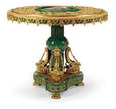
This contemporary table was made in the Napolean III style, known for extravagent decorations.