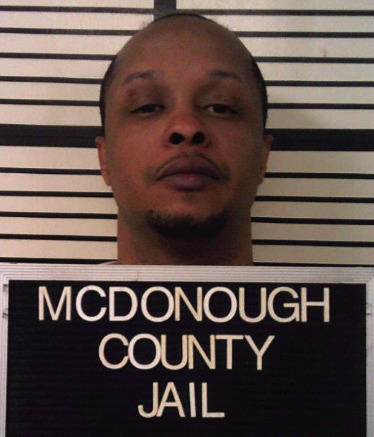
The Macomb man accused of shooting two Macomb police officers in September 2024 was found guilty Aug. 27 after the jury deliberated for approximately two hours following closing arguments Thursday afternoon.
Shaking Mathis, 40, was found guilty Thursday afternoon of two counts of aggravated battery to a police officer, four counts of aggravated discharge of a firearm and two counts of possession of a firearm by a felon following the three-day trial in McDonough County Circuit Court. Sentencing has been set for Nov. 5. Judge Nigel Graham ordered Mathis to remain detained in the McDonough County Jail until his sentencing date.
McDonough County Assistant State's Attorney Susan Maxwell, who represented the prosecution, argued during closing arguments Thursday afternoon that it was clearly established Shaking Mathis was the only person inside 309 N. Normal St. when police arrived to execute a search warrant. Maxwell also pointed out that he (Mathis) was responsible for shooting two officers.
The shooting injured former Macomb Police Department Det. Nick Severs (now with the Illinois State Police) and MPD Sgt. J.P. McLaughlin when police were attempting to serve a search warrant in connection with a sexual assault that allegedly took place earlier in the day at the address. Mathis was arrested in February 2026 on two counts of sexual assault by force stemming from Sept. 4, 2024. He has also pleaded not guilty to these charges.
A pre-trial hearing is set for Sept. 15 on those charges.
The State's Case
'Officers repeatedly identified themselves and announced the search warrant before entering the residence, giving Shaking Mathis ample opportunity to know they were police.
Shaking Mathis fired three shots, striking Det. Nick Severs in the hip and Sgt. John McLaughlin in the thigh,' Maxwell stated. 'In the standoff that followed, Mathis fired five additional shots after police, and ballistic evidence linked those shots to the same firearm used during the initial shooting.
'While the SCCY (pronounced Sky) firearm used to shoot the officers was never recovered, that did not create reasonable doubt,' she told the jury.
'There were two other firearms found hidden in ductwork in the basement, along with Mathis' mail and ammunition. The guns belonged to him and that, as a convicted felon, he was prohibited from possessing them. There is no evidence anyone else remained inside the residence. There is only the defendant, and he is guilty of each and every charge against him.'
Following the verdict, Maxwell said it was clear the jury listened to all of the evidence presented over the three days, and arrived at the correct verdict.
'The verdict is consistent with every piece of evidence that was presented,' she added. 'The circumstantial evidence was overwhelming as to the defendant's guilt.'
Officers Express Thanks
Severs and McLaughlin both expressed their appreciation to Maxwell and the State's Attorney's Office, as well as the jury's attention to the details presented.
'We appreciate the community's, and our family's, support, and all of the work that was done leading up to the trial,' Severs shared.
McLaughlin added that they had hoped for this verdict, and he was 'relieved.'
The Defense's Case Mathis' attorney, Michael Jarard of Chicago, told The Community News Brief following the verdict that he was surprised by the jury's decision.
'I do not believe the state met its burden. I understand the community was concerned, as they should be, but I do not think Mr.
Mathis committed the crime he was accused of,' Jarard added. 'While I don't necessarily agree with the verdict, I respect the decision of the jury.'
During his closing arguments, Jarard, argued the case came down to one fundamental issue: whether the state proved beyond a reasonable doubt that Mathis was the person who shot the officers and possessed the firearms. The defense repeatedly emphasized the lack of direct evidence identifying Mathis as the shooter, noting that none of the approximately 18 witnesses testified they saw Mathis fire a gun, hold the firearm used in the shooting or shoot either officer Sept.
4, 2024. The defense also challenged the credibility and reliability of several officers' testimony, arguing that statements made in court were sometimes inconsistent with reports, photographs or video. Jarard highlighted the absence of fingerprint, DNA and gunshot- residue evidence tying Mathis to the recovered firearms. A central defense theory was that another person—or people—could have been inside the residence, particularly in the attic, which defense counsel argued police never properly searched during the standoff. The Trial
After the jury broke for lunch Thursday morning, Jarard made the motion to dismiss the case due to lack of evidence. Judge Graham denied the motion, stating the evidence presented was sufficient to continue with the case.
During the three days of testimony, jurors heard from several Macomb and Illinois State Police officers and experts who were on the scene either or both days, and who also searched the home and collected evidence following Mathis' Sept. 5 arrest. ISP forensic scientist Jason List testified Thursday morning that the 9mm bullet retrieved Oct. 8 from McLaughlin's leg came from a SCCY Industries firearm. List explained his method of determining the type of firearm, and noted that it could not have been fired from another gun.
Special Agent James Whelan and Special Agent Gregory Huwe, both who are with the ISP Division of Criminal Investigations, both testified that neither of the two guns found in ductwork in the basement Sept. 5 was a SCCY firearm.
Whelan and Huwe returned to the residence Jan. 3, 2025 to search for the other firearm and came up empty- handed. Jarard also made the case that two individuals – later identified as Marcus Williams and Paul Dodd – were seen running nearby following the gunshots.
MPD Officer Korri Cameron, who was on the scene that day, stated that she saw the two individuals come out of a garage from a home two doors down, and added that these two individuals were known to frequent the neighboring home.
'As I told you on day one, the lack of evidence is evidence,' Gerard told the jury in his closing remarks. 'Evidence might establish that officers were shot, but did not establish beyond a reasonable doubt that Mathis was the person who shot them. Use your eyes. Use your ears. That's evidence.
Evidence is what the officers say. And you heard 18 witnesses all unanimously say or most importantly not say, 'Mr. Mathis shot anyone. We saw Mr. Mathis.' The standard, as you're going to hear in the jury instruction is the burden of proof is beyond a reasonable doubt. It doesn't matter what's said so much all the time, but we're here in this court of law, this justice system is about what can be proved.'
Severs, who was the first to testify when the trial started Tuesday morning.
At the time of the shooting, Severs was a nine-year veteran of the Macomb Police Department, and was serving as a detective.
He and fellow Det. Jordan Hawes were attempting to serve the search warrant at Mathis' home. After knocking and not receiving an answer, a team composed of seven additional officers responded to assist with entering the residence.
'We were attempting to reach Mr. Mathis to do a field interview in an attempt to obtain evidence,' Severs told Maxwell. 'After receiving no answer and detecting no movement in the home, we asked for other officers to join us in the execution of the search warrant for the home.'
After repeatedly announcing their presence, police used tools to breach a back porch door, and upon entering the home, Severs testified he was immediately met with gunfire. The shooting, which was captured on body cameras outfitted on all of the officers, showed a chaotic scene, with officers immediately running from the area. Severs was struck in the hip, while McLaughlin was struck in the back of the leg. Both men were flown to OSF Hospital in Peoria for treatment of their injuries. Severs' testified that due to the location of the bullet, it remains intact in his upper hip. The bullet was removed from McLaughlin's leg nearly one month later.
'When I entered the home, I could see the silhouette of a Black male, who was short in stature, and I gave the command to show his hands and then I was struck by a bullet,' Severs said.
Severs and McLaughlin, along with the other officers, were able to make their way out of the home. The injured officers were transported first to McDonough District Hospital for treatment before they were transported by helicopter to OSF.
During the cross-examination, the defense attorney asked Severs if any part of the bullet had been retrieved from his body, asking the officer if he knew the caliber of the projectile that struck him in the hip and if he could see who shot him.
'It's fair to say I don't know who shot me, but I do believe the individual is here today,' Severs stated after Jarard's questioning about what the now-ISP trooper saw on Sept. 4. 'He was the only individual in the room at the time of the incident.'