
Editors Note: The Annual Camp Ellis Day event will be held Saturday, September 12 in Ipava. Each year, leading up to the event, the Community News Brief collaborates with local historian Julie Tierstrip, who shares stories from the historic WWII Camp located east of Adair, Table Grove, and Ipava. Fact: Camp Ellis was a WWII training camp and a prisoner-of-war camp on 18,000 acres. It was first constructed in September 1942 and officially opened on January 31, 1943. At its peak, it contained roughly 2,200 buildings, housing up to 44,000 troops, civilian workers, and thousands of other personnel.
While Camp Ellis was in operation, 125,000 service men were trained. and the camp held 5,000 German prisoners of war. The camp officially closed in 1945. Part of Camp Ellis was later refurbished to serve the Illinois National Guard (1946-1950) and then later for Air Force training in 1953. Beginning in the 1950s, the government started to sell the land, which was used for farming or strip-mining.
Camp Ellis tremendously impacted the area’s economy, as 100s of people from Fulton, McDonough and surrounding counties were employed at the camp and soldiers frequently visited local communities.
From September 1942 through November 1945, the U.S. Army’s Camp Ellis rapidly increased the population and employment in Fulton County, IL, and had a significant impact on McDonough County as well. The Army camp was a part of the 6th Service Command. It was established to prepare soldiers for assignment to Quartermaster, Corps of Engineers, Medical, Signal Corps, Prisoner of War, and Special Services Units.
The 1940 US Federal Census estimates unemployment in McDonough County at 9-10%. Like elsewhere in the nation, jobs had been difficult to find in the previous decade. The agricultural economy was beginning to improve as the country distanced itself from the Great Depression. Agriculture, manufacturing, and education were important employers in the county, but no one was quite prepared for the impact that building a military camp had on the workforce.
In September 1942, construction began on the camp between Table Grove and Ipava. Local newspapers and firsthand accounts estimate a workforce of 10,000 to build the camp at a cost of almost $25 million, including the cost of the land taken. Three major companies, including those from as far away as Des Moines and Chicago, brought employees to the area.
Harvey Bubb, Sr. worked as a Fiscal Officer for the Post Engineer’s office after leaving a principal job at Bader Grade School in May of 1943. Bubb became the head of over 500 civilian employees at the camp: “90 carpenters, 40 electricians, 30 plumbers, 40 truck drivers, 20 road and street employees, 20 water and sewage employees, 40 ice and cold storage employees, 90 firemen, 50 office workers, surveyors, one blacksmith and other odd job employees.” Several of these positions are listed in the Macomb City Directory for 1944.
Macomb, at this time, accounted for about 1/3 of McDonough County’s population. A quick look through the Macomb City Directory of 1944 shows that almost 120 citizens listed Camp Ellis as their employer. Bubb’s employment experience was more in jobs traditionally associated with men. Still, the Camp Ellis News quite frequently advertised for “Clerks, Clerk-typists, Clerk-Stenos,” with full Civil Service benefits and free courses in military correspondence and refresher courses in typing and shorthand. Cooks, house mothers, PS managers, accountants, nurses, telephone girls, and teachers were jobs filled by local women.
Men and women from McDonough County were filling important roles in the war effort at Camp Ellis, and the wages were highly competitive. Madeline Heaton Olsen was 20 years old and working at a grocery store in Table Grove for $1 a day when Camp Ellis was built. Someone from the camp stopped by the store and asked if she would be interested in managing the PX there. She accepted, and her pay rose from $1 per day to $200 per month while she managed seven employees. When her father saw her first paycheck, he said, “My God! I should quit farming and go to work there!” The combination of competitive wages, Civil Service benefits, and steady work at the Army camp gave Camp Ellis an advantage that other McDonough County employers may have struggled to match.
US Army Camp Ellis closed in late 1945 as the war drew to a close, but other versions of the camp survived well into the 1950s. The Illinois National Guard used the buildings for several years, and the U.S. Air Force held a survival camp on the grounds. Civilian employees didn’t complete the destruction of Camp Ellis until the early 1950s, when the government sold the buildings and they moved off the property. All that time, Highway 10 (now US 136) was busy with vehicles traveling daily from McDonough County to the camp for camp-related jobs.
It’s difficult to measure exactly how many employees at Camp Ellis lived in McDonough County. A search for payroll records hasn’t been fruitful to date, but in the 1970s and beyond, obituaries often stated that the deceased had been an employee of Camp Ellis. There is no doubt this unique Army camp in Fulton County had a major impact on employment and wages earned in McDonough County.
Next week: USOs as McDonough County rolled out the red carpet to welcome troops to the area.
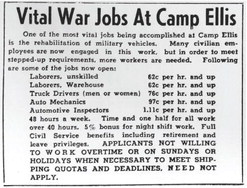
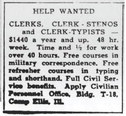
Above: VITAL WAR JOBS Camp Ellis News, Friday, February 23rd, 1945 Left: One of the Help Wanted ads published weekly in the Camp Ellis News.