WIU Leadership Showcase Opportunity & Progress
2026 University Assembly Kicks Off 2026-27 Academic Year
'We are moving forward with purpose and a clear vision for the future.' – Western Illinois University President Kristi Mindrup.
Highlighting a message of working together for the future of Western Illinois University and providing opportunity and growth for students and the region (and beyond), the president and members of her cabinet outlined the year ahead for the 126-year-old public higher education institution at Friday's University Assembly on the WIU campus in Macomb.
'The 2025-26 academic year marked a defining chapter in Western Illinois University's evolution. Across the nation, universities made significant adjustments as they navigated shifting student expectations, evolving workforce needs, and financial pressures along with rapid change. Our university community at every level of our organization and across all divisions has responded with purpose and embraced this evolution as an opportunity to strengthen and position WIU for continued success,' Mindrup told the crowd of 300-plus at Friday's assembly. 'Today, we celebrate our progress and impact while looking ahead to 2026-2027 with optimism, confidence and a shared commitment to building on positive momentum while we write the next great chapter for Western Illinois University.'
According to Mindrup, Western's vision emerged in the past year as a result of university-wide discussions, environmental scanning and examining student needs. What emerged was a message – and goal – of creating opportunities for students.
'Together, we are strengthening Western Illinois University's role as an opportunity university that expands access, cultivates belonging and transforms lives,' she explained. We provide an education, a degree, and a credential that is attainable. Together, we will serve as a catalyst for the west central Illinois workforce development and regional vitality through education, partnership and innovation.'
While Western's enrollment in recent years has shrunk, with an estimated 4,500 expected this fall, Mindrup stressed that growth for growth's sake is not a strategy, or a win, especially when it can sacrifice quality and sustainability.
'There is greater impact when we as a society, community or university strengthen our core, improve what we deliver and ensure that the pursuit of a number does not come at the expense of integrity or quality as we seek to provide new and expanded opportunities,' she added. 'This week, WIU reached an extraordinary milestone For the W campaign by surpassing $75 million in contributions from nearly 24,000 donors. That shows incredible support for our institution.'
With the changing landscape of public higher education, Mindrup told those present and watching online that the university is following a path to the future with intention and focus on the opportunities it delivers through excellent programs, experiences and services.
'Through our action and strategic planning, WIU is aligning resources toward quality, investing in quality and building on the strengths of our student-centered campuses,' she noted. 'While we focus on quality, we also are planning for sustainable, incremental and intentional initiatives that will strengthen enrollment.'
The priorities Mindrup outlined at last year's assembly continue, she pointed out. Strengthening enrollment, promoting a culture of self-authorship and thriving and amplifying the success of Western Illinois University remain key initiatives.
'This past year was significant in the number of long-term enrollment initiatives developed by our teams. This year, we will implement these initiatives and expand them. For example, throughout 2025-2026, strategic enrollment initiatives focused on expanding academic pathways, strengthening transfer partnerships, increasing online and flexible learning opportunities, supporting military-affiliated students and re-envisioning Quad Cities campus programs and services,' she stated. 'The positive impact is starting to yield, including an increase in first-year student persistence. This reinforced that we are on track with our focus on student success and retention as one of the most important university priorities. Every student who persists, graduates and enters the workforce prepared to lead strengthens both the university and the communities we serve.'
She also pointed out the exciting new opportunities that are taking place, including the opening of the Goldfarb Center for Performing Arts (see the Friday, Aug. 21 issue of The Community News Brief for an update on the center, which opened Monday for classes), and the new Emergency Operations Center, under the direction of the School of Law Enforcement and Justice Administration, for the university and region in Sallee Hall.
WIU also completed a comprehensive academic restructuring efforts in its recent history. Effective July 1, 2026, WIU transitioned from four colleges to two, the College of Humanities, Arts, Science, and Education, and the College of Business, Health, and Community Programs. According to Western's 13th president, this intentional redesign strengthens interdisciplinary collaboration, aligns academic resources with student and workforce needs and positions the University for long-term sustainability at its current enrollment levels and as a path for future growth. Provost and Vice President of Academic Affairs Mark Mossman pointed out Western is engaged in phase three of the Division of Academic Affairs' total rebuild.
'What we've figured out with the rebuild is that the two-college structure demonstrates that we are both sides of the coin (a liberal and fine arts and education institution and a pre-professional college), and this is thriving at Western Illinois University,' Mossman said. 'When our students enter WIU, they are placed in an academic environment that is based on breadth and success.'
For its mission of providing a quality, accessible education to first generation students, Western Illinois University has been designated as an Opportunity College and University by Carnegie Classification, which recognizes WIU as an institution that can serve as a model for studying how campuses can foster student success. Western is among 16 percent of all U.S. colleges and universities that are in the Student Access and Earnings Classification.
From a budget standpoint, Vice President of Budget and Finance Ketra Roselieb highlighted the institution's fiscal responsibility to ensure long-term viability and growth. Western continues to advocate with its counterparts across the state for equitable funding, with Roselieb noting the cause is gaining momentum at the state level. In addition, a continued investment in technology and an investment in areas that show an opportunity for growth will be at the forefront, as will the resources that support students.
'We are in a much better financial position,' she told the media following the assembly.
Mindrup added that Western is 'sustainable at this moment, and the university is positioning itself to reinvest in growth areas for the future.' Roselieb will present the All-Funds Budget for the coming fiscal year at September's Board of Trustees meeting.
The programming and efforts within the Division of Student Success have contributed to student persistence and retention, explained Vice President for Student Success Justin Schuch. Spring-to-fall retention has increased, as has fall-to-fall student persistence. The institution implemented several new initiatives last year that amplified student involvement, which Schuch explained has a direct correlation on student success and persistence.
Approximately 1,300 new students are enrolled at Western this fall, with around 1,000 moving into the residence halls over the weekend in preparation for the start of classes Aug. 24. Of those new students, 35 percent are freshmen, 28 percent are transfer students, nine percent are 'reentry' (students who once attended WIU and are returning – ranging in ages from 22-67) and 28 percent are graduate students. Transfer students come to Western from 27 states, with Illinois, Iowa and international leading the pack, while freshmen are from 21 states, again with Illinois and Iowa as the top states, followed by Missouri. Top Illinois feeder high schools are Macomb High in the top spot, followed by United Township (East Moline) and Rushville in second. Several are tied for third including West Prairie Sherrard, Lake Park and Morgan Park.
'We are embracing that Western is the number one opportunity school in Illinois and what this means for our students,' he said. 'Last year, we used RockyBot, a 24/7 text/chat, to reach our students, and we've rolled it out to prospective students to stay in touch. We've asked them their goals, what they're worried about and why they selected WIU. This is having a direct impact on our current and new students, and we are able to help them figure out the multitude of resources we have at WIU.'
Schuch also said they've asked students how connected they feel to Western right out of the gate.
'Connection truly matters,' he stressed. The division is also continuing its 'First Four' efforts for students – a series of programs, activities and resources for the first four days, the first four weeks and the first four months of the semester. These check-ins, opportunities to get involved and other resources continue to provide that connection and set students up for success, Schuch pointed out.
Mindrup concluded the 2026 assembly with the ongoing theme of opportunity and togetherness.
'I hope you leave here encouraged and inspired,' she said. 'And what WE (the first two letters of Western) are building together. Together, WE make WIU the number one opportunity in Illinois.'
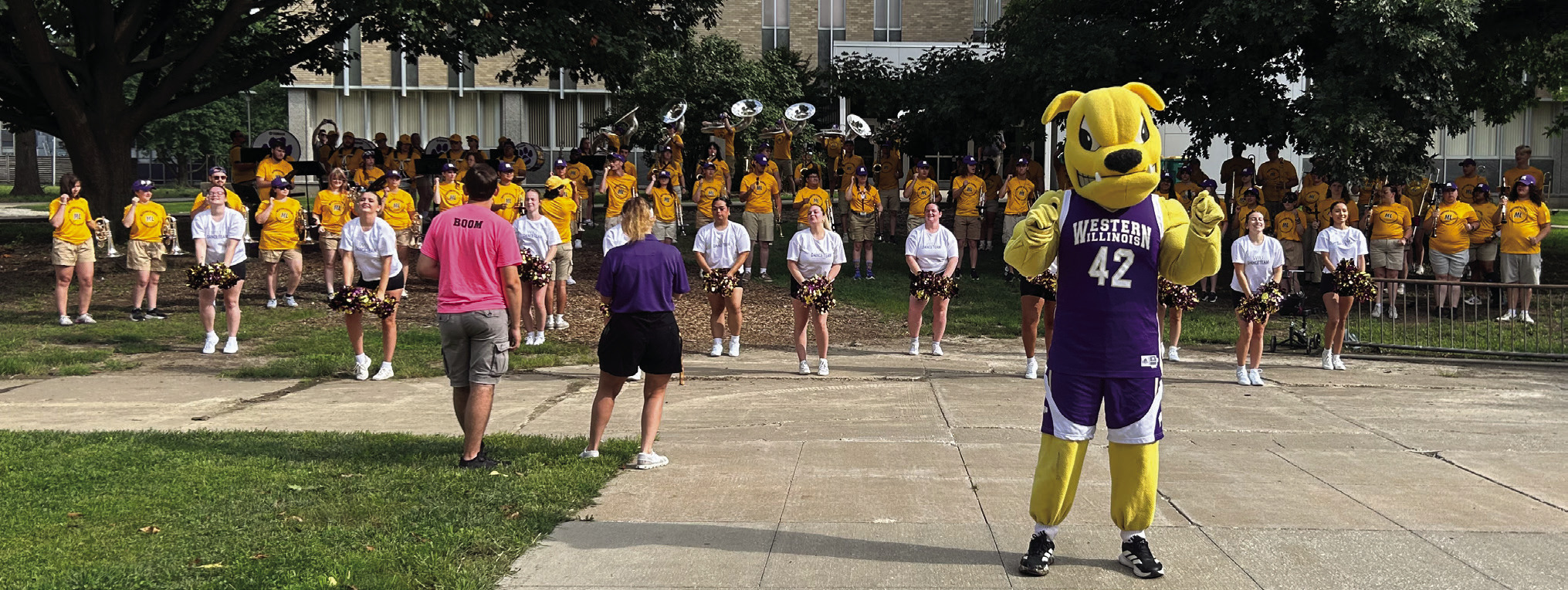
The Marching Leathernecks and Rocky greet University Assembly attendees Friday morning.