Those Who have Lived at 704 S. Lafayette
- Barbara Harrison The Boblak family spent nearly as much time on their front porch at 704 South Lafayette Street as they did inside of the house. The family owned the historic William Lipe house from the late 1970s until just recently, a 50-year span.
Kenny Boblak lives in Reno, NV, and his two siblings, James Jr. and Becky, also live out west. Recently, Kenny’s sister sent him an article that someone had sent to her from their hometown newspaper in Macomb, Illinois. The Community News Brief was doing a series on an old house at 704 S. Lafayette St. that had recently been sold and that was currently being renovated by a man from Wisconsin.
Kenny wasted no time contacting the writer of the articles (me), about the fact that their family lived in that house for over 50 years, it was the only childhood home he had ever lived in.
And that the Boblak “kids” were thrilled the house was being restored.
The house is being renovated by Wisconsin native Frank Smoot, who stumbled upon it while visiting Macomb to look at Lustron homes. Frank, who has an extensive background in museum start-ups and old house restorations, bought the property last spring and is working day and night to make the structure comfortably livable again.
James and Netty Boblak, Kenny’s parents, had purchased the property in the late 1970s as a home for their growing family, and even then it was a “fixer-upper.”
But that was not an obstacle, as James Boblak was a skilled carpenter and could work on the house himself. The large two-story house with three bedrooms, a large dining room, a living room, a large kitchen, and living space in the basement, was located in a wonderful, child-friendly neighborhood close to schools, and would turn out to be an ideal home for the Boblaks.
The home the Boblaks owned was not just any house, it was built in 1884 by William and Harriet Lipe.
In part two of this series, I provided a brief overview of the Lipe family and their significance in the early Macomb community. The house was at one time one of Macomb’s Grand Old Ladies, a stately and prominent home that was the sole structure on the 700 block of South Lafayette. Yes, the Lipes owned the entire block. William was Macomb’s first telegrapher, owned a grocery store on the west side of the Macomb square for some 20 years and was active as Macomb’s treasurer, in addition to being on the county board of supervisors and the fair board. In addition to all of those accomplishments, William and Harriet were the parents of three daughters, Louise, Addie and Ruth.
Frank Smoot, the current renovator, has in his possession the application to possibly get the house officially recognized as a historic home. This plaque program involves studying the house and its significance to Macomb, and evaluating whether it meets qualifications to be in the prestigious club. If it qualifies, a bronze plaque will be placed in front of the house.
To qualify, the house must meet one or more of these criteria: Age: A building must be 100 years old or older and must retain much of its integrity, namely its original architecture Architectural significance: A building that is at least 50 years old and a good example of a style which had an architectural impact on the community Historical significance: A building or site of historical significance to the community, or the home of a prominent person.
Hopefully, the William and Harriet Lipe house will hit these qualifications out of the ball park.
I was able to connect with Kenny Boblak via telephone, and he was forthcoming in sharing that he and his siblings loved their childhood home. When they lost their mother, Netty, to cancer in 2019, their father continued to live in the family home.
James Boblak; however, had in his 40s and 50s become afflicted with severe rheumatoid arthritis, which drastically affected his carpentry abilities. Going upstairs became nearly impossible and even the beloved front porch steps were difficult to maneuver.
James passed away in 2022, and the Boblak children were left to decide what the next step would be for their childhood home.
Several possibilities were discussed, from donating it to Macomb as a homeless shelter, to keeping it, to selling it, as all three children live far away.
They began to slowly clean the house out, which was a daunting task as their parents were collectors. A precious possession of their mother, her doll collection, was safely removed.
Unfortunately, at one point during their absences from Macomb, a squatter decided to move into the house and to even take some of their parent’s possessions and sell them. Neighbors contacted the Boblak children and told them that sometimes at night they would see a light on in the house. With help from the local sheriff, cameras were set up and the squatter was caught and removed.
The Boblaks decided the best choice was for them to sell the house. As much as they loved it and the memories, it was going to be nearly impossible to oversee it from afar. Reaching that decision was probably a painful relief.
Kenny remembers the South Lafayette neighborhood as being a child’s Utopia. There were kids in nearly every house up and down the street. Groups of South Lafayette kids would walk uptown to Macomb’s Square and to school together. Lemonade stands were common. Last names like Weston, Ward and yes, a young lady named Sandra Mosley come to Kenny’s mind, as she was their piano teacher and lived down the street. Becky Boblak is a well-known piano teacher and plays at concert-pianist caliber. (The Boblak piano remains at 704 South Lafayette today.) James Boblak Jr. owns a recording studio in Berkeley, CA, while Kenny holds a Ph.D. in chemistry.
The Boblak family spent hours upon hours on the front porch of their home.
Photos Kenny has shared show the family sitting on the front steps, swinging on the porch swing, their chocolate lab of 18 years sitting happily amongst them. Kenny says, without elaborating, that Ollie, the dog, still haunts 704 South Lafayette. Porches were historically vital because they served as the primary outdoor living room and social bridge between the private home and the public street.
Before modern cooling and entertainment, front porches provided essential climate relief, community connection , and a safe semi-public space for daily life.
Home construction of the 1970s and onward removed the porches as they were considered unnecessary and expensive to maintain. My aunt, Marjorie Trovillion, once told me that television was the culprit. When homes began to have television sets, the evening hours were spent huddled around the new invention. The front porches were forgotten. It is comforting to see newly constructed homes today oftentimes boast outside living spaces again, and in some cases even expansive wraparound porches.
Kenny stresses that his parents never had a lot of extra money to put into the house, as much as they’d like to have had. His dad was self-employed, and in later years his mom served as a nurse at local nursing homes. He says his mom dreamed of French doors in the house and of massive gardens in her yard. But as the years went by, and health started to fail, the house fell into disrepair. The front of the house eventually became almost invisible, covered by tall shrubs. To some, the house might even have been considered “too far gone.” Kenny emphasizes his parents hated this, that the house wasn’t up to their standards. But that life, as it sometimes unfortunately does, simply got in the way. One of the Boblak children’s favorite memories of their mother is of her sitting on her front porch with her lifelong friend Linda Robinson and other neighbors and friends having a cup of coffee.
While cleaning out the house, Kenny one night had a dream. His father was speaking to him, and he said “the combination to the safe is your birthday.”
Kenny and his siblings tried Kenny’s birthday numbers to no avail. They then tried combinations of all of their birthdays and special dates, and…the safe opened.
When his parent’s health began to fail, Kenny remembers community members stepping up and helping them. Names like Chris Francisco, Dick Marcott, MCPT Public Transportation and many others. The Boblak kids are eternally grateful for that.
The house, perhaps by luck and fate, has now fallen into the hands of another skilled carpenter. Frank has been amazed that the house he bought has historical significance to the City of Macomb. It has perhaps altered some of his renovation plans, such as now he wants to paint the house white with dark red trim, as it was possibly pictured in an original 1884 photograph. He originally thought he would paint the house light yellow with white trim.
Smoot has been in contact with Kenny Boblak and Boblak has shared photos for the Community News Brief.
We seem to sometimes forget. We forget that the time period we grew up in was different. It was a golden era of bicycles, lemonade stands, catching lightning bugs in jars with holes in the lid, and yes, a time of big solid wraparound porches where kids shot marbles, traded baseball cards and played guitars.
Kenny sends out a big thank you to Smoot and also Macomb High School band teacher David Wetmore, who Boblak said was a huge influence in his and his siblings musical lives. Kenny hopes to return to Macomb, perhaps in the fall, to meet Frank Smoot and to see the progress he has made with the house. And Kenny jokes, or maybe not, that when Frank is done perhaps he will buy it back. And live in his childhood home with the big wraparound porch again. Stranger things have happened.
Credits for this article: Allen Nemec and Marla Vizdal McDonough County Genealogical Society Sue Scott - Western Illinois Museum WIU Archives The Macomb Journal Jimmy, Becky and Kenny Boblak
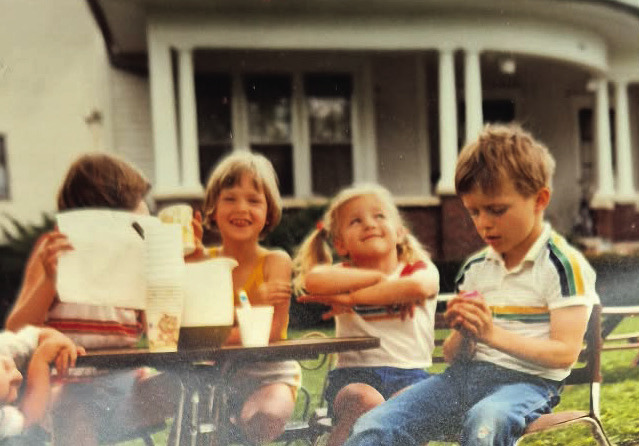
Left photo: On the porch swing Mom (Nettie) Boblak and Becky Boblak Above: Lemonade Stands were a common sight at the Boblak house. Jimmy Boblak (r) and Becky Boblak
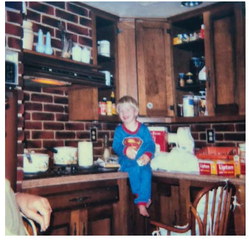
Superman - Kenny Boblak in the home’s kitchen