The Rotary of Macomb meets Tuesdays at noon at the First Presbyterian Church.
August 11, 2026 President Nick Knowles called the Rotary Club’s 6th meeting to order with the ringing of the Rotary Bell at the First Presbyterian Church in Macomb. First, Larry Adams delivered the invocation, and Max Pierson led the Pledge of Allegiance.
Abbey Thorman reported attendance of 31 members in person and one member via Zoom, representing 59% of the club’s membership. There was one guest, our speaker, Julie Terstriep.
The Happy Money portion of the meeting followed during which eight Rotarians shared special events from the previous week. During the 50/50 drawing, John Corson held the winning ticket and had the opportunity to claim the $168 prize by drawing the 9 of Hearts from the remaining 30 cards. However, John drew the 5 of Spades and did not win the prize this week.
President Nick had a list of Rotarians to read who had or will have birthdays or anniversaries in August.
Those who were having birthdays had “Happy Birthday” sung to them.
Nick then wanted to have a surprise presented to two Rotarians that highlighted their giving to the Rotary Foundation. Kim McKee was presented her Paul Harris Fellow +2 pin and Garry Johnson received his Paul Harris Fellow + 5 pin which signifies their generosity in giving to Rotary.
President Nick then called upon John Corson to introduce the guest speaker, Julie Terstriep, who was to present on the history of Camp Ellis.
John noted that Julie describes herself as a public historian and shares her research with area audiences through programs about the historic camp near Macomb. She is the daughter of Dean and Sharon Chenoweth and is married to Steve Terstriep.
They reside on a farm near Industry, Illinois.
Julie explained that the program focused on the rise and fall of Camp Ellis, located in Fulton County. She noted that she is continually surprised by how little is known about the large military installation that once operated in west-central Illinois.
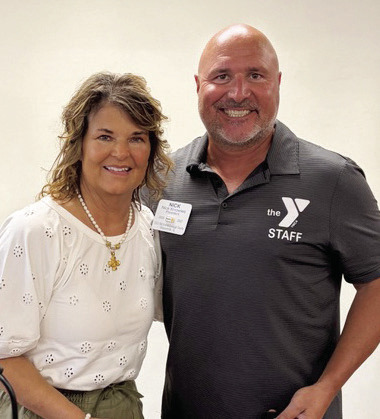
Kim McKee receiving her Paul Harris Fellow +2 pin
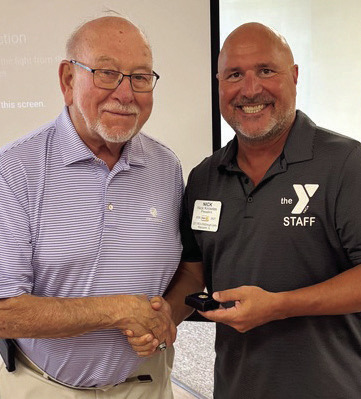
Garry Johnson receiving his Paul Harris Fellow +5 pin
The land for the military camp was acquired through eminent domain and totaled 75,000 acres. This acquisition displaced 140 families from their homes and farms. Julie displayed a copy of the hand-delivered letter her grandparents, Elzie and Vera Chenoweth, received from the federal government in February 1943, notifying them that they had 30 days to vacate their farm. They were permitted to take any or all of their belongings, but they had only that brief period to complete the move.
The site for Camp Ellis was selected because its terrain closely resembled conditions found in Europe, which made it suitable for training in construction and military movements. In addition, the location required access to a rail line, proximity to a substantial water supply, and a central location within a county.
Construction of Camp Ellis began in September 1942 and was completed in April 1943. The camp included 2,200 structures, including barracks, a hospital, a prisoner-of-war camp, laboratories, and many other buildings. Approximately 10,000 men were involved in the construction. The Army hospital at Camp Ellis was the largest in the world at the time. Overall, Camp Ellis was the largest military camp in Illinois, and six smaller satellite camps were also constructed throughout the state.
Julie highlighted July 4, 1943, as a significant date in the camp’s history, when Camp Ellis was formally dedicated to the public. An estimated 250,000 people attended the dedication, resulting in a 20-mile backup of vehicles attempting to reach the camp. Because the day was extremely hot, both attendees and vehicles became overheated. The government distributed sack lunches, more than 210,000 bottles of soda, and over 7,000 pounds of ice cream to those who were able to reach the parade and tour the camp.
Julie also discussed the camp’s varied training programs, which included medical, engineering, and morale-building activities. Morale events featured appearances by national celebrities such as Bob Hope, Jack Benny, Joe Louis, and Sugar Ray Robinson. Although Camp Ellis operated in the area for only four years, it represented a major undertaking and left a substantial historical legacy.
Club members thanked Julie for her engaging program and for sharing stories and historical information that many attendees had not previously encountered.
The meeting concluded with the recitation of the “Four-Way Test” and the sounding of the Rotary Bell, encouraging all members to make Rotary part of their lives and to “Unite for Good.”