History of Macomb, Industry & Littleton Railway
Another Piece of McDonough County’s Past
Who amongst us can say we built our own railroad?
Many who live along the St. Francis Blacktop outside of Macomb probably do not realize that the well-traveled backroad used to be the general vicinity of a railroad. It was known as the Macomb and Western Illinois Railway at first, and was chartered Oct. 26, 1901. The railway was built along Johnson Street in Macomb and traveled to nearby Industry and Littleton, an area that was considered underserved.
The railway was owned by local icon C.V. Chandler and opened for service Jan.
1, 1904. It ran for about 25 years, under two different names and owners. Before delving into the reasoning for wanting his own railroad, one must first understand that C.V. Chandler was singlehandedly the man who did the most to develop Macomb in the latter 19th century.
Charles Vilasco Chandler was born in the pioneer village of Macomb on Jan. 25, 1843. His father, Charles Chandler, was a land dealer and banker. C.V. attended private schools in Danbury, Connecticut and Lake Forest, Illinois.
Young Charles then served as lieutenant and adjutant in the 78th Infantry during the Civil War. After his military service, Chandler began a business career that is unparalleled in Macomb history. He was a great investor in Macomb’s downtown buildings buying eight structures on the square - not to mention the Opera House. The Opera House was built in 1872 on the site of his former home (the Macomb Journal building).
Years later, in 1889, he built a second Chandler Block across from the opera house, and ten years afterward he built the Chandler Hotel at the corner of Lafayette and Calhoun Streets.
In 1909, that building was purchased by J.M. Pace and many of us recall it being called the Pace Hotel.
The upper level of his 1872 block contained a magnificent opera house that seated 800 people. Oil lamps lit its main floor gallery, and were later replaced with gas lights. The stage featured painted scenes that could be lowered. Throughout the nineteenth century, the opera house symbolized Macomb’s emphasis on culture.
When his father Charles died in 1878, C.V. became president of First National Bank. He was later president of the Bank of Bardolph and the People’s Bank of Colchester. He founded Macomb’s pottery, was President of the Macomb Wagon Company and numerous other businesses. C.V. served as city treasurer and alderman, belonged to various civic groups, supported the GAR (Grand Army of the Republic) activities and perhaps his most memorable act was the giving of Chandler Park to the City of Macomb. So it comes as no surprise that in 1901, C.V.
Chandler decided to build his own railroad.
The 1850s saw railroads come to Macomb. The Northern Cross extended from Galesburg to Quincy, and eventually merged with the Chicago, Burlington and Quincy Railroad. It was completed by the end of October 1855, entertaining the Macomb residents who saw their first locomotive.
Rather than spending days on the road by horse and wagon, Macomb residents could now travel to Quincy in five or six hours. By 1856, Macomb people could travel all the way from Quincy to Chicago, a distance of 268 miles.
With the coming of the railroads to much of Illinois in the late 1850s, the frontier period was over. Many new towns had surfaced along the tracks, including Prairie City (1854), Bushnell (1854), Bardolph (1854), Tennessee (1854), and Colchester (1855). McDonough County became a hub of growing farm communities with its railroad connections.
Farmers could ship livestock to distant markets, a major convenience.
C. V. Chandler intended the Macomb and Western Illinois Railway (its first name) to serve as a local railroad to provide freight and passenger service to and from locations between Macomb and Littleton, and eventually to Beardstown. It would give farmers a way to transport grain and livestock to Macomb, with the hope of Macomb eventually connecting with a national railway network.
The railroad was planned as an interurban electric mode of transportation, but lacking the funding for the infrastructure it became a train pulled by a gas-electric locomotive.
From the start the small railroad had problems. Many thought C.V.
Chandler was building too massive of a business empire. C.V.’s partner sold his interest in the railroad to C.V. within two years.
One year into the service the railroad’s engine house burned down, destroying its gas-electric locomotive.
The local Illinois bituminous coal hauled from mines near Littleton had a sulfur content that made it unmarketable for most domestic and industrial use.
The track was light and the roadbed was marginal at best, causing common derailments. Property owners along Johnson Street in Macomb filed a series of lawsuits to evict the railroad from the city streets, and when some of the plaintiffs were successful investors shied away.
In 1910 the Bank of Macomb, owned by C.V.
Chandler, went bankrupt and Chandler later left town to live with his son in Indianapolis. As part of the bankruptcy the M & WI ( Macomb and Western Illinois) was sold to the Chicago House Wrecking Company which planned to abandon the railroad and sell it for scrap.
In 1913-14 the railroad was bought back by a group of local farmers and merchants from the local area and reorganized as the Macomb, Industry and Littleton Railway (MI&L).
It started on the north end where Johnson Street in Macomb crossed the CB&Q (Chicago, Burlington and Quincy). There was an interchange with the Burlington train at that location, from which the tracks proceeded to run down the center of Johnson Street to the edge of Macomb.
Just south of St. Francis Hospital, the railroad crossed onto a private rightof- way running along the west side of Johnson Street, which was later known as the St. Francis Blacktop.
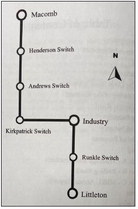
South of Beaumont Road the line curved and headed straight east before entering Industry from the northwest on a winding path. South of Industry the railroad headed more-or-less straight south until Carter’s Creek Crossing. It then curved gently to the west before heading straight down the east side of Main Street in Littleton.
In 1904, a lawsuit brought against the railroad forced it to tear up a block and a half of tracks north of Jackson Street in Macomb.
The MI&L no longer had a link to the CB&Q. A belt line was constructed to allow the interchange of equipment on the west side of Macomb and this line split off the main line just south of St. Francis Hospital. Here a wye, an engine house and a small yard was built. In 1908 all tracks on Johnson were torn up following another lawsuit, and thereafter trains could only access downtown Macomb with a special trackage rights agreement with Burlington.
There were several sidings along the tracks between Macomb and Littleton. They were located at Henderson, Andrews, Four Mile, Industry (two sidings), Runkle and Littleton. On the south side of Littleton was a wye with an engine house.
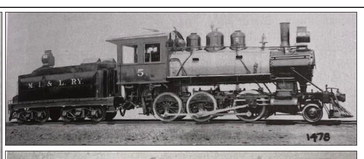
The railroad owned four passenger cars and about eight freight cars during its life, in addition to six locomotives. The original depot at Macomb was located at the corner of Jackson and Johnson Streets, and was actually the front room of a blacksmith shop.
It was probably abandoned when the tracks were torn up in 1908. Thereafter the Burlington Depot was used.
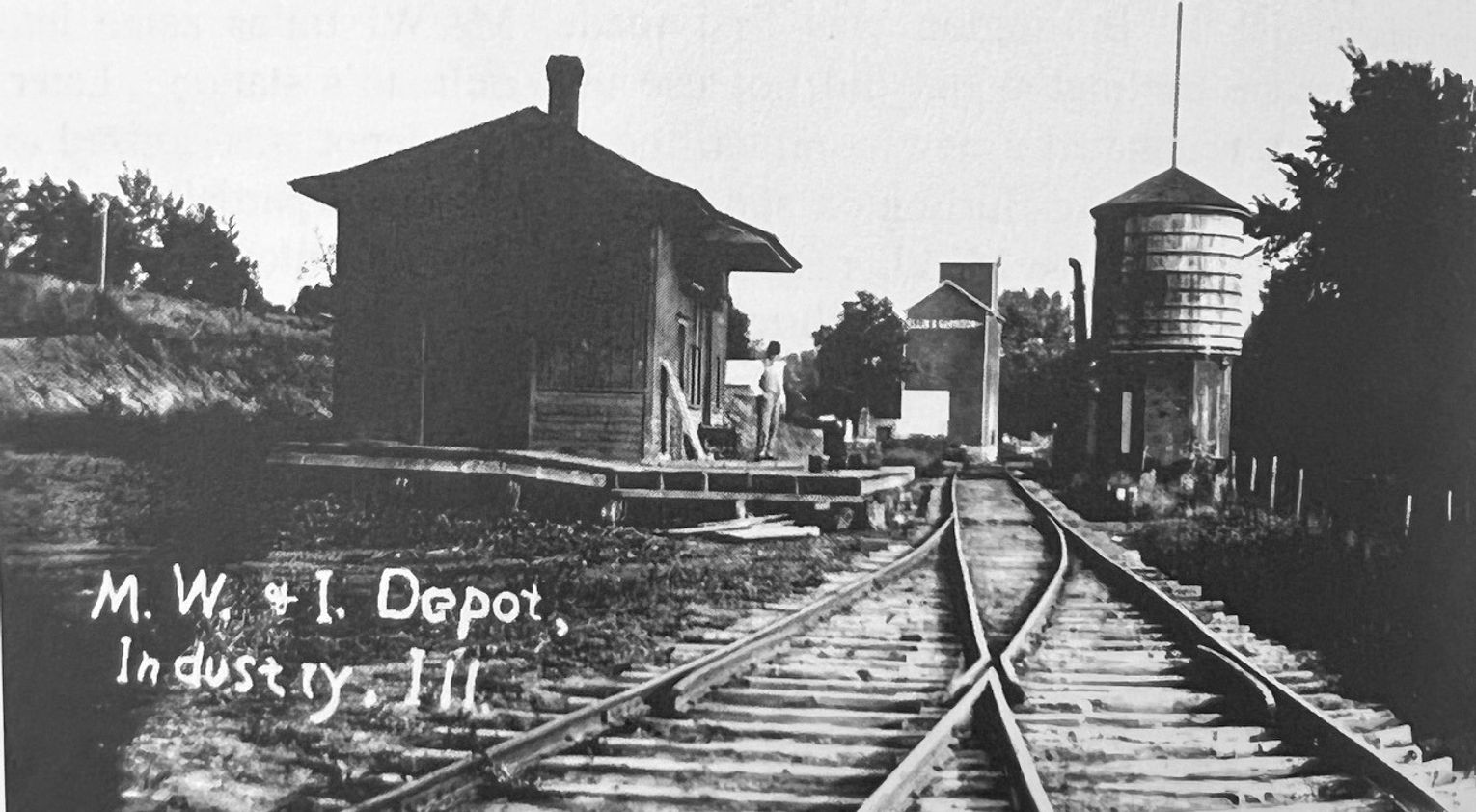
The Industry Depot was a small frame structure built in 1904. Industry had a water tower, grain elevator, tool shed and stock yard for the railroad. Littleton’s first depot was a “Pagoda” style frame structure. In 1914, it was replaced by a concrete block depot located on the south side of Broadway. Littleton also had a stock yard, elevator, and a one-stall engine house. There was also a superstructure astride the wye that was used to load coal from the mines into coal cars.
During the MI&L years there were also waiting shelters at Andrews, Kirkpatrick and Runkle. The Kirkpatrick shelter was actually an old coach body, while the other shelters were made of tin.
While the MI&L lasted longer than its predecessor, increasing competition from the trucking industry and an aging infrastructure would lead to the demise of the little railroad. By 1930, the line would make its last run, and the next year the rightaway was torn up. Portions of the original roadbed, right away and bridge approaches can still be found parallel to (on the west side) South Johnson Road, also known as the St.
Francis Blacktop. The grade embankment and roadbed just southwest of the old St.
Francis Hospital property is still in place, This is where the route turned northwest for its eventual interchange with the Burlington CB&Q.
Another embankment on either side of Grindstone Creek on the northwest side of Industry is also still in existence. A large concrete culvert over Sugar Creek on the north side of Littleton is still there, and the embankment at that location is used for an access road. The Littleton Depot was intact until 1981 when it was destroyed by a tornado.
Over the years, railroad buffs have kept the memory of Macomb’s little trains alive. In 2006 Western Illinois University published the book with 2005 graduate Frank Hicks, “The Little Road - The Story of the Macomb, Industry & Littleton Railway.” Hick’s goal in writing about the MI&L was to share his research notes on his passion for railroads with a wider audience. But it soon became apparent that notes were not enough, that this subject merited an entire book. Hick credited the WIU Archives, Kathy Nichols, Bill Cook, Marla Vizdal, John Hallwas and countless others for assistance in getting the book published.
The forward of Hick’s book is beautifully written and states the following: “Macomb, Illinois was very different at the dawn of the 20th century than it is now. Like all of the cities in McDonough County it was a farm town, just another county seat along the line of the Chicago Burlington & Quincy Railroad. But early in the new century the city began to change. Ultimately the most significant change would be the establishment of the Western Illinois State Normal School. But there was another change at the dawn of the century that signaled the advancement of Macomb - it got its own railroad.
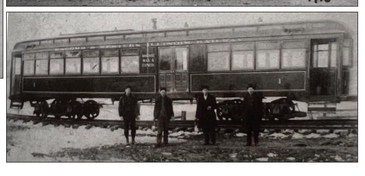
Combine 1 was brand new when this picture was taken in December 1903. Posing in front of it, left to right, are Roy Sullivan, 'Happy Hooligan' Roy Ransom, James Ira Hodges and Clarence Vail.
WIU Special Collections The Macomb Industry & Littleton Railway, or MI&L, ran south out of Macomb twenty miles, serving the communities of Industry and Littleton and the farmers in between. Its trains ran through McDonough and Schuyler Counties for more than a quarter of a century, carrying people and products affordably, and generally reliably, to what had only fifty years before been the frontier of the United States. Farmers shipped out livestock and grain destined for the Chicago markets; merchants shipped in goods to sell in their stores; customers shipped in products ordered from remote locations; and everyone rode the train. The MI&L was affectionately nicknamed the “Little Road” by the local newspapers.
Unlike the massive, impersonal Burlington system that ran through Macomb, the MI&L was owned and operated by locals. The train would stop at any house or corner along its route to pick someone up or let someone off. All that was required for front door delivery was a quick request of the engineer, and when the train arrived, the crew would obligingly unload the merchandise before continuing on their way. The conductors and engineers knew everyone who lived along the route, and everyone knew them. Personal service was a way of doing business.
The story of the MI&L is a twisting, tortured one, for from a purely financial perspective the railroad probably should never have been built. It was the product of the optimistic interurban boom of the early 20th century and the determination of its owners to benefit their communities even if it meant running a money losing operation. Though never very profitable, in the end it did benefit the people and towns it served and for decades was an acceptable and important part of life for thousands of people.”
The end of the MI&L came in 1929-30. Problems with money were not only a temporary local issue, it had become a trend in short line railroads across the country. As the nation’s network of paved roads spread and automobile ownership exploded, the need for short-haul railroads declined dramatically. In September 1929 the Great Lakes Coal and Coke Company, which supplied the coal to keep the Little Road steam engine running, filed suit against the MI&L for $528.70 in unpaid coal bills. The locomotive was on its last legs, most of the rolling stock was barely functional, and some bridges and portions of the right-of-way had been condemned by railroad inspectors.
On Feb. 5, 1930, Circuit Court Judge George C. Hillyer signed the order authorizing the railroad to petition the ICC for permission to abandon and scrap the railroad. The life of the railroad that had been built by C.V. Chandler, that had been saved by farmers and businessmen, that had been owned its entire operating life by the people of McDonough and Schuyler counties, was over.
Credits: “ The Little Road” by Frank G. Hicks “Macomb A Pictorial History” by John Hallwas WIU Archives & Special Collections