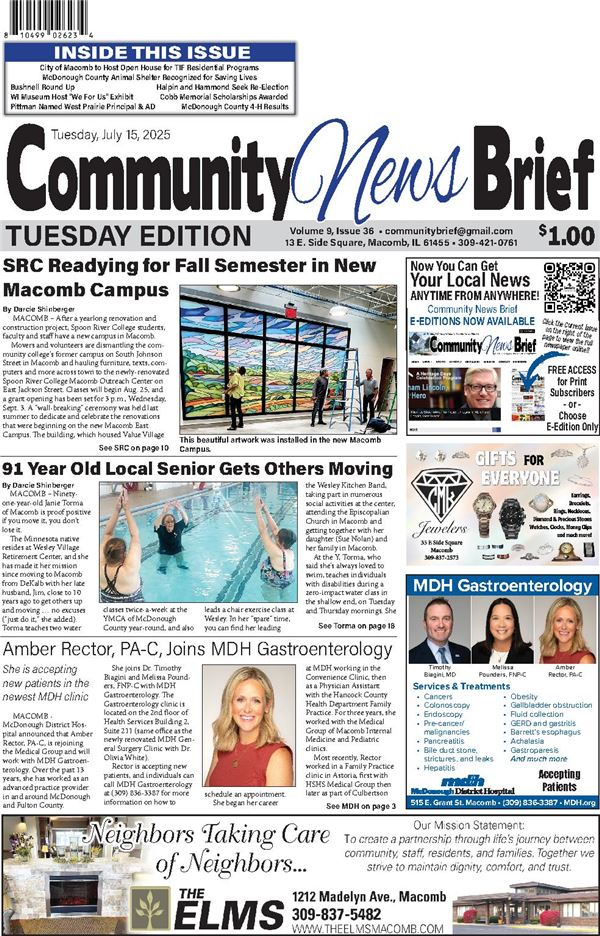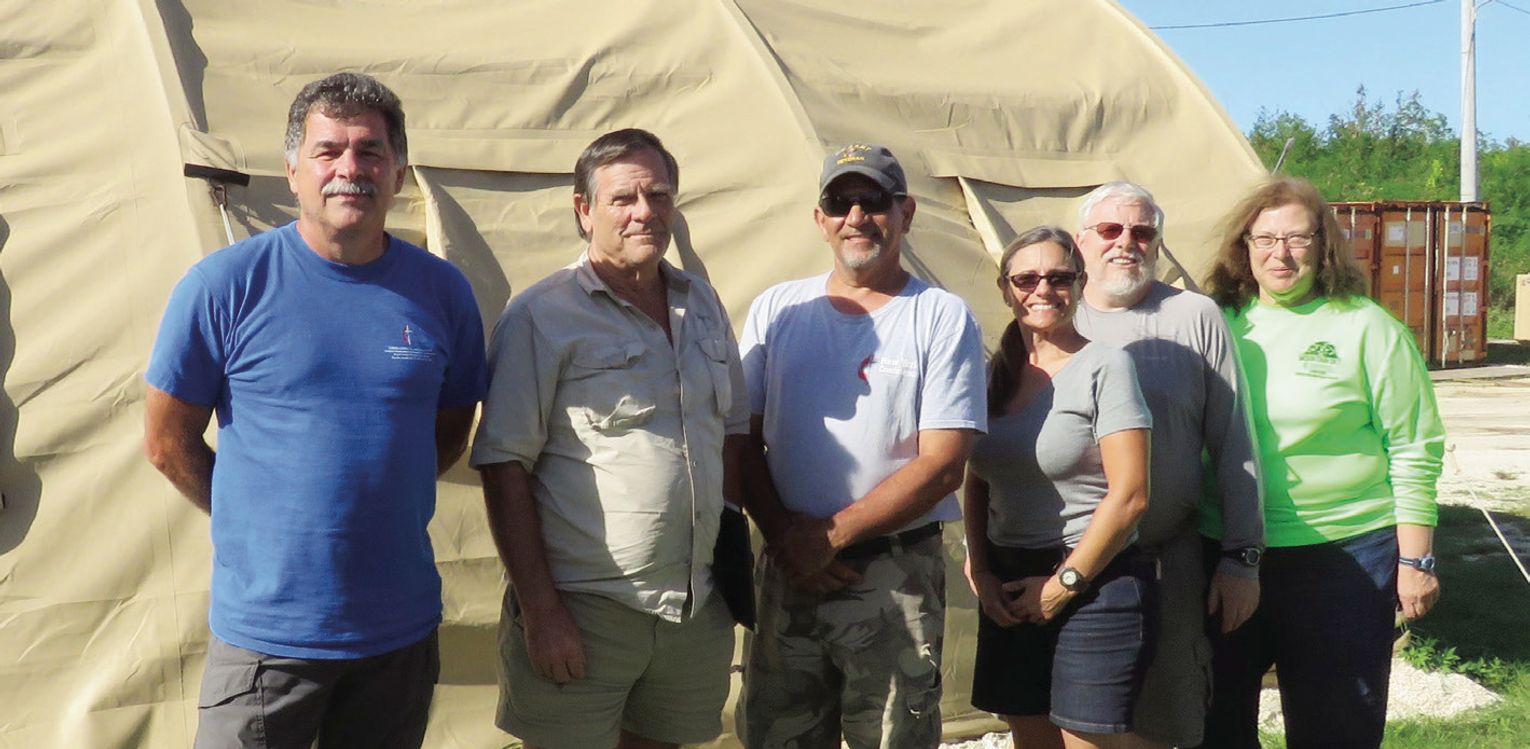
What motivates someone to travel to distant lands, work without pay, sleep on the floor, all in the name of faith? Byron Baughman would probably tell you it's a calling, and he should know. In the last 20 years, he's made at least 28 mission trips for his church, so many that he's lost count.
An Unexpected Offer
Baughman was born and raised in Abingdon, Illinois, and later served in the Air Force for four years. He moved to Macomb after leaving the service and eventually started a real estate agency with an office on East Jackson. He spent 18 years in that career, and then came an unexpected offer.
'The Macomb postmaster lived across the street,' said Baughman. 'He came over one day and asked if I'd fill in part time on a rural route. He said it would never become full-time because of postal service regulations.'
About a year later, the rules changed, and they needed a full-time carrier.
'I did that for a little more than 20 years. I drove all the rural routes and made about 350 stops a day,” he said. “I'd have to go in at 6 a.m., spend about three hours sorting mail, and then hit the road.'
Stateside Missions
Skilled in construction, Baughman began work on building a house south of Ball Fore. For most of his life, he has been an active member of Wesley United Methodist Church in Macomb, and after completing his dream home, he decided in 2005 to take time to put his faith into practice, using the skills he had acquired as a builder. For the next decade, he helped supervise the church's youth group annual mission trips to various places in the United States. Baughman squeezed in his trips during his vacation time. He had about five weeks available and spent almost all of that time doing missions, which were usually about 10 days each. One of his first trips was to South Dakota to work on a reservation.
'We did a lot of sorting clothes there,' he recalled. 'They would bring in a semi-trailer load of clothes and just dump them outside on the ground.'
He and other workers would then sort and fold items either to be distributed on the reservation or to other locations. While he was there, he used his construction skills to put a new lean-to-style roof on one of the resident's small homes, all by himself.
As an adult leader, he accompanied the church youth group on trips to Colorado and to southernmost Louisiana delta territory.
'One year, FEMA trucked in four 60 x12 trailers and they put them up on 12-foot poles because that area flooded every time hurricanes came. In fact, they even put brick homes up on poles, so we helped by building the stairs up to these homes,” he explained.
Overseas Missions
For the last decade, Baughman has expanded his mission service to countries outside the U.S. He's worked on projects in Chili, Guatemala (twice), Costa Rica (six times), Belize, Guam, Mariana Islands, Saipan and India, as well as St. Croix and St. Thomas. And then there's Cuba (more on that adventure later).
His first mission outside the U.S. was to Mexico to the small fishing village of Le Pesca on the Gulf of Mexico coast. The group helped build a church foundation, but because of constant heavy rains, water kept flooding the excavation. So they simply dumped concrete mix into the trenches to force out the water. Baughman offered no comment about the effectiveness of the maneuver.
Sometimes, he has gone on trips with fellow members from Wesley, but other times he's joined up with Methodist groups from throughout the country. He pointed out that some volunteers aren't prepared for the living conditions they'll encounter at overseas locations. They'll quit and leave early.
'They aren't able to adapt to roughing it, to where we had to stay, and to the meals and other stuff,' he said. 'One time I had to sleep on an air mattress on a cement floor, but the mattress would go flat every night.'
Surprisingly, for his overseas trips, Baughman and other volunteers haven't had to get vaccinations or special travel permits. Most of the mission trips assist the local churches or schools, as well as some community needs. In Guatemala, they built chicken coops high up off the ground so that no animals could get to the chickens. The people there didn't have any way of getting protein except through chickens and eggs, he explained.
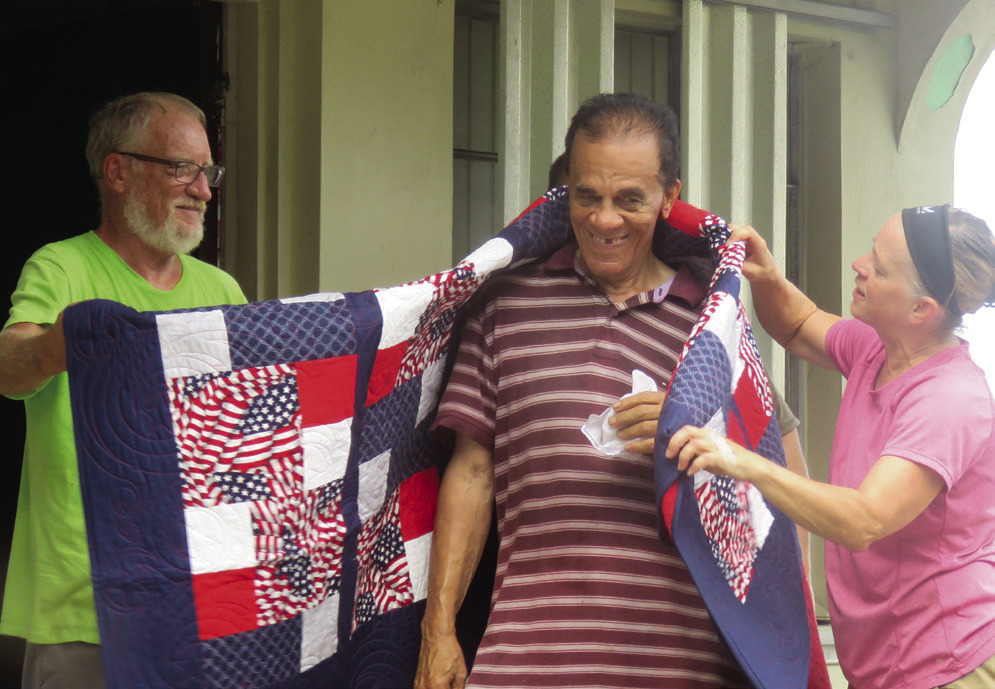
A St. Thomas homeowner (second from left) who was gifted a quilt by a mission crew.
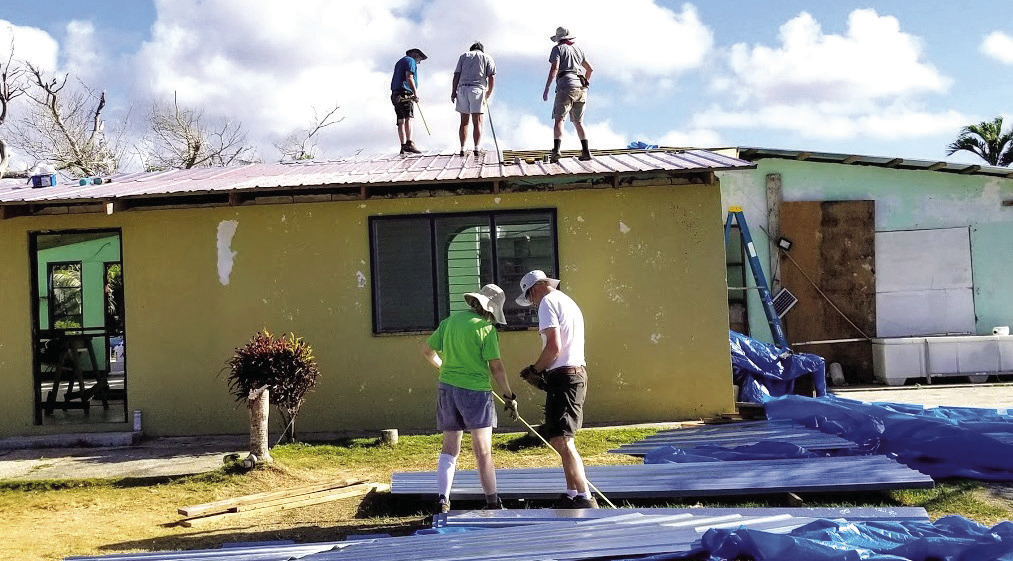
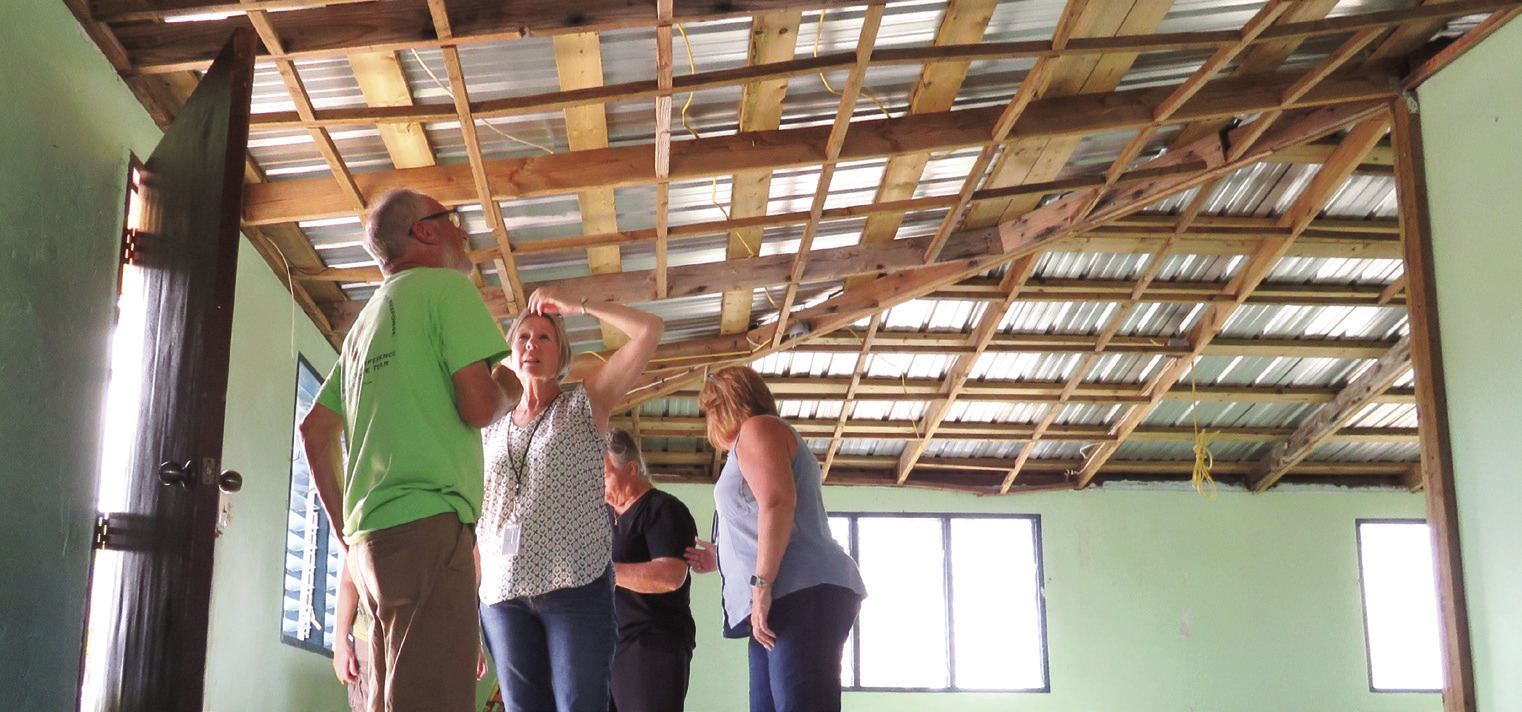
Roof repair in Saipan
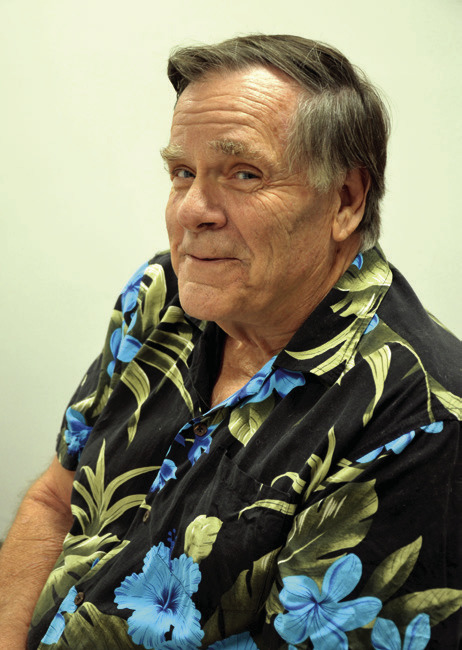
Byron Baughman
On Baughman's trip to Belize, his group was there for the Chinese New Year, which created an interesting cultural mix. He noted that the Chinese influence in Central America and other parts of the world is expanding.
'They're buying up more and more of the mom-and-pop businesses and other properties, and there's a growing Chinese population in this area. In Costa Rica, they sponsored the building of a huge football stadium and donated it. They also donated 1,000 police vehicles to the local police,” he added.
Baughman has taken six mission trips to Costa Rica and has a residence there that he visits regularly. On one of his trips, he helped build a retaining wall to support a school playground, which was built right next to a precipice.
'It was basically a straight drop-off at the edge of the property,' he said. 'We began the process of building a 14-foot retaining wall 90 feet long to protect the school. A bulldozer came in and moved dirt while we dug a foundation and then started constructing the wall.' He added that it took about a year for the job to be completed, with the help of other mission groups.
Expecting the Unexpected
Most of the time, mission-goers don't know what they'll be doing when they arrive in-country. As for tools, Baughman said he's taken a few of his own, but most of the time they use tools provided by the local workers or tools left over from other mission groups.
On a couple of recent trips, Baughman has taken his drone and documented the projects on which he and others have worked. He's recorded stunning footage of the local terrain and environment, as well as the living conditions. When asked about adjusting to different dietary choices in other countries, Baughman sort of shrugged off any concerns.
'We didn't have any problems [with food]. For our breakfasts and lunches, we had pretty much American fare,” he shared. “Sometimes in the evening, we'd go out to local restaurants to eat. I was celebrating my birthday in Cuba. I was served sea turtle, squid, and octopus. The sea turtle tasted like the best roast beef ever.'
Of course, a church-sponsored mission trip is about more than material contributions to a community — it's also about participation in the local religious gathering.
'On mission trips, we generally had a prayer before we left and another where we were staying,' he explained. 'We'd pray along with the people who lived at the site, then another one at lunchtime and again a service at the end of the day.' Mission-goers regularly participate in the local worship services.
The Cuba Experience
Although the governments of the U.S. and Cuba are on less than amicable terms, actual people-to-people relations are much more friendly, Baughman noted. On his trips to that country, he and the mission teams have participated in worship services, sometimes up to three a day, and have been invited to be a part of social events.
One time, Baughman said he conducted a children's coloring project in a pig sty. Gathered around a fallen tree, the children used crayons to color pages featuring Sunday School lessons. He has taken numerous photos and video clips of services in which the mission teams have participated.
To emphasize some of the working conditions, Baughman recounted using long iron spikes to chip out solid rock in order to create a 3x3 foundation — by hand. 'If we had known, we would have tried to bring a jack hammer.'
But not everything has run smoothly in Cuba. He recalled his group going to downtown Havana to visit the market next to the national theater. While there, they wanted to get some souvenirs, and he bought a cross (which he continues to wear).
“I think Satan didn't like me buying that cross because he sent a car with no brakes down the hill as I was crossing the street. It was like an old '56 Buick that had been preserved. Some of the cars down there, they put lawnmower engines in to keep them running. Anyway, I realized that I had to go up on top of the hood of the car or get knocked down,” he recalled. “I had the cross in a bag in one hand and my camera in the other, all spread out over the hood.' He modestly said that he suffered no injuries (maybe because of the cross?!?).
The story of old American cars from the 1950s in Havana and efforts to keep them running has been documented elsewhere, but evidence of the 'make-do' spirit, which is largely necessitated by the harsh restrictions imposed by the government and by other government embargoes, shows up in other ways in Cuba, he pointed out.
'In downtown Havana, I saw people restoring mattresses right out in the open on the streets. They'd strip everything off right down to the wire and springs. Then they'd repair what was damaged or missing and re-stuff the mattresses and recover them,” he said.
Other Cuban experiences have been a little more intimidating and ominous. Occasionally, a local resident working with the mission-goers would invite some of them to their houses. However, Baughman had been cautioned not to do so because of the danger the locals faced by socializing with Americans. Their actions were always monitored by the local military, and neighbors weren't above reporting these interactions.
'One of the local cameramen who recorded our work asked me to come to his home,' Baughman related. 'I asked Rodney Fink (one of the primary organizers of Wesley mission trips) if I could go, and he reluctantly said yes. At the home, the man served coffee in a tiny cup, more like syrup. I found out that in order to make the coffee go farther, because it was so expensive, they would crush up peas and mix in pea powder. It took on the flavor of the coffee and made it good.' (and that was the first time Baughman had ever had coffee).
To continue the story, Baughman said, 'The cameraman had put up an antennae on his roof to receive video from someplace in Florida, and he was able to transmit, and they came and took his antennae down.' He added that seven members of this man's family had been involved in the infamous Tugboat Incident (search for the July 13, 1994, Marzo tug boat disaster for the full story). They and others stole a tug boat with the intent to escape Cuba, but the Cuban Navy caught up to them, shot holes in the boat causing it to sink, and then drove their boats around the survivors until they drowned.
'Seven members of his family,' Baughman lamented. 'We found out he's disappeared since we've been down there.'
Mission Asia
One of the most exotic places Baughman has served was in India, northeast of New Delhi.
'It just came to me, God's vision, I guess,' he said. 'I said, 'We need to do a trip to India'.'
He had read about a missionary who had established a Methodist hospital and was the doctor there. Her clinic had been saving to buy a generator because electrical service was unreliable.
'You can't operate without a generator,' he said. 'I talked to a lady in charge of the mission and found out that it would be $8,000 for this generator.
'By the time we had established the date to go, the price had come down to $5,000, so I applied to the Fellheimer foundation and was able to get the money,” Baughman said.
When the mission team arrived in India, Baughman was surprised to find a marble plaque with his name on it in the new generator room. 'I was surprised to see my name in marble that early,' he joked.
What's Your Why?
Baughman is not one to tout all of his experiences serving as an ambassador for his church and his faith. He has learned that living out his faith by helping the needs of others in this world is just as meaningful as more demonstrative worship practices, most often confined inside a church sanctuary. Instead, he's walked the walk in the wider world, without the need of the talk.
So why do this? Why invest so much time in making the necessary travel arrangements and in absorbing the expenses to journey to less-than-accommodating places around the world? Why deal with the language barriers (though Baughman said he's expanded his Spanish vocabulary), endure extreme local environments, labor in sometimes primitive ways, and just maybe face threatening persecution? His answer is simple: 'I just had a desire to serve. I figured I was blessed to be able to do it.'