Local Pastor Brings Vivian's Message into Today
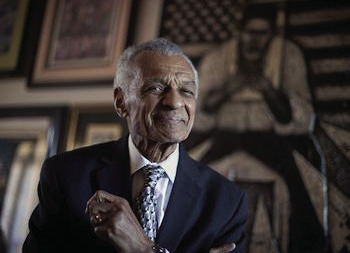
On July 31, 102 years ago, a baby was born in Missouri. This child would later move to Macomb with his mother and grandmother, who were dedicated to getting their child out of a segregated state and to a community where he could attend school and have more rights as a young Black man. Today, the Rev. C.T. Vivian's message lives on thanks to those in the community and beyond who are keeping his legacy and life's work alive.
Elder Allen Henderson, who is the assistant pastor at the Mount Calvary Church of God in Christ, brought Vivian's message to a special program at the Western Illinois Museum on the eve of what would have been Vivian's 102nd birthday.
'If I had to use a word that described Dr. C.T. Vivian, I would have to use the terminology that the young people use today. He is a real one,' Henderson told the crowd. 'Some people fit into their assignment, their calling, but Dr. Vivian, his life, his appearance, his speech, portrayed his calling. He was an activist, a father, a teacher, an unwavering advocate for justice when everything around was at the height of evil. That's what we call a real one.'
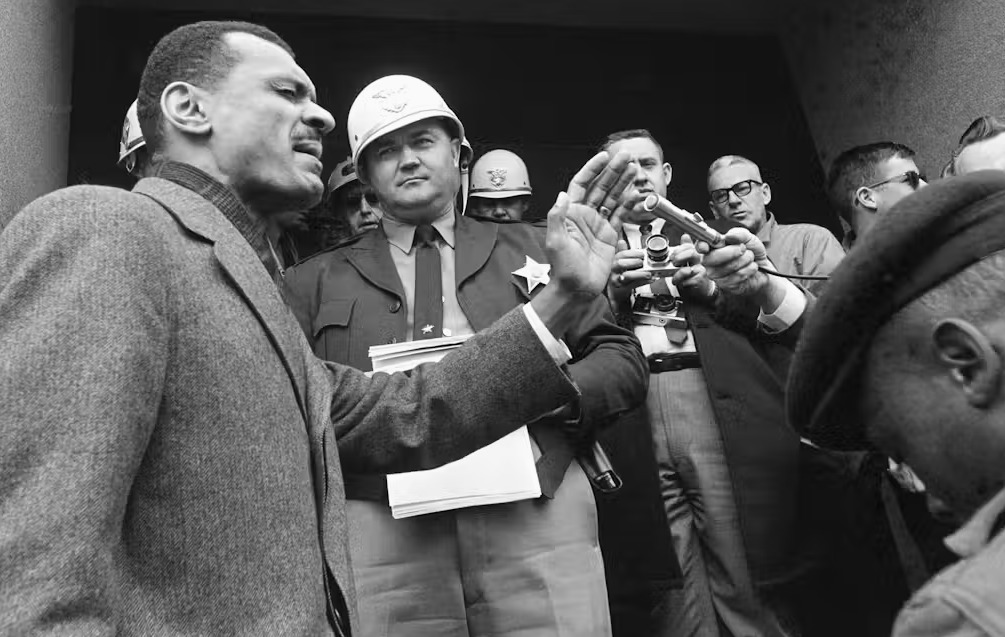
The Rev. Dr. Vivian, a 1942 Macomb High School graduate and Western Illinois University alumnus, was a distinguished author, organizer and Civil Rights pioneer. His journey as an activist began in Peoria in 1947, where he participated in his first sit-in demonstration which resulted in the integration of Barton's Cafeteria. During the Rev. Dr. Vivian's illustrious career, he served with Rev. Dr. Martin Luther King, Jr., in Tennessee, Alabama, Georgia and Florida. He joined King's executive staff and served as the national director of affiliates for the Southern Christian Leadership Conference. While in Chicago he organized and directed the Coalition for United Community Action, which became known as Chicago's Black Front.
He was the first one of King's staff to write a book on the Civil Rights Movement, 'Black Power and the American Myth.' In 2013, he was among 16 individuals recognized with the Presidential Medal of Freedom. Vivian was the director of the Urban Theological Institute at Atlanta's Interdenominational Theological Center, a consortium of African-American seminaries, and was board chair of Capitol City Bank, a minority-owned bank in Georgia. Through his C.T. Vivian Leadership Institute, he fostered innovative leadership and career development for at-risk youth and college graduates. The Rev. Dr. Vivian passed away July 17, 2020 at the age of 95.
'He was a man among men. A beacon tower in our darkest times. He sacrificed his life for our freedom,' Henderson added.
Like his colleague, the Rev. Dr. Martin Luther King, Jr., the Rev. Dr. Vivian preached, followed and advocated for nonviolent activism. He was trained, taught and learned about nonviolence well before it was 'popular,' taking part in his first sit-in at the age of 21 or 22, in the 1940s, in Peoria, Henderson explained.
'When I was watching an interview between Dr. J.Q. Adams and Dr. Vivian, one of the things he mentioned is that we don't have training for young people to teach them how to deal with confrontation in a nonviolent way. Rev. Vivian and others received training. They had people who would survey a situation and bring back information,' he shared. 'These are things we don't practice today, even though some of the same attitudes and challenges exist. When confrontations happen between different entities and we have to respond, how do we respond? Some of our young people haven't been taught that actions or reactions have consequences and that they need to know how to respond to the police, how to assess a situation and respond with a tone, words, and actions that de-escalate a tense moment. - We have to prepare our next generation of youth on how to deal with conflicts when they arise.'
Henderson has some ideas, but as he noted, they're not popular ones. For example, he pointed out that kids spend more awake time in school than in their own homes, and in this day and age, the teaching of history - what really happened - is critical to keep from repeating the same mistakes of the past.
'They must be taught our nation's real history. If they're not being taught the history of how the young men and women of the past dealt with racism, violence and more, they're not going to know or see how it has been done,' he added. 'Some of our history is being conveniently misplaced, and if our young people aren't learning about history - Civil Rights, segregation, Native Americans and more - they're not getting the true picture.'
Henderson said that our communities and churches also have a responsibility to speak out and teach others how to deal with adversaries in a nonviolent, peaceful fashion. What the community has been doing to keep the Rev. Dr. Vivian's legacy alive is great; however, as a community, it just can't be done on his birthday or special occasions; his ideology and message should be front and center, Henderson stressed.
'Bold moves have to be made and sometimes they won't be popular, but they have to be made. If they're not being made by those in position to make them, it will collapse. History keeps us from preventing what we did in the past, and if that history isn't being projected, we repeat our mistakes,' he stated. 'And there are all types of ways that we can put history back into the system, just a little bit at a time, such as recommendations for books to be read, learn more about people, give assignments dealing with history. It builds to a bigger thing. And it's not just African American history; there are so many histories - Native American history is all but lost in this country. When you take something away, you claim what somebody else owned because there is no history to dispute it.'
As for what the Rev. Vivian's message would be today, while Henderson said he certainly can't speak for the late Civil Rights pioneer, but knowing his temperament and mentality, Vivian would most likely say, 'Good job but we still have a long way to
8°','' What I liked about him, he didn't just teach or preach about history, he gave solutions. He could talk about what happened 25 or 50 years ago, but if there was no solution, you're stuck in the mindset of the past. What he would want for our young people is to number one, be educated, and receive as much education as they can get and let them know that sometimes their education is going to have to come from their desire to want more,' he said. 'Don't rely just on what people tell you. He would want us to do our own research and get more information.
'He would continue to advocate for voters' rights. Nothing is going to change unless you put your voice and your name at the ballot box. So many people don't believe in the system, they believe it's broken, but he'd tell them it can't change if they're not part of it. He'd push them to become more involved in politics to have a voice in it,' Henderson concluded. 'He would also talk about unifying under one banner of peace and understanding and love rather than a banner of fighting and evil. That’s the same spirit he embodied when he told Sheriff Clark that he wasn’t as evil as he portrayed himself to be. He would want us to hold these same types of conversations and mindsets. He stood in the gap for those who couldn't stand at all and he would help them to stand. He was leaving his family to fight for our families. That's a powerful legacy. Who can you point to like that right now who is making that sacrifice? You really can't. We're losing more than we’re gaining and because of that every generation is less equipped to take on the mantle.'