Many local residents know something about WIU’s history, dating from its opening in 1902, and about Spoon River College’s local operation and impact more recently, since 1973, but few know that Macomb had a reputation for locally sponsored higher education that extended from pioneer days to the early 20th century. I drew upon many historical sources when writing briefly about that for Macomb: A Pictorial History (1990), and I’ve subsequently written articles about that as well. Now I’m looking into our early higher education heritage again. It’s a story of struggle and persistence, which impacted our town and county and deserves our appreciation.
As I mention in the Macomb history, local Presbyterians founded McDonough College in 1836, and the trustees “borrowed money, constructed a building at Carroll and College streets, one-half mile east of the square, secured Rev. James M. Chase as the main teacher, and opened the school in 1837.” Of course, at that time Macomb was little more than a log cabin village, and that brick building—60 feet long, 40 feet wide, and two stories tall—was then very imposing. But the school struggled financially, partly because college classes cost only about $10, and the number of students was small. So, the original McDonough College lasted only a few years.
But it re-opened, in 1849, and soon had a capable leader, Rev. William F.
Ferguson, whose title was “President, and Professor of Mental and Moral Philosophy, Political Economy, and Evidences of Christianity.”
There were three other faculty members, including a woman who taught music.
By the early 1850s there were 86 male students and 47 female ones, who were mostly from McDonough County.
An account of the extensive “closing exercises” for the summer term in 1851 appeared in Macomb’s first newspaper, the McDonough Independent, and it included such things as male students reading from their first newspaper, The Gnarled Oak, and female students reading from theirs, The Prairie Flower, as well as speeches by students on subjects like “The Prospects of Life” and “The Cultivation of the Mind.” The newspaper reporter declared that the students “did honor to themselves and their teachers,” and he predicted that “this institution will rank among the first in Illinois.”
According to an 1853 article in the McDonough Independent, there were classes in “Grammar, Arithmetic, and Philosophy,” as well as “Algebra, Chemistry, Trigonometry, Latin, and Greek.” Because the college was supported by one of Macomb’s few churches, students not only had to study subjects but were required to attend church and have daily prayer sessions, too.
Unfortunately, President Ferguson died on March 13, 1853, at age 41, and although the school acquired a Yale-educated minister, Rev. Ithamar Pillsbury, as the next president, the Presbyterian Church gradually stopped supporting the school, and it closed in 1855. The college building was used as a public school through the Civil War. Then, in 1865, a new school superintendent from Prairie City, Daniel Branch, bought the property. That led to the incorporation of “McDonough Normal and Scientific College” by an act of the Illinois General Assembly, on March 1, 1867. The new institution was led by Branch and his wife, Sarah, and the college soon had about 100 students, from McDonough and surrounding counties. It was largely a teacher training school, for as the area population grew, teachers were increasingly needed.
In a May 14, 1921, Macomb Journal article, a former student, Mrs. Darius Runkle, recalled the college building and her experience there in 1868: “There were seven rooms upstairs besides a large recitation room. In the smaller rooms, 23 girls slept, did their own cooking, and had their study hours from 7 till 9.
Mr. and Mrs. Branch lived below, on the first floor.
Besides their apartment, there was the large schoolroom, where most of the classes [were held]. I loved the school and thought a great deal of Mr. and Mrs.
Branch. . . . Some of the happiest days of my life were spent under the roof of the ‘Macomb Normal and Scientific College.’” She was studying to be a teacher, which is what a “Normal School” was essentially devoted to—although people could then teach without college preparation. As she mentions, too, the female students were especially under the supervision of Mrs. Branch, who was noted for earnestly “lecturing” the girls if their behavior wasn’t up to a high standard.
A 1921 article by local historian Alex Holmes mentions the next changes in the college: “In 1879 the school was purchased by Maxwell Kennedy of Rushville and Thomas J. Dudman of Macomb,” and “They added a commercial course to the normal work and changed the name to ‘Macomb Normal and Commercial College.’” In 1882 Mr.
Dudman was elected County Superintendent of Schools, and so, he disposed of his interest to his partner, who conducted the school till about 1886-1887, when J.
L. Whittey took charge. The latter was a scholar from St.
Louis, and in an 1888 ad he indicated that “the building . . . has been thoroughly remodeled inside,” and there are “151 students” currently enrolled there.
Yet another change in leadership came in 1891, when Whittey sold the college building to Ido F. Meyer, who had taught there for several years, and soon, the latter entered into a partnership with G. W. Miller. Those two men abandoned the sixty-year-old college building, as Alex Holmes points out: “In 1896 they moved from the old building, which was condemned as unsafe, and [was] demolished, and [they] established the school in the Twyman Block [at 206 N. Lafayatte St., across from Chandler Park], and at which time the name was changed again, to ‘Western Illinois Normal School and Business Institute.’” As that name suggests, the central focus of Macomb’s college was changed to business. In fact, by 1903, when Meyer sold it, the teacher training was discontinued— and the name was also changed again, to the “Central Preparatory School and Business College.” By then, the owner and president was Ivan Deach, a graduate of Stanford University. He soon changed the name to “Central Commercial College,” and he moved it to the Gamage Building (later called the Masonic Lodge building). It had a dozen faculty members and attracted students very widely.
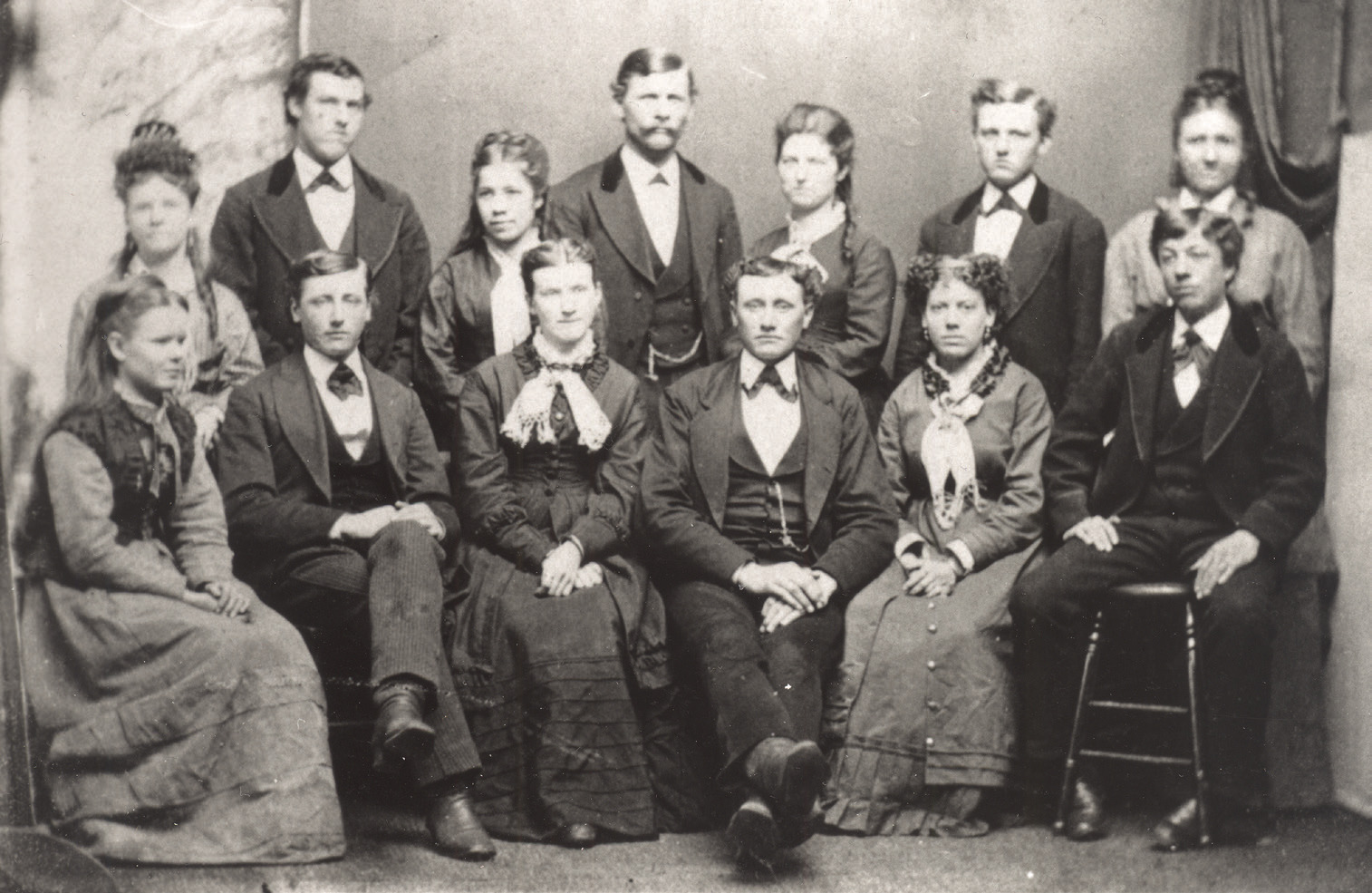
This photograph from the 1870s shows Cephas Holmes (top left), younger brother of local historian Alex Holmes who recalled the school in a Macomb Journal article published in 1921. Lucinda Allison, daughter of Underground Railroad conductor Andrew Allison and his wife, is in the front row, at the far left.
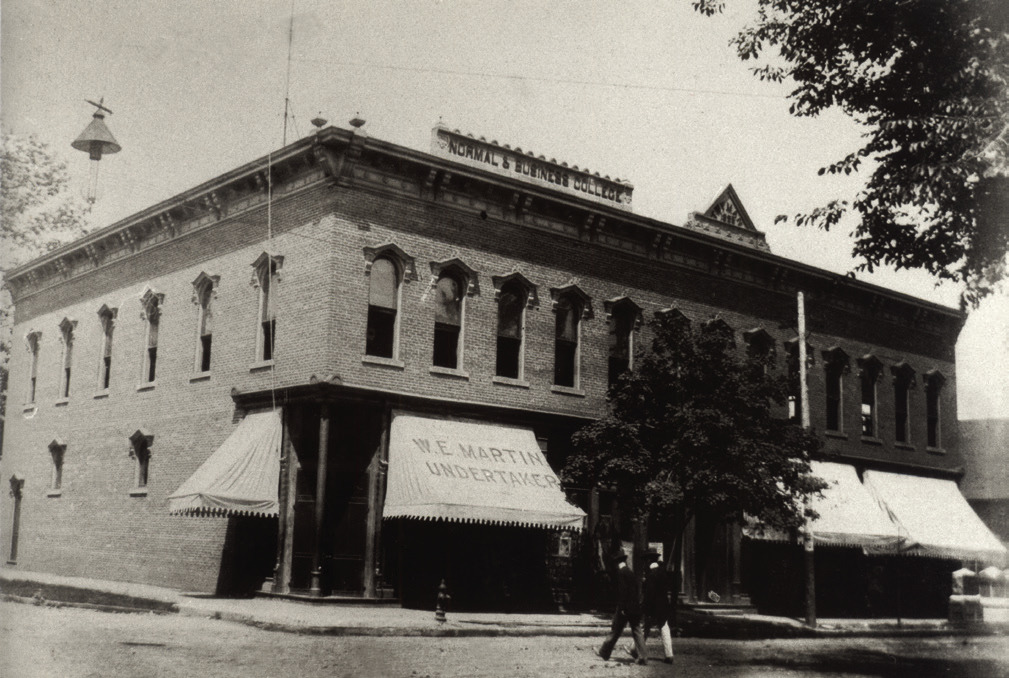
In 1896 the original McDonough College building in the northeast part of Macomb condemned as unsafe, so college head Ido F. Meyer formed a partnership with George W. Miller, and they moved the college to the T wyman Block at the northwest corner of the intersection of Lafayette and Carroll streets, across from Chandler Park.
However, financial struggle and the opening of Western in 1902 prompted Deach to sell the college to Maxwell Kennedy, during 1906, and it was re-named again, as “Kennedy Business College and English Training School.” It was located on the south side of the square. But in July, 1908, he suddenly died of a heart attack. The Macomb Journal titled that shocking story “Maxwell Kennedy Drops Dead.”
Then, two other men, J. R. Kenneday (unrelated to Maxwell Kennedy) and C. C.
Ebbert, operated it in succession, until 1911, when Ebbert’s poor health and the school’s limited enrollment forced him to close it permanently.
Of course, all of those struggling early colleges (with various names and purposes) in Macomb had a significant impact on area people during the decades when they functioned. On July 28, 1921, there was a big reunion of people who had been associated with them, as teachers or students. According to an August 11 Macomb Journal article, “375 . . . [attended]—214 women and 161 men.” Of those, “four were students before the Civil War, 13 were there in the 1860s, 30 in the 1870s, 62 in the 1880s, 136 in the 1890s, and 115 in the first decade of this century.” They all related deeply to their experience at “The Old Normal”—which they often called those many changing colleges, as if they were just extensions of one another.
So, even in the early 20th century, local people were very conscious of being part of a town with a long tradition in higher education. That complicated, changing, college venture greatly impacted the identity of Macomb. It was “a higher education town,” long before Western opened in 1902.
But that early heritage has been increasingly forgotten in the past century or so, as the teachers and students associated with those institutions have all passed away.
Also, these various early efforts at founding and re-focusing colleges in Macomb, generations ago, reveal that many local residents have realized the connection between higher education and the flourishing of our society. And that’s a crucial awareness, to which Western Illinois University and Spoon River College also contribute in our own time.
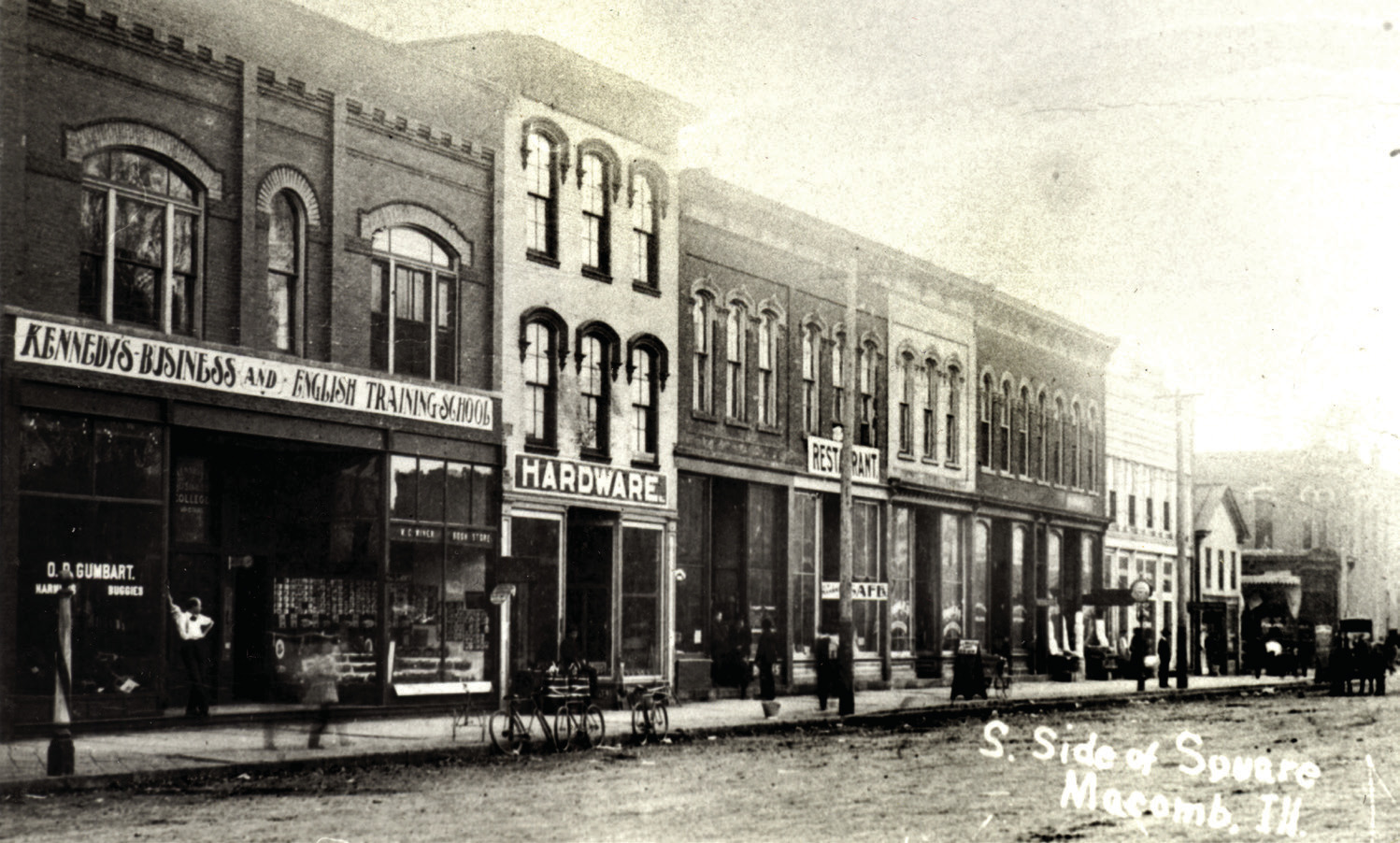
Last, in 1906, the college, renamed Kennedy’s Business and Training School, was moved to the east end of the south side of the square, now the conference room of the Clock Tower Bank. The institution still provided a broad educational program for those who wanted to obtain a teaching certificate, but its main purpose was to prepare people for secretarial, bookkeeping, and other business positions.