As of April 1, after 20 years of service, Regional Office of Education (ROE) 26 Superintendent John Meixner 'retired' from his role as chief administrator for the fourcounty region. Stepping in to assume the duties is Dave Demler.
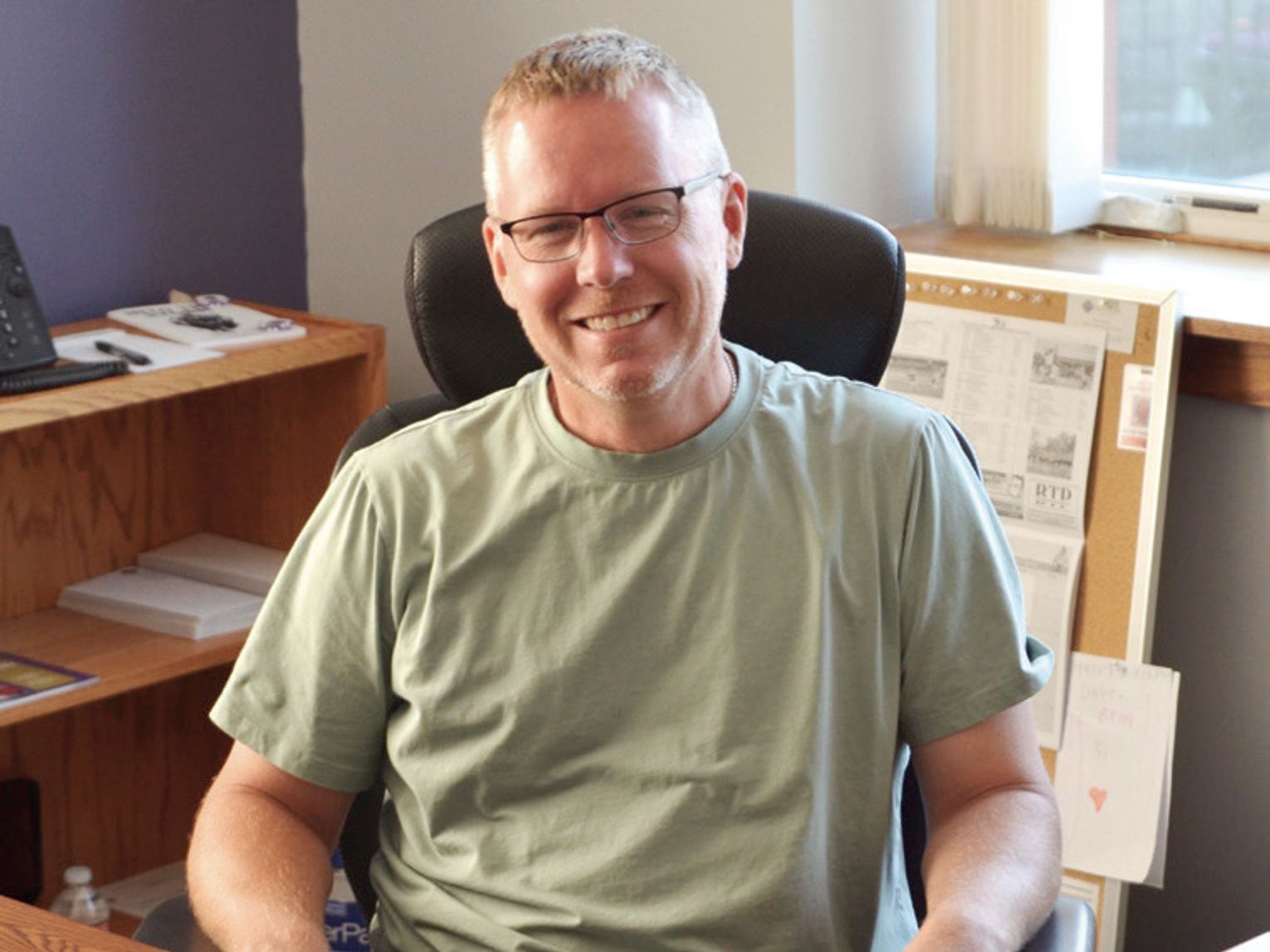
I met with the new superintendent at 7 a.m. on a Tuesday in his corner office on the second floor of the old Sears Building, overlooking the Western Illinois Museum and the breakfast crowd at Old Dairy. Dave had already shown up at 6 a.m. as part of his regular routine, having left his home in Canton, Illinois, 45 minutes earlier.

No stranger to the program, Demler had been serving as ROE26 assistant superintendent for the last 10 years, operating out of the Canton office, with occasional meetings in Macomb.
So, who is this 'new kid in town': the person charged with overseeing educational operations in McDonough, Hancock, Fulton and Schuyler counties?
Background
Demler was born in Canton, Illinois, and raised in nearby Cuba. He graduated from high school there, then attended Eastern Illinois University, graduating with a major in physical education and a minor in driver's education. It's at college there (well, really at Panama City, Florida, on spring break) where he met his future wife Jackie, who was a student at Western Illinois University. His first teaching job was at Colchester High School in 2000.
He recalled his interview with then superintendent Jerry Meyer. 'The only thing he asked me in our interview,' Demler recalled, 'was what kind of player would I put in center field? Is he right-handed or left-handed? Does he need to be fast? It was the weirdest superintendent interview of my life.'
In 2007, Demler earned his master's degree in educational leadership. He shared a story at the recent 'Champions of Education' celebration last June about how a teacher complimented him on his handling of some irregular student behavior during a tornado drill. 'She made a comment that maybe I should consider becoming an administrator, and it just resonated.'
After earning his administrative degree, Demler didn't actively pursue a position, unless something local might have emerged. He and his wife Jackie lived in Macomb, he was teaching PE and coaching at Colchester, she was serving as a paraprofessional in the district. Then came an opportunity over at Canton when Al Coleman was ROE22 superintendent.
He encouraged Dave to consider transitioning from the classroom to the front office.
At first, Demler was hesitant because the position of regional superintendent is a political one — he'd have to run for election, with all the stress of fund-raising, politicking, and making connections.
Around 2008 or 2009, Louise Basset was planning to retire as the regional superintendent for ROE22.
No one had yet submitted a petition to run for the position, so Al Coleman, who was serving as Bassett's assistant, told Demler 'This is your opportunity.' Turns out, someone from Rushville put their name in for the position, so Demler had to prepare a primary campaign. 'I just thought I was going to start a new job, but now I had to campaign and learn how to be political.' Yet, it turned into a good learning experience. 'I would never wish [running for office] on anybody, but the lessons learned and the opportunities I had to meet people were great.'
He won that primary in 2010 and ran unopposed in the general election. He was now the Regional Superintendent for Fulton-Schuyler counties.
Back Story on ROEs From the portraits of past 'superintendents' in the staircase leading to the offices at 130 S. Lafayette, one notes that for decades the title was 'County Superintendent.' In 1995, decisions were made at some level to reduce the number of offices by combining adjacent counties. Thus, McDonough and Hancock merged their operations.
Meanwhile, in that same year, Fulton and Schuyler counties also merged. For 20 years, these education regions were the norm. Then in 2015, more compaction was ordered, this time merging ROE26, with John Meixner as superintendent, and ROE22, with Dave Demler as superintendent, creating the present fourcounty territory.
Rather than challenge each other, for convenience, Demler agreed to serve as assistant superintendent and remain in Canton, his home.
Meixner, likewise, would stay in Macomb. Thus, a partnership was created that lasted for a decade until Meixner's 'retirement.' (He has turned his attention to a new position at ROE26 as Director of Legislative and Community Initiatives.)
As mentioned earlier, Dave is married to Jackie, who is a first grade teacher at Westview Elementary in Canton. She served as a paraprofessional at Colchester, as an office secretary in the Canton school district for 13 years, then earned her Master of Arts in Teaching (MAT) from Western Illinois University.
They are parents of two daughters: Faith is the older and is in her third year as an elementary teacher in Lewistown, having graduated from Illinois State University in three years. With her parents as educators, Demler proudly said, 'She's the best of us.' Ella, the younger daughter, recently finished her education at Lincoln Land Community College in Springfield, playing basketball for the Loggers, and will enter Western Illinois University this fall, likely studying in the business department.
The Job Description of an ROE Superintendent What is involved in serving as a four-county regional superintendent?
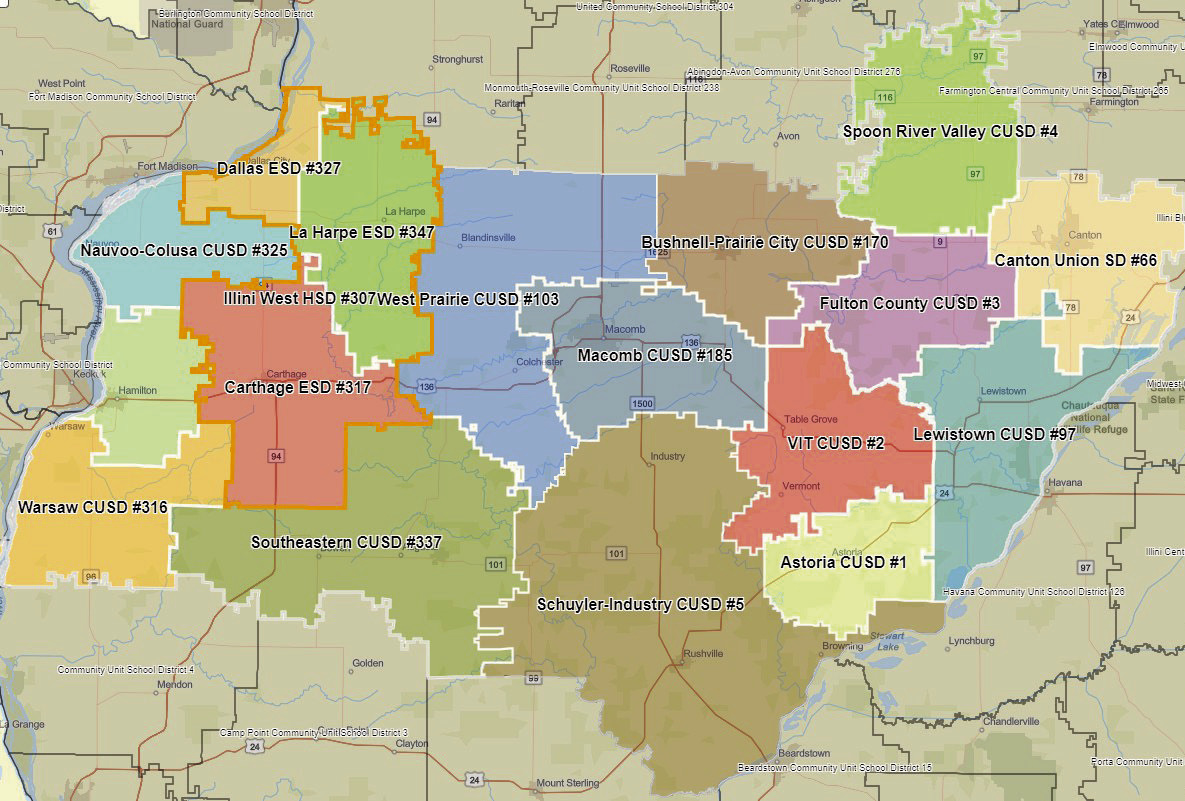
Considering the swath through west central Illinois — from Warsaw and Dallas City at the western edge to the bridge at Beardstown and the marshes of Banner on the east — ROE26 covers a land mass of 2,686 square miles, and covers 18 school districts, four non-public/ private schools, three alternative academies, 958 educators, and 10,620 students (as of 2025).
According to the ROE26 2025 Annual Report, the job description of a regional superintendent is to carry out educational regulatory functions as directed by the Illinois School Code and the State Superintendent of Education. The office has supervision and control of all school districts in its jurisdiction.
In this chain of command, the superintendent and assistant oversee five major branches, each further divided into four or five sub-categories with individual directors for a total of 23 separate programs. They range from educator licensure to school bus driver training, from hearing/ visual screening to truancy issues/home schooling/adult education. Families can also benefit from their programs; for example, Illinois Early Intervention (EI) for children 0-3, a family resource center, and cooperative parenting.
ROE26 is also the fiscal agent (administering financial activities) for five agencies: McDonough County Teen Court; West Central Illinois Special Education Cooperative; Western Area Career System (WACS), Western Area Purchasing Cooperative (WAP); and McDonough County Interagency Council. With the phrase 'Championing our Community,' ROE26 is involved on the boards and committees of 30 community organizations.
About ROE staff, Demler said the region employs between 90 to 100 people.
'When I came in in 2015, we were in the mid-40s between the two offices (Macomb and Canton). John gets a lot of credit for that expansion in services.'
Conducting Business Given this diverse educational landscape, Demler then focused on some of the specific protocols for which ROE26 is responsible. One of the obvious areas is handling educator licensure, certification, endorsements, and professional development.
Because of evolving endorsement criteria (teaching areas and age groups), declining numbers of teachers serving and entering the profession, and required continuing education and professional development, ROE26 monitors and assists educators in acquiring skills and best practices. The office also monitors substitute teacher lists and verifies qualifications (fingerprinting and background checks).
'We have a professional development (PD) consortium that's really good,' said Demler. 'We provide a lot of opportunities for teachers and administrators. Anybody who works in a school system can find something worthwhile in our PD consortium, which is listed on our web page — roe26.net.'
A second ROE responsibility is Health/Life Safety.
Each year personnel from the office visit school campuses to ensure the safety and sanitation of the premises — alarms, exit markings, emergency equipment, environmental hazards (mold, lead, asbestos, chemicals, etc.), water supply, kitchen hygiene, to name a few. Some training is necessary for these inspections, but usually local fire and emergency responder personnel assist.
'We're the authority having jurisdiction when it comes to school buildings,' Demler noted. 'What we say goes. We give a report to the district, and then they let us know what their plan is to fix it. The following year we follow up and make sure the problem is resolved.'
Regarding the upcoming school year, Demler doesn't anticipate many surprises for the districts. But that doesn't mean they aren't seeking additional resources. 'We've submitted letters of commitment with the Illinois School Board of Education (ISBE) on two competitive federal grants through Substance Abuse and Mental Health Service Administration (SAMHSA): Project Aware and the Mental Health Awareness Training (MHAT). These applications focus on expanding student mental health resources, crisis de-escalation training, and tele-health access for our rural districts.' Demler added that these are competitive grants, so nothing is finalized.
A major program instituted in the last couple of years is the Leading, Educating, and Partnering Program (L.E.A.P.), which has transitioned to Alternative Learning Options Program (ALOP). This service provides full time student advocates in some districts, in order to boost attendance and student well-being for at-risk students in grades 4-12. According to Demler, Governor Pritzker recently signed a bill that allows ALOP to also cover grades K-3. The program seems to take a more sociological approach to helping students navigate difficulties that affect their learning. 'We've seen attendance go up, discipline problems go down, reduced behavior issues, and improved academics. It's a really good, smart program.' When asked about goals for the future, Demler stressed program efficiency and fiscal stability. 'The ROE is not a taxing body,' he stressed,' so we can't raise funds that way. All we have is Evidence Based Funding with our school districts paying a small tuition fee to send students to our programs.' According to the ROE's 2025 Annual Report, approximately $10 million comes from state funds, $500,000 from federal funds, and $400,000 from local sources, such as tuition, program fees, and grants.
The ROE has a good working relationship with the local post-secondary education systems. 'Personnel from WIU, Carl Sandburg College, and Spoon River College attend our superintendent's meetings,' said Demler. 'They interact with our several districts and provide monthly reports.
Briefs that the colleges send to us get pushed out to the districts. We work with WIU on grant proposals and with their faculty and staff for professional development opportunities.'
Planning is already underway for the second annual 'Champions of Education' event at the end of the school year in 2027.
It's designed to recognize educators and staff across the region.
Sharing the Load
When the four counties merged in 2015, Meixner and Demler worked out a compromise on assumed duties. When he was the assistant superintendent (an appointed position), Demler spent most of his time in Canton where the bookkeeping office is located.
'I didn't go to as many meetings or have that many public engagements. I just did a lot of the behind-thescenes stuff. I spent three or four days in Canton and then would come over here to Macomb for a day, just to keep in touch with personnel.'
Now that he's the regional superintendent, Demler plans to be in Macomb two days a week: usually Tuesdays and Thursdays.
On Mondays and Fridays, he'll be in Canton. Wednesday is the swing date, his office location will depend on need. In the meantime, Assistant Superintendent Scott Sullivan will be based primarily at the Macomb office.
A loquacious, sometimes self-deprecating educator, Dave Demler sincerely enjoys the opportunity to make things better, to help others live up to their potential. As he wrote in his introductory comments on the ROE26 website, 'My goal is to ensure ROE26 is the best possible support system for our districts. That means being smart with our resources, steady in our daily works, and deeply invested in the success of every student, educator, and family we serve.'