Go to main contentsGo to main menu
Friday, July 31, 2026 at 4:09 PM

Bardolph’s Earliest Residents Make Important Decisions

Bardolph’s Earliest Residents Make Important Decisions
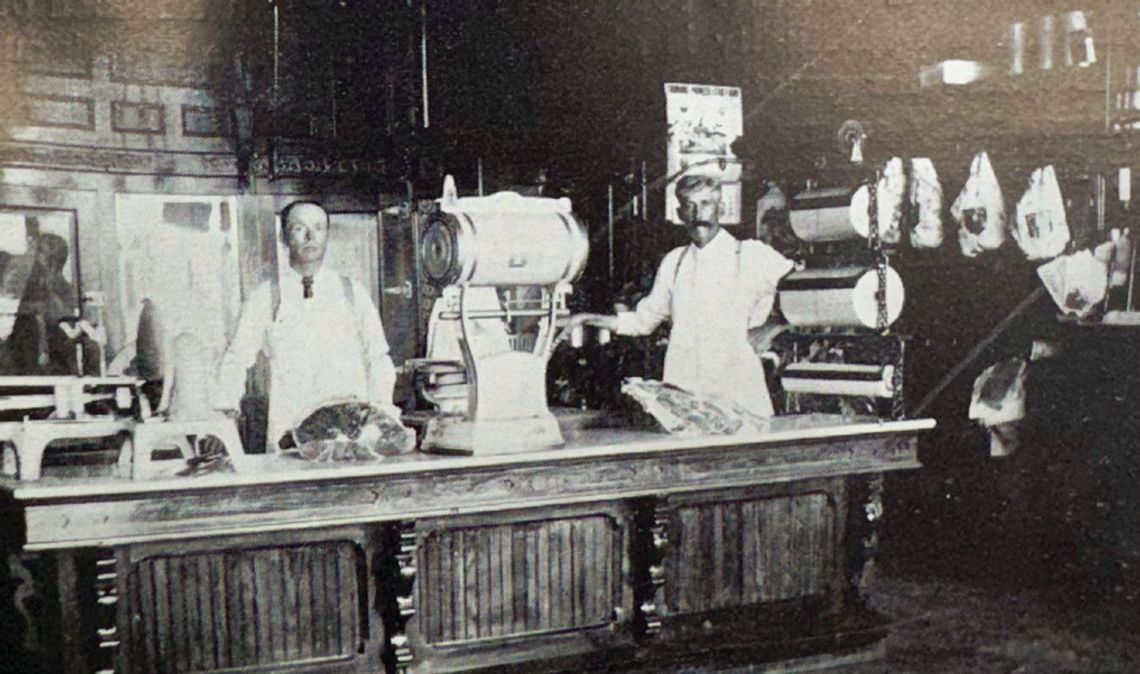
Bardolph Meal Market was known for its modern refrigerator, quality meats and cleanliness.

Many states have Springfields, Washingtons, Franklins and Mount Pleasants.

Bardolph, Illinois, however, may be the only municipality in the world with the unique name. That’s because it’s not a surname and it’s not a descriptor. It’s not even a word - someone made it up.

Towns often are named after natural landmarks or their founders. In its earliest days, the area about nine miles northeast of Macomb was named Wolf Grove because wolves were plentiful in the area. In 1854, Macomb businessmen William H. Randolph and Charles V. Chandler laid out a new town in the spot, naming it Randolph. However, they soon learned there already was a town named Randolph in the southern part of the state. A couple of letters were rearranged and a “d” was exchanged for a “b,” and Bardolph was born.

Like other small towns in McDonough County, Bardolph was created because a railroad was coming to the area. In this case, it was the Chicago, Burlington & Quincy Railway. Unlike other new communities that were anxious for growth, the first locomotive arrived in an empty town in 1855.

Only the home of the Rev.
William Jackson existed.

Land was slow to sell in the beginning, leading to an auction of about 50 lots in Spring 1856. The first new home was built that year by Nathan Jones.

People Making Government Work

Bardolph’s residents lived in the small town for nearly 15 years before articles of incorporation were accepted on April 15, 1869. Whiskey made them do it.

One year earlier, Macomb resident James McClintock erected a building in town and opened a saloon.

Because the town wasn’t incorporated, traffic going to and from the saloon couldn’t be regulated. At the same time, residents following the temperance movement tried to drive the saloon out of town. The town’s new charter forbade granting licenses to sell alcohol and the saloon closed.

In the beginning, the town was governed by an appointed president, W.J.

Merritt, and four appointment trustees, W. S. Hendricks, E. Dyer, N. D. Clark and David Adams. After the initial appointments, trustees were elected annually, and the police magistrate served as president.

Taxation for education created friction in the developing town. Residents within and outside the town’s boundaries paid an equal amount of taxes to support the school.

However, those living on the outskirts had no say in making decisions about the tax amount or school.

On Feb. 5, 1876, Bardolph was incorporated as a village, and a separate school district was created. The first village board president was Glenn Walker.

Despite losing a portion of the village to fire in 1893, trustees voted down a bond issue in 1902 to purchase $850 of firefighting equipment. In a close vote nearly one year later, villagers elected to issue $1,000 in bonds to get the equipment.

The money was used to buy a hand-powered fire engine with a 60-gallon water reservoir and storage for a chemical firefighting substance. After a constitution and bylaws were approved in 1904, the Bardolph Fire Company began.

Living in Bardolph

Bardolph became a self-sustaining community.

The first business building in Bardolph was erected in 1857 by Clinton Jones, who operated a general store.

Later, it became the Bargain Store, owned by Elmer Jackson. Other early businesses were:

• Bardolph Department Store owned by R.F. Blythe

• A hardware store and lumber company operated by men named Douglas and Bethel

• Bardolph Meat Market run by men named Casner and Irwin

• Blacksmith Greenberry Cramblett

• Restaurant

• Hotel

• Flour mill

• Henry Folsom’s shoe shop and confectionery

• L. McPherson’s cabinet shop

• William Binnie grocery and meat market

• Doctor’s office

• Drug store

• Bank of Bardolph, founded by C.V. Chandler and U.G. Smith A young entrepreneur combined cutting hair with satisfying a sweet tooth. In 1893, 11-year-old James Elba “Jennie” Jackson began barbering in Bardolph’s twostory hotel. He opened his own barber shop in 1904.

Jackson took his talent to Good Hope for two years before returning to Bardolph in 1910. He reopened his shop and added an ice cream parlor. The concoction known as “Jackson Cream” was frozen using power from a steam engine. The shortest-lived business may have been “The Bardolph Gong.” The newspaper was published in 1869 by George Litzenburg, who said he chose the name “Gong” because “it required no great amount of skill

Bardolph Town Hall

Inside the Bargain Store

The Bardolph Elevator was operated by Hendee & Company of Bushnell.

James Elba Jackson, barber and ice cream maker


Share
Rate

Facebook