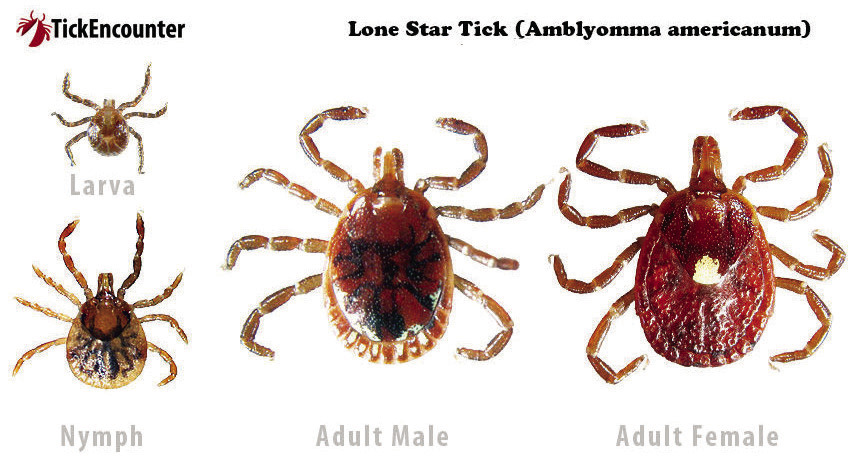
What seemed like an obscure ailment just months ago now is appearing repeatedly in commercials across numerous networks, in stories during the evening news and on talk shows and in videos on social media platforms. The warnings of Alpha-Gal Syndrome (AGS) seem to be everywhere.
What is Alpha-Gal Syndrome? It's a serious allergy to alpha-gal, which is a molecule found in most mammals, such as cows and pigs, that can develop after a tick bite from the Lone Star tick, explained Nikki Duffy, emergency response coordinator and public information officer for the McDonough County Health Department. When someone who develops the allergy eats red meat (beef, pork, lamb), dairy, or animal- derived products, the antibodies trigger immune cells to release histamines.
Unlike traditional food allergies, these symptoms often do not appear until two to six hours after eating. Reactions can range from mild to life-threatening. The body may experience hives, skin rashes, swelling (lips, face, throat), severe gastrointestinal distress (stomach pain, diarrhea, vomiting) and a dangerous drop in blood pressure known as anaphylaxis.
In addition to AGS, the Lone Star tick, which has been found in McDonough County, can also cause Ehrlichiosis, STARI, tularemia and Heartland and Bourbon Viruses.
According to Duffy, while AGS affects up 450,000 people in the U.S., public health agencies like the Centers for Disease Control and Prevention (CDC) do not track real-time mortality rates as AGS is not a nationally notifiable condition, meaning doctors are not legally mandated to report cases or deaths to federal authorities.
'The Illinois Department of Public Health (IDPH) reported that McDonough County had suspected cases between 2017 and 2022 (the years that data have been compiled on the IDPH tickborne disease dashboard),' she shared.
Duffy shared the best way to protect against tickborne illnesses is to avoid tick bites by taking the following precautions:
• Check your clothing often for ticks climbing toward open skin. Wear white or light-colored longsleeved shirts and long pants so the tiny ticks are easier to see.
• Tuck long pants into your socks and boots. Wear a head covering or hat for added protection.
• Apply insect repellent containing DEET (30 percent or less) to exposed skin (except the face).
• Ticks are usually found in ankle- to shin-high grass and weeds. Ticks cannot hop or fly. Walk in the center of trails so weeds do not brush against you.
• “Tick Checks” are an important method of preventing tickborne diseases. In areas where ticks may be present, be sure and check yourself, children and other family members every two to three hours for ticks. Most ticks seldom attach quickly and rarely transmit tickborne disease until they have been attached for hours.
• If you let your pets outdoors, check them often for ticks. Infected ticks also can transmit disease to them. (Check with your veterinarian about preventive measures against tickborne diseases.) Ticks that 'hitch a ride' on your pets but fall off in your home before they feed pose a risk to you and your family members.
• Remove any ticks promptly. Find complete information on how to safely remove a tick at cdc. gov/ticks/after-a-tick-bite.
• Wash the bite area and your hands thoroughly with soap and water; apply an antiseptic.
• Place swing sets and other play sets in the sunny areas, away from woods/ fields.
• Keep grass mowed and keep weeds cut around your home.
• Know the symptoms of tickborne disease and consult with your physician if you have a rash or unexplained fever with flu-like illness (without a cough) during the month following a tick bite.
'Ticks are most active in the spring and summer, but ticks remain active anytime temperatures are above 40°(f), so it is important to remain alert and check for ticks anytime you and your pets are outdoors,' Duffy added.
While ticks cannot be tested for AGS, the McDonough County Health Department collects ticks throughout the year to submit to IDPH for identification. The Illinois health agency sends ticks to CDC to be tested for reportable tick-borne disease based on their identification and other factors.
The McDonough County Health Department is scheduling a vector seminar to take place in October, with Jennifer Russell of Illinois Lyme Association as the featured speaker. MCHD Director Chris Adams pointed out that vector- borne diseases have been increasing over the years.
'As we continue to experience warmer than average temperatures, ticks, mosquitoes, flies, midges, and fleas have no problem finding a host to feed on,' he concluded.