Our local heritage reflects our nation’s high values in many ways, and two eras that should always be remembered are the years of World War I and World War II. Of course, with our county named for Commodore Thomas Macdonough and our county seat named for General Alexander Macomb—both national heroes of the War of 1812— and with our county’s notable involvement in the Civil War, which prompted large Memorial Day activities for decades, it is not surprising that local residents also supported in many ways the two biggest twentieth-century American conflicts.
As I mention in Macomb: A Pictorial History (1990), “Macomb had always been exceedingly patriotic, so when Congress declared war [against Germany] on April 6, 1917, local residents were immediately caught up in the wartime enthusiasm.”
Indeed, the city council in Macomb declared May 1, 1917, to be a “Grand Patriotic Day,” in which everyone was invited to show their loyalty. And so, on that day, “Almost every home, store, and public building flew a flag, and two thousand people marched in a vast patriotic parade.”
In the months between that time and November 11, 1918, when Germany was beaten and the Armistice was signed, McDonough County produced hundreds of soldiers for that conflict.
Of course, some died in battle, but many others also died of disease.
And back home, local residents made a multi-faceted effort to support the American war effort—by conserving food and coal, working through the Red Cross (to make and ship garments and hospital supplies to the war front), and organizing Liberty Loan campaigns.
Local women played a big role in those efforts. In fact, during the fall of 1917, 1,400 of them registered that they were “able and willing to take the places of men who have been called to the colors [i.e., enlisted in the military],” according to a November 12, 1917, Macomb Journal article.
And that big number, “much larger than expected,” was hailed as “a credit to Macomb womanhood.”
As I pointed out in a 2017 article, “The county’s Liberty Loan campaign raised $1,500,000, placing McDonough County third in the state (among our 102 counties) for the amount of money raised per capita to support the war effort.”
And other activities expressed the county’s supportive response, such as “McDonough County Patriotic Day,” on May 1, 1917, which featured flags, music, and gatherings, and The Pageant of the Allied Nations, on December 5-6, 1917, developed by students at Western Illinois Normal School and Macomb High School. Naturally, when the Armistice was signed, on November 11, 1918, the Macomb celebration featured a big parade, people dressed in costumes and masks, and the firing of cannons, sirens, and whistles.
The most notable U. S. organization formed during the two years of World War I was the American Legion, and McDonough County’s post, established in 1919, was only the sixth such post founded in Illinois. That alone reveals the enormous local appreciation for veterans. So, our county’s great tradition of war support and patriotic values, extending way back to the frontier era, very definitely continued through that horrific conflict.
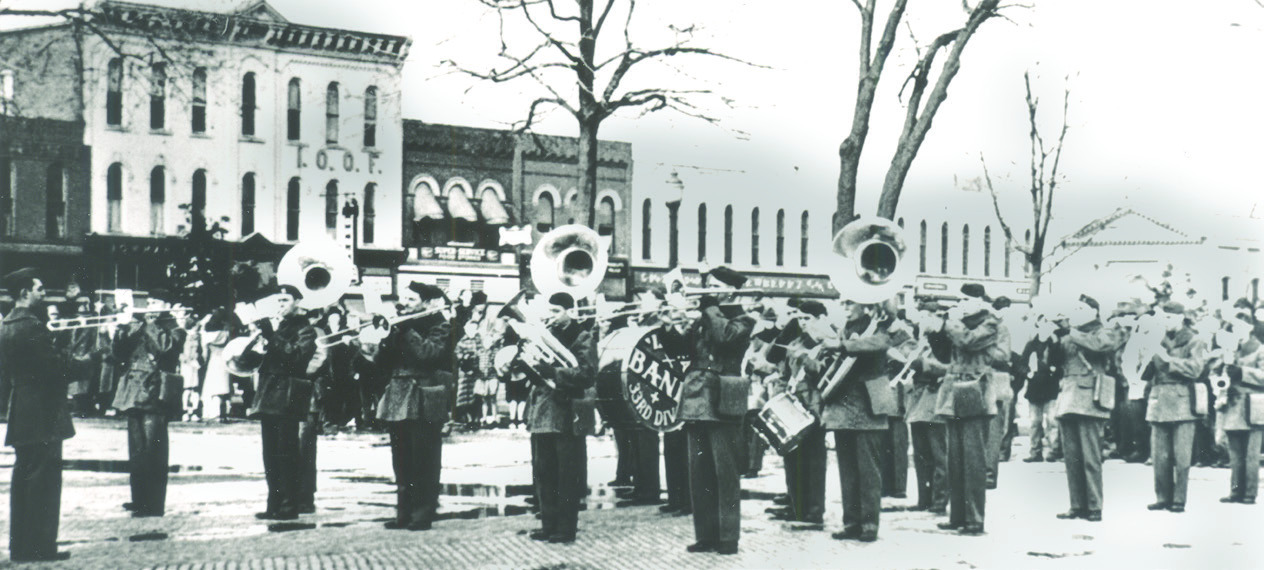
This photograph shows soldiers marching in preparation for entering World War I combat. Note the buildings in the background along the 100 block of North Lafayette Street in Macomb. The tallest building was the longtime site of the Macomb Journal.
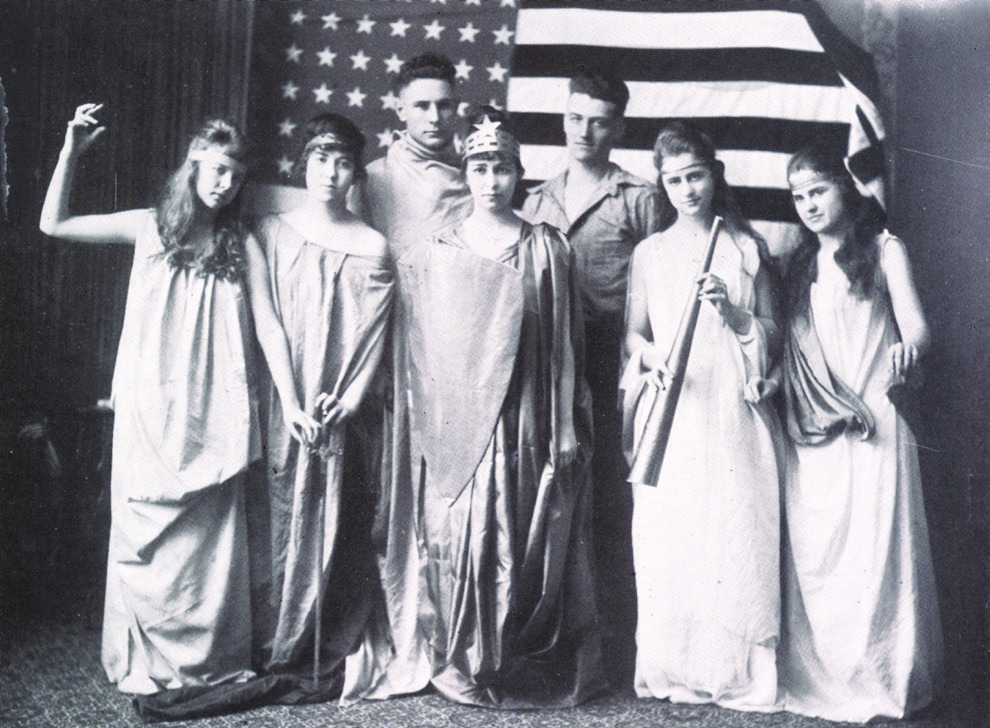
Perhaps the most striking production of the 1917 school year was the Pageant of the Allied Nations, which took place on December 5 and 6, under the auspices of and for the benefit of the Council of National Defense, a United States federal agency established to coordinate resources, industry, and transportation in support of the World War I effort.
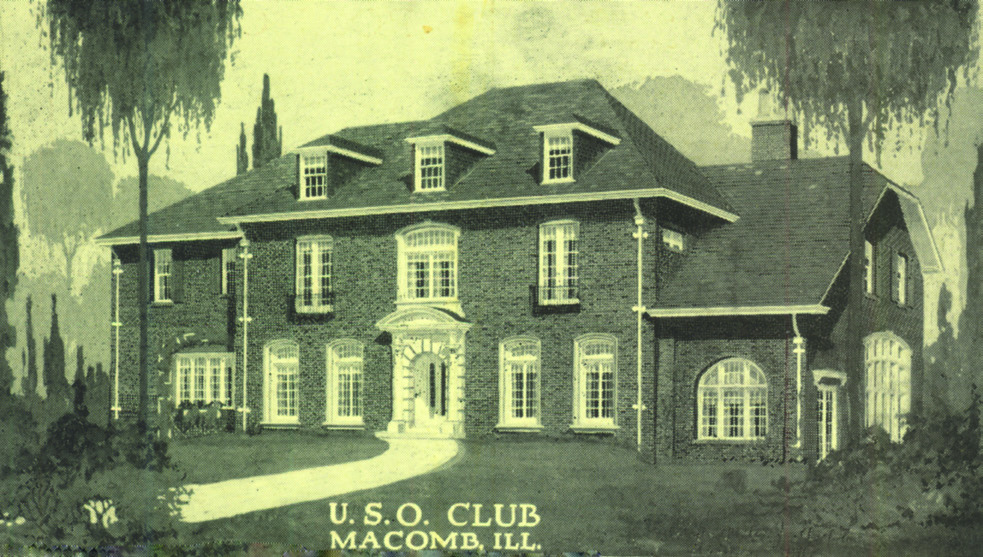
Pictured on this commemorative post card is an image of the building just east of the Macomb square, which had been the home of Dr. Joseph B. Bacon and the Holland Clinic prior to World War II and is now Macomb City Hall. It’s publication was sponsored by the Macomb Coca-Cola Bottling Company. On the back is printed, “Congratulations to the Macomb U.S.O. Cub: Soldiers’ Home Away from Home.”
Of course, World War II was longer and had an even broader impact. On September 3, 1939, Great Britain and France declared war on Germany, which had just invaded Poland, but the U. S. was not involved until the Japanese attacked America’s Pacific Fleet at Pearl Harbor, on December 7, 1941— destroying many American ships and planes, and killing about 2,300 soldiers, sailors, and civilians.
Altogether, some 2,600 McDonough County men served in that war, on various fronts. As I discuss in First Century: A Pictorial History of Western Illinois University (1999), several men from the WIU faculty enlisted, as well as more than 550 students. That number included three dozen women, who served in the WACs, WAVEs, WASPs, Marines, and Army Nurse Corps.
In that book I also mention Western’s educational developments to support the war: “During the 1942-1943 school year Western began offering a ‘war curriculum,’ which consisted of oneyear and two-year courses designed to turn out people quickly in twenty-one high priority fields [for the war], including chemical engineering, map drafting, pre-medicine, pre-nursing, and social service.” The college also offered Navy Reserve and Marine Reserve training programs, including ones for those who wanted to be pilots. Such changes were initiated by Western’s War Council, which met every month.
Also, during 1942 Hemp and Company in Macomb shifted its production to war materials. The president, J. L. Hemp, was a World War I veteran who had been gassed and wounded in France, so he was aggressive in obtaining contracts to support the war effort, As I mention in Macomb: A Pictorial History, “More than five hundred local residents—including many women—worked round the clock in three shifts to produce . . . bomb parts, rocket parts, and launchers.” As a result, “By the war’s end, Hemp had manufactured twenty million munitions items, including 150,000 fragmentation bombs.”
As I point out in Macomb: A Pictorial History, “By the time Germany surrendered, on May 7, 1945, McDonough County had lost 84 soldiers [on the European front]; another sixteen were still missing in action, and 134 had been wounded.” Also, 57 local men were killed in the Pacific before Japan surrendered on August 14. And dozens of soldiers from the area had been in German or Japanese prison camps. So, the war was a very tragic experience for our residents.
Among our other contributions to the war effort, Macomb residents also helped with the operation of Camp Ellis in nearby Fulton County. Constructed in late 1942 and early 1943, it encompassed 17,750 acres and eventually had 2,200 buildings. The camp opened in April of 1943, and at its peak the facility had 44,000 men. During the war, some 125,000 soldiers were trained there, and the camp also accumulated 4,800 German prisoners of war. McDonough County provided a number of people who worked there, and the Macomb Journal even published the Camp Ellis News.
In conjunction with that effort, Macomb also developed a USO, just east of the square, which had been the home of Dr. Joseph Bacon and the Holland Clinic before the war. It was a noted social gathering place for soldiers—and after World War II it became the Macomb City Hall.
Of course, the Macomb Journal also covered the war very well, and it printed many items about local soldiers who had been killed, wounded, or reported as “missing in action”—which also fostered public appreciation for those who served in the military.
One was focused on Staff Sergeant Don Barry of Macomb, who led an infantry squad that killed 76 Japanese soldiers in a single encounter—but he was also severely wounded in the head. However, he was rescued and hospitalized, and he survived to tell his story—which later appeared in the August 9, 1945, Macomb Journal. Barry was awarded the Purple Heart.
Another account that appeared on October 29, 1945, after the war had closed, was Sergeant Leo Harmon’s memory of barely surviving “the infamous death march of Bataan,” after he had been captured by the Japanese. A resident of Bardolph who had served throughout the war, he was both starved for eighteen days and beaten several times—and he watched other servicemen “bayonetted to death by cruel “Jap guards” during the 150-mile trek to Luzon. After surviving the harsh Japanese concentration camps, he weighed only 87 pounds.
Naturally, such military accounts fostered McDonough County’s noted appreciation for those who had served in World War II. And there was huge sympathy for the families who had lost sons and husbands during the war.
As this short overview reveals, McDonough County had a remarkable response to the stressful, and sometimes tragic, years of World War I and World War II. Indeed, it would be hard to find another rural county, composed of several small towns and some tiny villages, in Illinois or the Midwest, with such an outstanding record of patriotic values and military efforts through the generations. And this remarkable heritage, which extends back to when War of 1812 veterans were drawn here to receive homestead acres in the unsettled Military Tract, deserves attention as a long, inspiring tradition that has fostered public values and strengthened our sense of meaningful community.
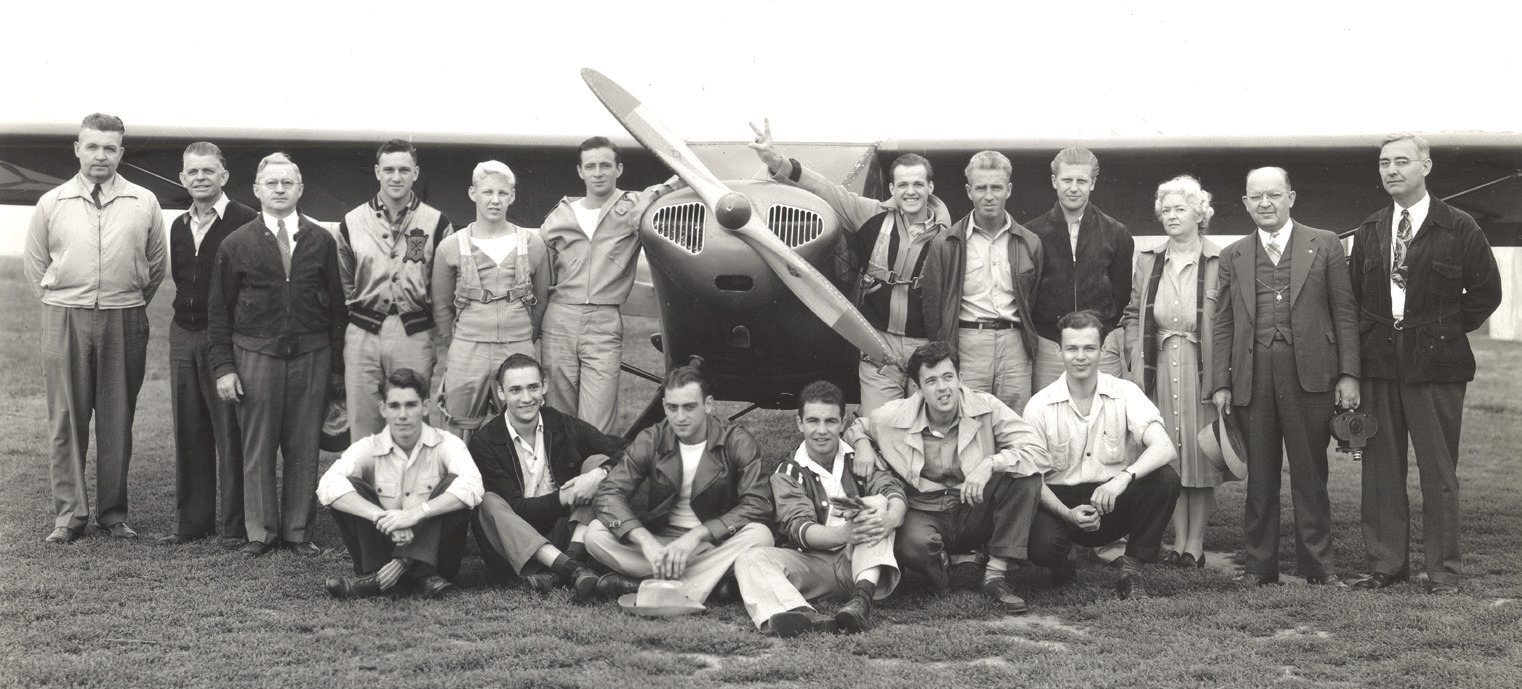
The first curriculum development prompted by World War II was a civil pilot training course created in 1n 1941, during the administration of Walter P. Morgan. That course led to a pilot’s license, enabling students to take advanced training as soon as they entered the Army Air Corps.