As July settles into its third week, families have established a rhythm for having fun while beating the heat. In children’s minds, the four weeks between now and Aug. 19, the first day of school in Macomb, may seem like forever. Parents know it will arrive much sooner.
MacArthur Early Learning Center has announced its back-to-school night Aug. 17. For the youngest students – 3-year-olds – participating in a pre-kindergarten (Pre-K) program is their first step into a formal learning environment and, for some, their first opportunity to interact with children who aren’t their siblings. Fortunately, starting the school’s educational program isn’t a big leap from what children know best – play.
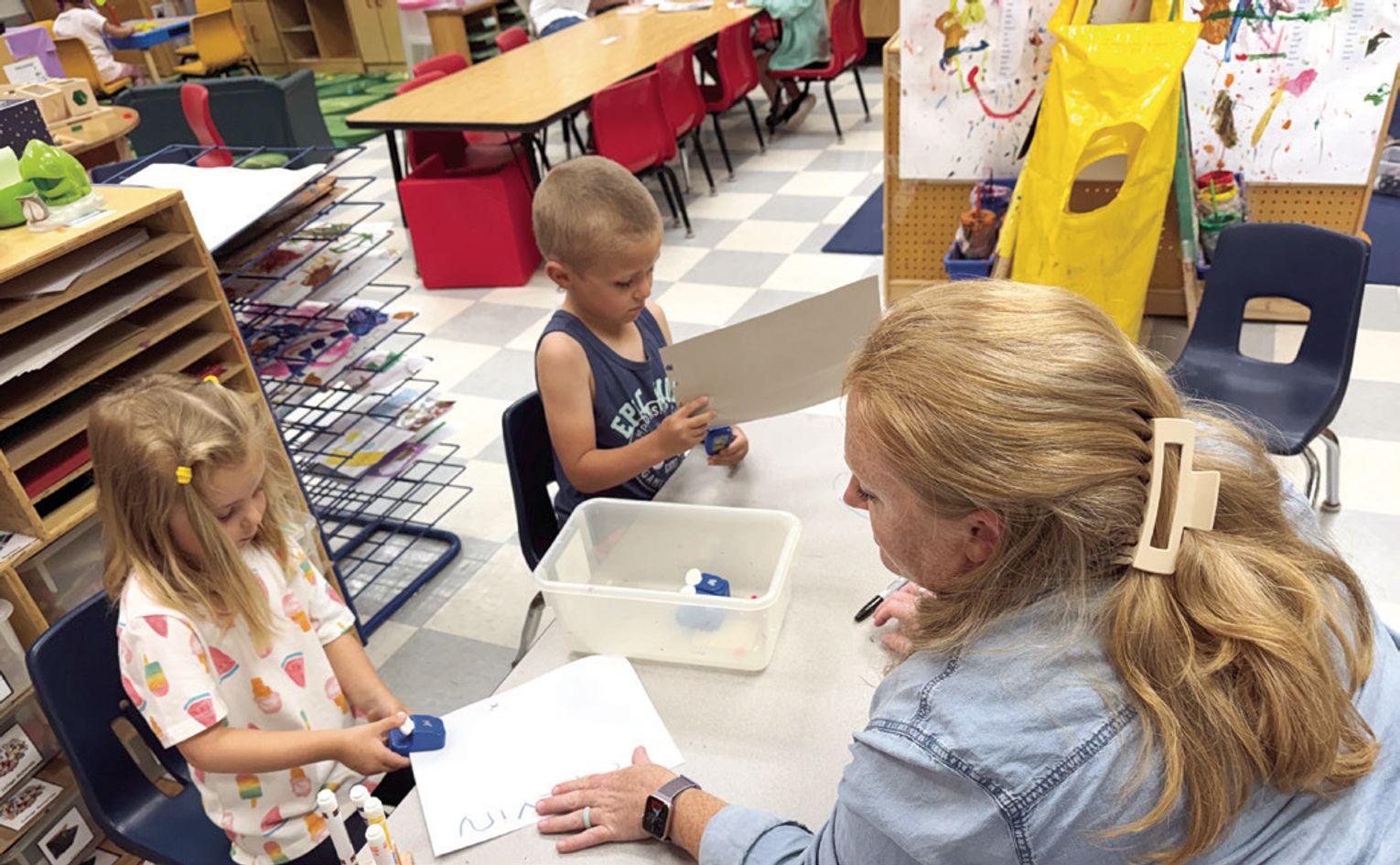
Hidden lessons in play More than 100 years ago, Italian physician and early education pioneer Maria Montessori said, “Play is the work of children.” The teachers at MacArthur use a directed-play learning method that helps its youngest students learn essential skills that will be helpful in academic learning when they begin kindergarten. Interacting with their peers and teachers through planned playtime helps young children learn how to speak, listen, share, reason, control their emotions, handle conflict and empathize.
“If somebody came into our classroom and looked at what the kids are doing, they could easily think, ‘Oh, this is just all fun and games.’ But it’s done with a very intentional purpose to teach lifelong skills,” said Mallory Kessler, who has been a Pre-K teacher for 14 years.
All classrooms have dedicated spaces for learning specific skills though play. Some learning centers are:
• Housekeeping center – The homelike environment of the housekeeping center helps children learn empathy. It is a place where they care for dolls and pretend to cook and serve food to each other.
• Reading center – Besides books, the reading center in Kessler’s room has an “environmental print” alphabet on the wall. Under each letter is the logo of a location in Macomb that is easily recognizable to students. For example, children learn how to pronounce the letter “M” by identifying the McDonald’s logo. “It’s how their brain is learning to read. They are learning that those symbols signify something.”
• Sensory center – Children learn by seeing, touching and listening to materials placed in a deep table filled with water or sand.
• Art center – In the art center, students practice fine-motor skills and dexterity. Activities include coloring, lacing and playing with Play-Doh.
Early Education Through the School District Formerly an elementary school, MacArthur Early Learning Center is the Macomb School District’s site for special education Pre-K and Preschool for All (PFA), a free, statefunded program. Eligibility for PFA is based on family income, academic risk factors and developmental needs. (Both programs will be referred to as ”Pre-K” for the remainder of this article.)
MacArthur School provides the single largest school-readiness program for 3- to 5-year-olds in the city. Half of the anticipated 140 children who will start kindergarten at Lincoln School in August completed Pre-K at MacArthur Early Learn Center in late May.
Pre-K teachers have, at minimum, bachelor’s degrees in early childhood education. Because of MacArthur’s affiliation with the Macomb School District, speech-language pathology, occupational therapy, physical therapy and vision services are available to students at no cost during the school day.
Morning and afternoon sessions are 2.5 hours long. During that time, children are exposed to a maximum of six minutes of technology, usually in the form of Danny Go!, a popular live-action children’s show that features music and movement.
The remainder of the time is filled with hands-on learning experiences, play routines and 30 minutes of gross motor skills such as walking, running, jumping and climbing. Fine motor skills – the use of fingers and hands – are incorporated into other learning activities.
The children are not divided by age within the school’s two programs.
“I really like it that way because you have older kids that can model to the younger kids,” Kessler. “They’re not just learning from the adults in the room. They’re also learning from their peers, like when washing hands. The 4-year-olds model turning on the faucet and getting soap. The younger ones see it. It’s kind of natural.”
Attending Pre-K is not required before beginning kindergarten. But its focus on helping children learn how to interact with others is invaluable.
“This has to happen first before they can start really focusing on learning letters and numbers,” said MacArthur Principal Kristi Reusch, who recently completed her 20th year in education. “I’ve told a lot of parents, this isn’t something that you can work on at home because you don’t have 17 other kids at home. That’s why Pre-K is so important.”
Learning How to Work Together
Special education Pre-K teacher Jennifer Clark said preparing her classroom for a new school year begins with showing children how to play with each other, how to talk to each other and how to share.
“There’s a lot of teaching self-regulation skills – how to teach children to stop and take a deep breath. You have to do it intentionally,” said Clark, who has been an educator for 29 years.
Most students in Clark’s morning class this past year were nonverbal, adding another dimension to teaching them how to communicate feelings and needs. The use of augmentative and alternative communication (AAC) devices in the classroom encourages nonverbal and verbal language. Children locate pictures of want they want on the device and press the corresponding button. The device “speaks” the word, which enables children to learn language and others to understand.
“We had two students begin talking this year because they used AACs. It fosters their language,” she said.
To encourage independence and cooperation, students use “saving hands” when they leave their unfinished projects unattended, such as when using the bathroom or working one-on-one with an educator. Students pick a laminated handprint from one bowl and find their picture in another bowl. Each has a hook-and-loop fastener which allows children to attach their picture to the handprint. Then they place the hand on their project.
“The saving hand shows the item is being saved. Other kids can’t take it,” Kessler said.
“Kids are invested in what they are playing with, so this gives them a sense of security.
They know it will be OK until they get back.”
Little Books have Big Effect
Every classroom has a low-stimulus area where children can calm down when they are struggling with their emotions. When students need extra help in solving behavioral problems, their teachers may create individualized booklets called social narratives to address specific actions.
For example, Clark created a booklet for a boy who yelled “Hey, hey, hey!,” whenever he wanted a teacher’s attention. The booklet, which has pictures of school staff, includes dialog such as, “I have many teachers at school. My teachers have names.”
Another booklet defines rules for the classrooms’ block centers: “We have a block center. You can only knock down your own blocks. Take what you need.”
“A lot of our narratives tell children what we want them to do,” Kessler said. “If you say what you don’t want them to do, such as ‘don’t run,’ the last word they hear is ‘run.’ So we phrase it with what we want them to do. Some young learners don’t understand the negative yet.”
Through narratives, classroom activities and even snack time, children learn how to have conversations, engage in eye contact and solve problems.
Meeting Standards
Like all school curricula, play-based learning has standard educational requirements.
“The foundational things like teaching letters, numbers and counting can all be embedded in whatever unit of study you’re doing, whether it’s squirrels or farm animals or vehicles,” Kessler said.
Several years ago, Kessler said, another MacArthur teacher had students who were excited about the squirrels on the school’s playground. To meet the children’s interest, the teacher planned a unit of study on squirrels.
Although they have a plan, the Pre-K teachers don’t have a syllabus that outlines every activity for the year.
“We’re always evolving,” Kessler said. “I think that’s why I love pre-k and have never left. I like to do lessons based on what they’re interested in. And then we build on that excitement, that interest or that curiosity.”
The greatest job satisfaction comes when children master a skill or comprehend a lesson.
“I get really excited. It’s definitely a joy,” Kessler said.
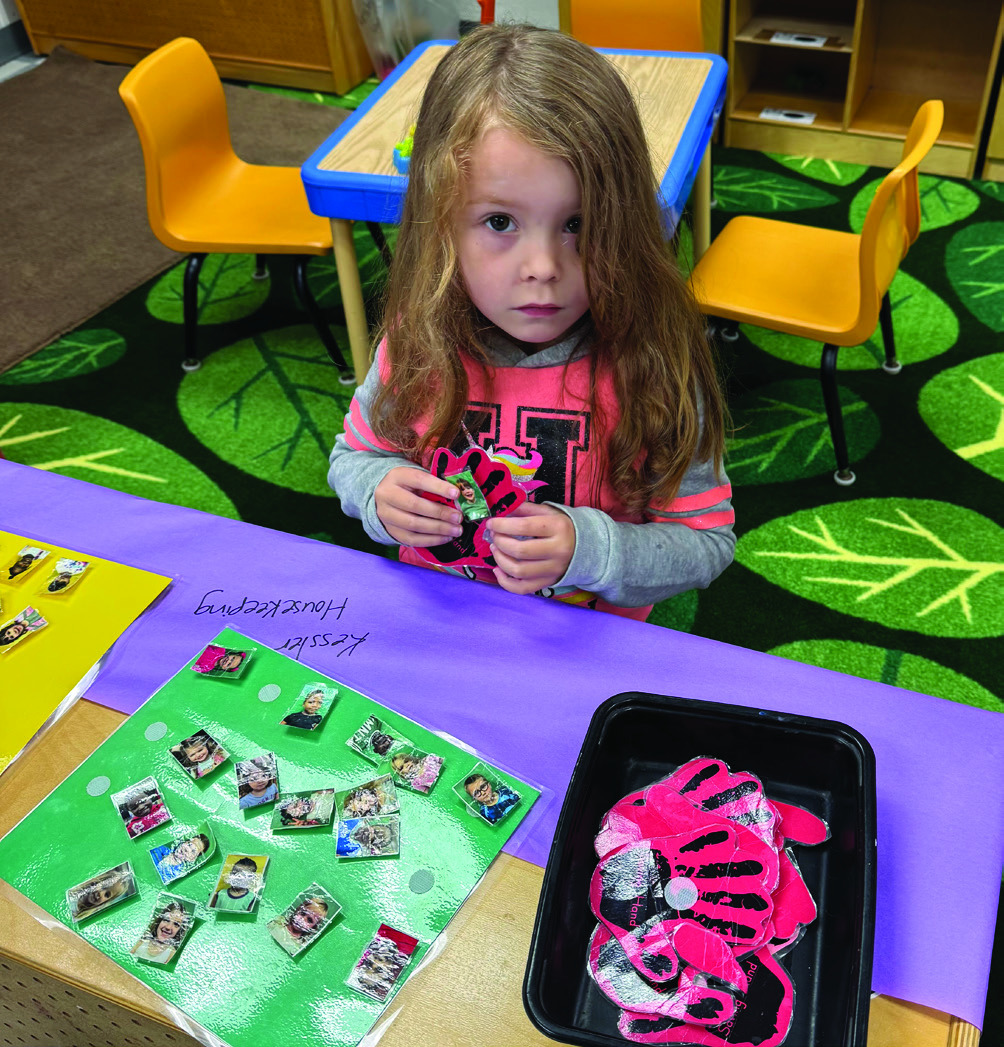
A MacArther Early Learning Center student attaches her picture to a saving hand. Putting a saving hand on an unfinished project signals other children not to touch it.
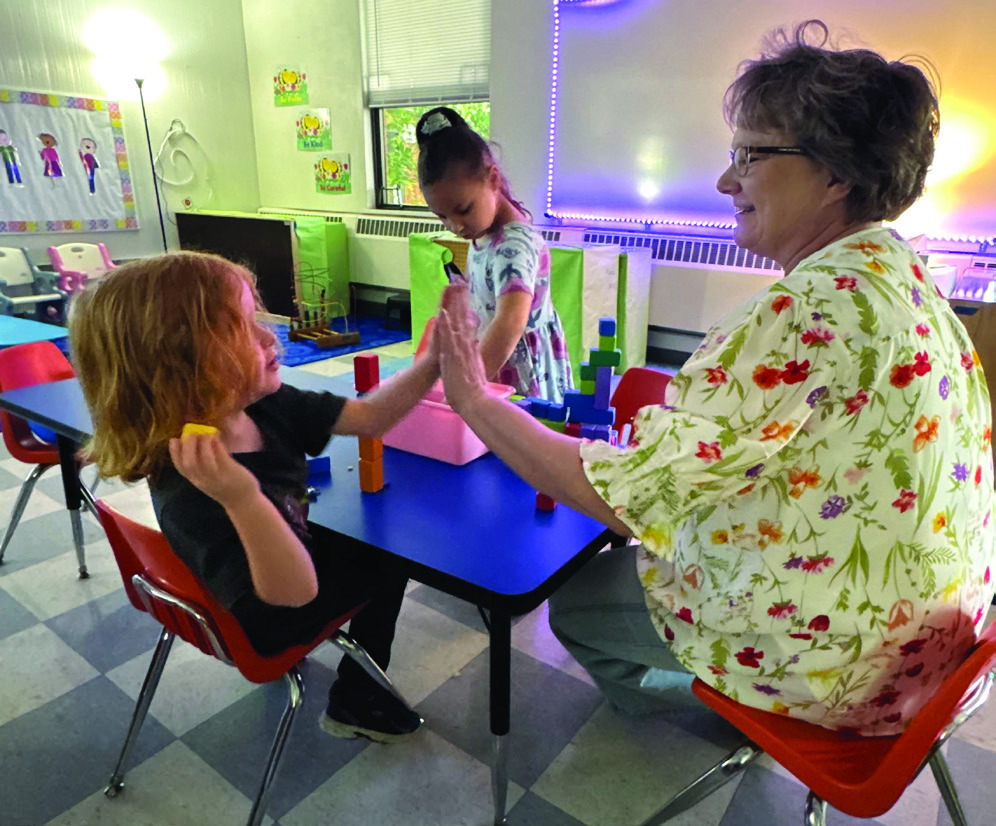
Pre-K teacher Jennifer Clark recognizes her student’s work with a high-five. She uses lamps and rope lighting to create calm space.
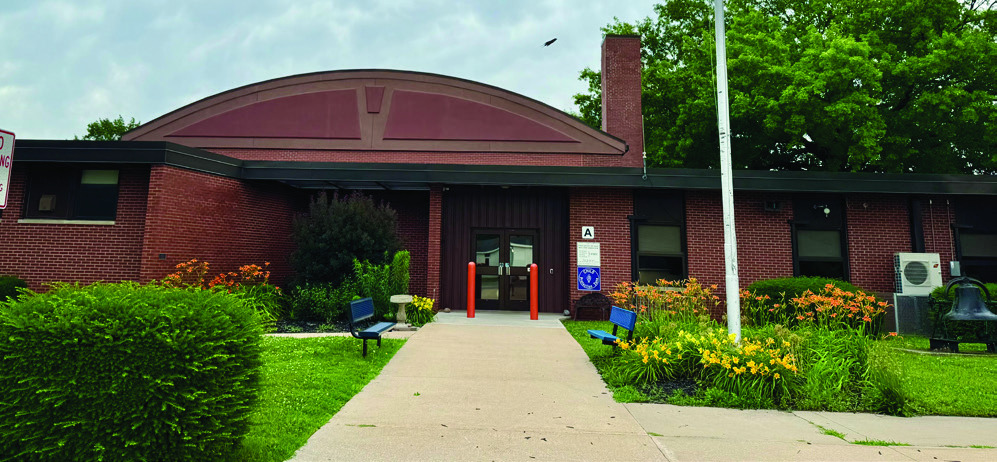
MacArthur Early Learning Center is home to the Macomb School District’s Pre-K program.