Those Magnificent Men and Their Flying Machines - Part 4
In 1965 writer Ron Goodwin wrote an epic British comedy novel that was a satire on the early years of aviation. The story was about a fictitious air race from London to Paris set in 1910. The title of the novel was “Those Magnificent Men and Their Flying Machines.”
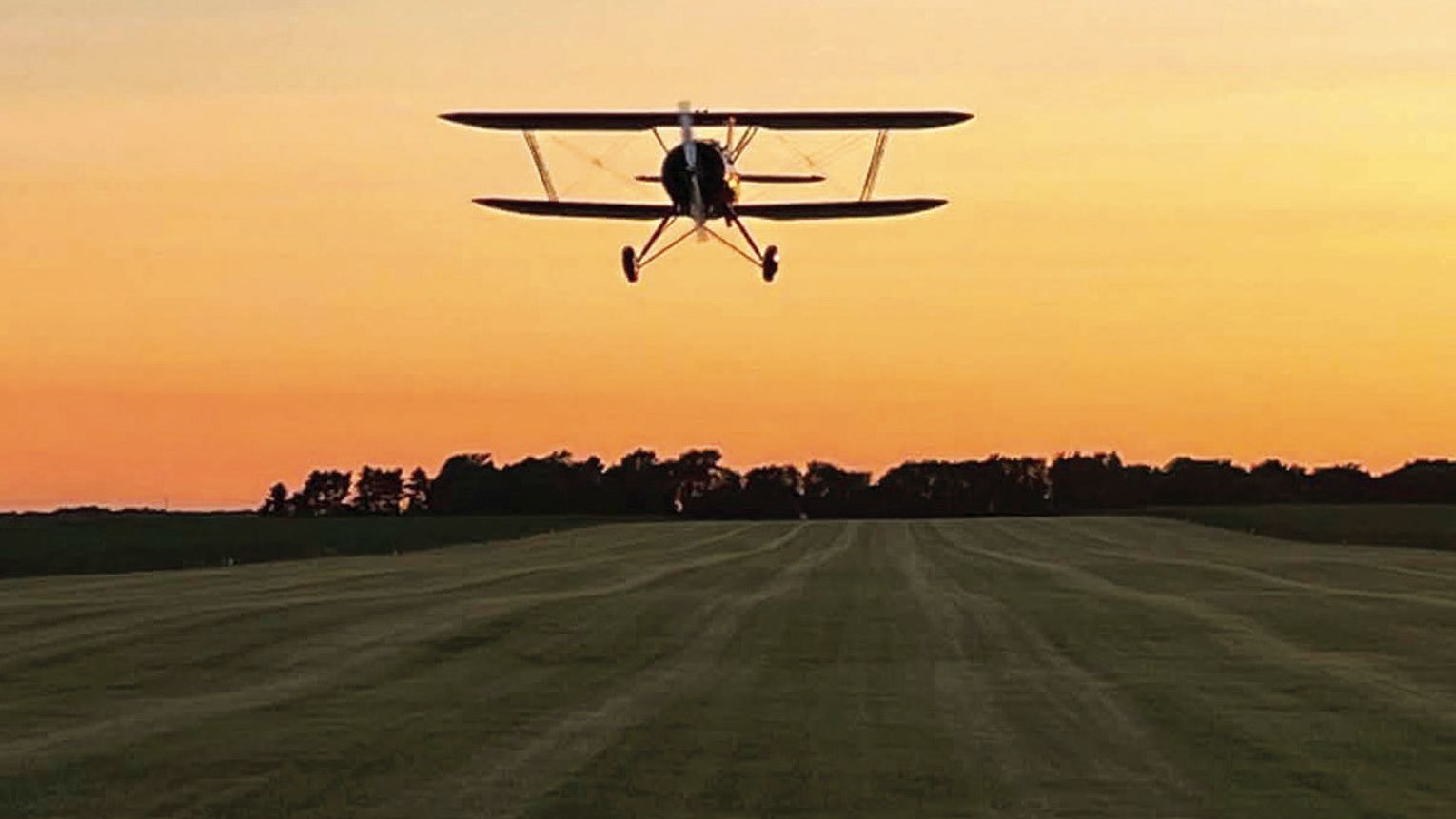
When writing about Macomb’s earliest pilots, I could not forget that movie and the lyrics to the song. Some of our early local pilots loved their airplanes so much that at night they wanted to take them home with them. So they built their own airstrips and hangars - they were true pioneers. Those magnificent men and their flying machines.
Prior to Macomb Municipal Airport’s paved runway that opened in 1969, there were numerous grass strips in McDonough County.
Here are a few.
McClure Airport
McClure Airport was established in 1946 on the George McClure farm by John and George McClure.
The farm was located two and one half miles north of Tennessee and was in the northeast quarter section of Tennessee Township in McDonough County. It had two grass runways, east/west and north/south.
John McClure learned to fly at the old Macomb Airport. Darwin McClure, son of John McClure, had returned home from the Navy and was working on a commercial license and instructor rating at Macomb Airport. His dad’s field was in the process of being constructed.
On the McClure site they built an office and five T-hangars. After being granted certification as a Class I airport, the McClure Flying Service purchased a new Aeronca 7AC Champion and a Aeronca 11AC Super Chief. John McClure already owned a Taylorcraft and a four-seat Aeronca 15AC was added later.
George McClure, partner to John, never obtained his license but did learn how to fly. After Darwin McClure earned his commercial license and instructor rating, several students learned to fly at McClure airport. Names such as Lee Meyers, George Fowler, Don Bilderback and the Keithly Brothers paid $6 an hour to rent the “Champ” and $2 an hour for instruction.
In 1948 George purchased a Piper J3 Cub and started a crop dusting business. He hired Don Brandon, a pilot who lived in Blandinsville, to apply the chemicals to combat corn bore infestations. Brandon also performed part-time instruction at McClure Airport.
The year 1948 brought more excitement to the airfield. The McClures sponsored an airshow to draw attention to their field.
The airshow was owned by “Up-side Down Ray Henry” who flew a 450 hp Stearman and featured Roy Timm, a wing-walker/parachute jumper. There was also a female pilot, Charlene Rucker, who performed a sixty-turn spin in a Piper Cub; a Taylorcraft takeoff from the top of a car, a comedy act in a Cub, and another aerobatic act with a Rose Parakeet (a type of airplane).
The show was so successful that another was held in that same year, this time Johnny Vasey with his 450 Stearman. While these shows were entertaining, the McClures lost money on them, and no new flight students materialized.
In the fall of 1948, George McClure bought John McClure’s share of the airport. George continued the operation for one more year and finally closed the airport and sold the airplanes. In 1950 the land was returned to farming. Darwin McClure went on to become a commercial pilot.
Prairie City Airport
The aviation history of Prairie City Airport goes back to the post World War II era, even though it is said to have been constructed in 1968.
Ray Wisner was a farmer who lived a few miles south and east of Prairie City.
He learned to fly during the wartime years at the St. David Airport (Fulton County). His neighbors, Carl and Chalmer Formhals, also got the flying bug and learned to fly in early 1945, also at St. David. Aviation icon L.B. Lundry instructed all three men. An airstrip was constructed on the Formhals land in 1946.
They named the airstrip Happy Landing Airport, although it was never certified by the Illinois Department of Aeronautics.
Ray Wisner constructed an airstrip on his farm, which was in existence until the late 1960s. Wisner experienced a non-life threatening accident in 1946 on his airstrip, and Chalmer later had an accident at Happy Landings. Carl and Chalmer decided to end their flying careers and Happy Landings was returned to cropland.
Bruce Sweney, a 17-yearold neighbor of Wisner and Formhals, was another flyer from the Checkrow neighborhood. Sweney hitchhiked Illinois Route 9 to St. David to take lessons from L.B.
Lundry (from Checkrow to St. David was quite a haul).
Sweney earned his private license in 1948, and after graduating from Cuba High School, entered the U.S. Air Force in January of 1950.
During the Korean War, Sweney was shot down on October 2, 1951 over North Korea after 17 missions.
Many to this day believe Bruce was Missing in Action and a Prisoner of War. He has never been found.
In 1942 an Ellisville family by the name of Fayhee moved to Prairie City and set up a retail farm equipment business known as Fayhee Implement Company. In 1949 the business changed to a wholesale distributorship of agricultural implements under the name of John Fayhee & Sons.
Don, Doyle and Paul Fayhee used flying as a business tool. By the 1960s, John Fayhee & Sons had expanded their farm implement business into other enterprises that included other locations and the sales and installation of watering and irrigation systems. They used their airplanes nearly every day in the course of business.
The Fayhees, who had been driving to Long Field west of Avon to access their planes, began thinking about the time it would save to have an airport adjacent to the Village of Prairie City.
The ground for the Prairie City field was partially originally a big hog lot.
There wasn’t enough hog lot to build a runway, so Forrest Serven let them use his ground on the east - as long as it was used for an airport.
The Fayhees went to the Village of Prairie City with an offer to lease the land to the village for $1 a year.
The purpose of the lease was so that there could be an application to the Illinois Department of Aeronautics Board for a public airport rather than a private landing strip. The Village Board of the town of 600 voted unanimously to approve the application.
The proposed airport would consist of a grass landing strip of 1,997 feet and 100 feet in width with a 50 feet buffer zone on each side. A parking area next to Fayhee Implement business included a fuel pump and a public telephone, which allowed it to meet the requirements of an airport in that class.
Almost immediately work began on the airport runway. A creek on the west side was diverted. Many area farmers and citizens volunteered with labor and earth-moving machinery. When the runway was completed and grass began to grow, on September 7, 1968, the Illinois Department of Aeronautics granted Prairie City Airport final approval. That same day, Doyle Fayhee landed the company Cessna 182 at the airport at 5:00 p.m., and with him were passengers Carl Pickett, Carl Mowrey and Ralph McFadden. With the completion of this first arrival, Prairie City Airport was listed on the aeronautical charts as a public commercial airport.
In 1978, Jack Fayhee installed lights on the airstrip. The facility maintained the status of public commercial airport until 1986, when it became designated as a RLA, or restricted private landing area. The reason for change was financial as the Prairie City Village Board felt the insurance cost exceeded the benefit to the city. From that time on, Fayhee Implement Company undertook the financial responsibility of keeping the landing field open.
For a time during the 1970s, a skydiving team was using the airfield. Stearman pilots oftentimes used the airport for practice during the Stearman Fly-in held each year in September at the Galesburg Airport. Jack Fayhee for years continued to use the field in the operations of the company business, and today the former Prairie City Airport does not exist.
Runyan Airport
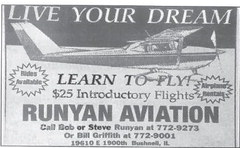
Runyan Airport was established by the Runyan brothers and is located on the Runyan Farm one mile west of Bushnell. The field was approved as a 2,100 foot, east/west Restricted Landing Area (RLA) in 1962. In 1983, the airstrip was relocated approximately one-half mile to the south of the original site. In 1992, Runyan Airport was approved as a Private Recreational Airport and licensed for commercial operations.
In 1993, Bob Runyan constructed a 60 foot by 90 foot hangar on his property. Over the years several pilots performed instruction at Runyan Airport. They include Bob Runyan, Dave Runyan, Paul Runyan, Roger Runyan, Marilyn Runyan, Steve Runyan, Matt Runyan and Joe Runyan. Other instructors included Brent Smith, Roger Smith, Nathan Olson and Pat Vlunck. By the end of the century, Jack Poppenhager and Kelly Stambaugh did most of the flight training duties at the field. Today, the Runyans maintain their airstrip as a private field.
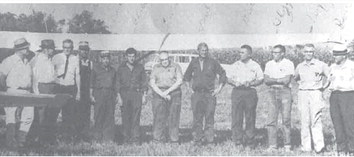
Prairie City Airport construction crew.
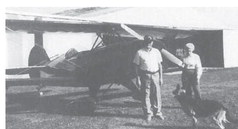
Henry and Betty Smith with the Skybolt Henry constructed.
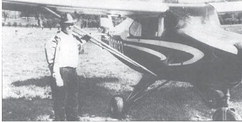
Doyle Fayhee and airplane at Prairie City airport
Smith Airport
In 1974, Harry Clugston discontinued the lease on the land that comprised the north/south runway at what was commonly referred to as Clugston/Old Macomb Airport. He sold the remaining twenty acres that made up the east/west runway to Henry Smith, another farmer-aviator from McDonough County. He was influenced toward flying from the time he went for a ride in Harold Johnson’s Ford Tri-Motor at Bushnell in 1934. He began flying lessons on July 17, 1946 at old Macomb Airport. On February 15, 1947, Smith earned his Private License.
In 1970, Smith began construction of a small, single-seat biplane known as Baby Great Lakes, and he flew it for the first time in 1975. His oldest son, Jerry, died as a result of an accident in that plane in 1979. He died from an infection in an Iowa City hospital while recovering from his injuries.
Henry Smith then built a 2-place biplane called a Skeen Skybolt. This airplane was completed and flown in 1986. Smith and his wife Betty discontinued farming and moved in 1978 to the airport, which they had purchased from Clugston in 1974. Smith was an established airplane builder and repairman, and could restore older planes to pristine condition. In April of 1995, Smith discontinued commercial fuel sale due to strict rules of the EPA and increasing liability insurance costs. The following February he removed the underground tanks. Smith continued his aircraft restoration business and in 1991 his son Roger had begun a flight instruction and aircraft repair operation on the property then known as Smith Aviation.
Macomb’s first airport, formerly known as Macomb Airport - Harry Clugston owner/ Clugston Flying Service/ and Smith Aviation, has recently been returned to farmland, with only a few airport buildings still remaining.
Macomb A Pictorial History by John Hallwas Shadows of Wings by James Haynes Joe Runyan