One aspect of the Haeger Pottery history in Macomb that many older residents can recall features the popularity of plant-based decorative products for homes and businesses. The idea person behind that development was the showroom manager, Larry Gillenwater, but the employee who fostered that new kind of appeal was an experienced decorator that I knew much better: my wife, Garnette.
In 1980 we were a young couple struggling to make it in a town that was very familiar to us. Garnette had come to Macomb with her parents in 1959, as a schoolgirl, and I had arrived in 1963 to attend Western. After we were married as college students, I had earned three degrees (two from Western and a doctorate from the University of Florida) and had become a WIU professor, and she was still pursuing her degree—while deeply involved in raising our two sons.
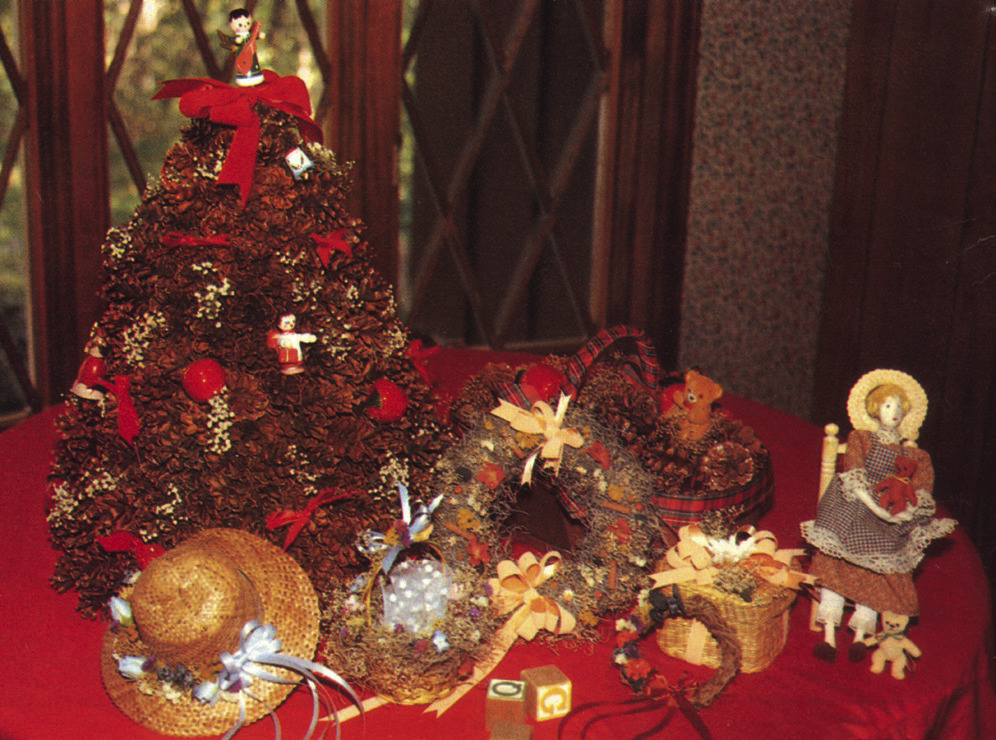
Starting in the 1970s, Garnette also did part-time work as a creator of flower arrangements and seasonal decorations— such as pine cone wreaths, center pieces, colorful baskets, and Christmas displays. Her creations were soon popular at craft shows— like the Altrusa Sale and Santa’s Workshop in Macomb and the Spoon River Scenic Drive in Fulton County—but they were also sold at our home as well. (She had a workshop and display area in our basement.) Many folks bought them who wanted to decorate public buildings, businesses, and homes. Garnette also did some displays of her craft work and floral designs at the WIU Library as well, in observance of Illinois Arts Week. Those annual exhibits were titled “Victorian and Nature Crafts.”
In Macomb, one company that frequently bought Garnette’s craft works was Haeger Pottery, which then sold her wreaths, baskets, Christmas trees, and other items in that showroom on Calhoun Street.
An article on her work in the Macomb Journal was titled “She Prefers Working at Home,” and it emphasized the still-common conflict between family obligations and career work that so many women experienced. As she asserts in the article, “I am very home oriented; I like doing house work and decorating my home, and I enjoy being at home with my husband and children.” But that newspaper account also features her successful venture into making and selling her crafts in recent years, and it concludes with a summary of her work: “Today she attends many arts and crafts shows, sells to several local stores, and even sells to a huge chain store in the Springfield area.”
Garnette’s rapidly expanding publicity, and the selling of her crafts at Haeger’s, prompted a call from Larry Gillenwater, toward the end of 1980. He invited Garnette to become an employee at Haeger Pottery—working in the showroom on Calhoun Street to create arrangements and craft items, especially for weddings and other events and advising people about purchasing pottery items that could be used for decorative displays.
Because Garnette was a busy mother, a university student, and a creator of plant-based displays, she naturally indicated that she couldn’t spend a whole week of work-days at the Haeger company. But Gillenwater was willing to try whatever might be good for her. So, Garnette started working three days a week at the Haeger showroom—and customers could see her work there as well as find out when she was available for consultation about specific decoration projects.
People were soon coming to the Haeger showroom from various western Illinois places, to purchase the many floral display items that she made and often seek distinctive arrangements by Garnette, for weddings, birthdays, dedications, and other events.
She also taught local adult-education classes that were devoted to making floral arrangements—for Spoon River College and at Western’s Horn Lodge. And Gillenwater allowed her to use Haeger ceramic pieces and floral supplies for those programs, which naturally fostered public interest in acquiring Haeger Pottery items as well.
As time passed, Garnette’s floral creations and decorations were also discussed in various newspapers and magazines. For example, the magazine called Ren: Illinois Rural Electric News, published in Springfield, carried a 1984 article about her work, titled “Art in Lace, Weeds, and Pine Cones.” The author commented that “As Garnette polished her skills and developed a very pleased clientele, more retail offers came along,” Also, to cite another example, a national periodical, Grit: America’s Family Newspaper, published in Pennsylvania, carried an article titled “Illinois ‘Pine Cone Lady’ Makes Christmas Trappings,” in a 1984 holiday issue. And after describing some of her works, it summarized her approach as a floral designer and craft maker: “She sells most of her creations to stores and at craft shows, but she still sometimes accepts special orders for unique projects.”
Because of her popularity, the floral supplies component of the Haeger showroom became so well-known that Gillenwater also asked Garnette to make day-trip visits to major supply locations—in places like the Quad Cities and St. Louis—to locate and purchase decorating materials that could be sold at the company showroom in Macomb.
So, the Haeger showroom became a kind of attraction for those interested in decorating a home, a business, or a public building. And Garnette enjoyed becoming acquainted with a variety of people, located in Macomb and elsewhere, to whom she could provide decorating assistance.
However, in 1989 Garnette finally received her degree from Western, with Summa Cum Laude honors, and by then she had also become more interested in education—partly because she had so many friends who taught in the Macomb schools or at Western. So, she left Haeger Pottery and began work as a substitute teacher (which gave her more flexibility than having a permanently assigned class). She eventually was asked to be a secretary in the Macomb High School principal’s office. And by then, our sons were older (one had just graduated from WIU and the other was in high school), so the hours necessary for her daily assistance with their activities and responsibilities were greatly reduced, and she could work full time.
Also, in the 1990s the Haeger showroom became a less popular attraction, and it eventually became just the Haeger office building in 1996, rather than a sales location. The company was then struggling, largely because various foreign competitors could produce less expensive art pottery. And that led to the closing of the Macomb company in 2004.
So, what this episode of the 1980s demonstrates is the former popularity of the Haeger showroom here in western Illinois. Back when Haeger art pottery was still selling well throughout the U. S., and in various foreign countries, the company’s interest in serving the general public in the Macomb area—by providing goods and expertise that helped with decorating—was evident to a great many people. And of course, Garnette was always pleased to have been an important part of that effort.