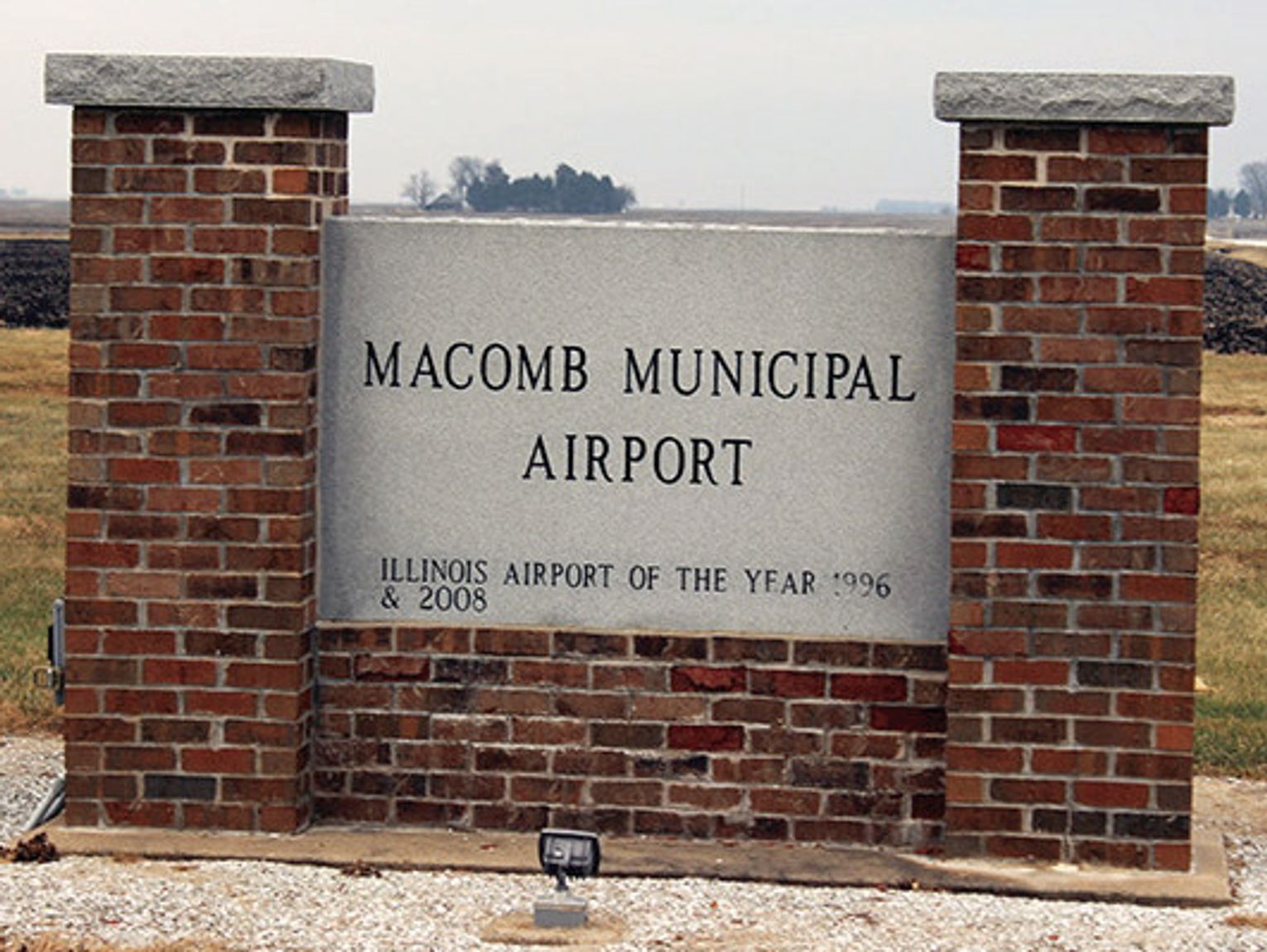
As James Haynes wrote in his 2001 book “Shadows of Wings”, as early as January of 1934, the idea of a Macomb Municipal Airport was raised. Dewey Ewing and Harry Clugston appeared before the Macomb City Council and asked that the city apply for a New Deal Project under the Franklin Roosevelt Administration.
The thought was to build a municipal airport on the present site of the old Macomb Airport that was being operated by Harry Clugston on leased ground.
The proposal never materialized and it was not until 1945 that another effort was made to establish a public airport referendum, and once again the effort failed.
In January of 1962, there was a national movement to upgrade the nation’s airport system by making available federal grants to states for the purpose of constructing new, all-weather airports. In 1961 Congress had passed into law the Federal Aid to Airports program and for the rest of the decade many grass fields around in Illinois were transformed into modern airports with surfaced runways.
In 1950, Harry Clugston had purchased the airport land east of Macomb, which had both north-south and east-west runways. There was little to no prospect of extension or hard-surfacing of those strips.
In February 1963, a Macomb Chamber of Commerce airport Committee, headed by Dr. Kenneth Pawlias, filed a petition with 780 signatures in an attempt to create a McDonough County Airport Authority.
County Judge Edwin Becker declared the petition valid and set April 23, 1963 for a public referendum. The argument made by Dr.
Pawlias in his case for a new airport was that a better airport would spur economic development.
In the Summer 1964, it was announced that a large industry had placed Macomb on its list of possible industrial sites in or near the city. One of these sites was on East Jackson Street, and would possibly employ 500 workers. One of the stipulations called for an airport with an all-weather runway that would accommodate large, twin-engine planes.
This exciting possibility became paramount to those wanting a new airport.
At the August 18, 1964 meeting, the Macomb City Council was asked to pass a resolution supporting an improved/new airport facility. Dewey Ewing, a member of the Chamber of Commerce Aviation Committee, pointed out that it would be possible to obtain state and local grants to assist in building a new airport. The council voted to proceed with a plan to create a municipal airport and also to extend water and sewer facilities to the industrial site east of the city.
For the first time, a municipal airport proposed for the City of Macomb became a public project.
Ewing had come to Macomb in the late 1920s and was associated with the Union National Bank.
He began taking flying lessons around 1932 with Harry Clugston. Ewing was to become the “ball carrier” for the new airport and arranged for three key aviation officials to come to Macomb and had Bruce Clugston fly them around the Macomb area to make an aerial survey of possible sites for the new airport.
The engineers also briefed Ewing on the procedure for applying for state and federal grant money for airport construction. The resulting report on possible sites was the document used by the Macomb Airport Authority Commissioners when determining the present site of Macomb Municipal Airport.
Between September and the November election date, a well-run campaign was conducted by the Macomb Chamber of Commerce.
They stressed to the public that a new factory was at stake of their vote. For the first time, the name of the company was revealed as Federal Mogul - Bower Bearing, Inc. Opposing forces took out a one page ad in the Macomb Daily Journal, calling themselves the Citizens for Tax Relief Committee.
They urged the citizens to vote no on the airport issue, citing a heavy tax burden and the question of the need for a new airport.
When results were announced on election night, the proposal to build a new airport won by a large margin. The next day Federal Mogul announced that groundbreaking ceremonies for the new factory would take place that afternoon. A few weeks after the election, Judge Edwin Becker appointed five commissioners to the Macomb Airport Authority Board. They were H.D. Ewing, A.L. Ring, T.
Mac Downing, Ron Phoenix and Neil Chandler.
At the first regular meeting of the Airport Authority Board January 26, 1965, four sites were presented by the engineers.
Site One - Three miles east of Macomb and north of the U.S. Highway 136.
Site Two - North and northeast of Macomb approximately three miles north of the C.B & Q Railroad.
Site Three -Four miles north of the city adjacent to U.S. Highway 67.
Site Four - The existing Macomb Airport (Clugstons).
Many factors entered in when considering a site, and the Clugston Airport figured to be the most complicated and expensive. There was the cost of moving CIPS power lines, “hospital road” to the south, annexation required a vote, required clearance zones had to be adequate, the cost of land was high, a hospital and a school were within two miles, and a water supply tower was a possible hazard.
Dewey Ewing clearly had a favorite site. Four miles north of Macomb adjacent to Highway 67. Wide open space, room to grow. No obstructions or hazards.
Now, who was going to tell the landowners?
As soon as site three was voted on by the board, there was an immediate reaction. A petition signed by 66 people who lived in the immediate area (Sections 7 & 8 of Macomb Township) protested the selection in vain.
With the boundaries of the airport determined, the names of the owners of the land were now known.
Appraisers went to work determining the value of the properties consistent with what current farm land was selling for. None of the land owners wanted to sell their land. In most cases a sale of some of their land would result in a decrease in the value of their farms, which were in some cases family generational farms.
The board offered $725 per acre and based on the appraisers report. All of the landowners initially turned the offer down, and negotiations continued into 1966. Finally when the owners realized lawsuits might be imminent, they agreed to sell. It was not until 1976 that the Macomb Airport Authority would have clear title to all of the airport property.
By the Summer of 1967, the Macomb Airport Authority had purchased enough land to commence building an airport.
Coggeshall Construction Company won the bid to construct the runway, taxiways and ramp apron.
The grant agreement with the Illinois Department of Aeronautics spelled out the perimeters of the new airport. Land acquired for development and clear zones - 82 acres. Construct and light an east/west runway 3300 feet by 60 feet approximately including taxiway and turnaround. Construct connecting taxiway 550 feet by 30 feet. Construct an apron 200 feet by 200 feet.
Install segmented circle, wind tee, airport beacon/ beacon tower and construct entrance road.
In September 1967, the board advertised bids on storage tanks, a “T” hangar, office building, floors and a water well. One month later bids were put out on plumbing, heating, electrical, cooling, a sewage disposal system and a fuel supplier.
Bids were also advertised on the removal of buildings on the former J.F. Pearce farm, which was located at the entrance road to the new airport.
By March 1968, the board finalized the purchase of the Vera Copeland property, which allowed the airport to have a north/south runway.
Also, that month, the airport board finalized a management contract with Gene Douglas, this writer’s father.
He would become the first manager of Macomb Municipal Airport, a job he would hold from 1968-1984.
See Part 3 - Gene Douglas becomes Macomb Municipal Airport's first Manager 19681984 Credits - James Haynes book “Shadows of Wings”, Western Illinois Museum, WIU Archives, John Hallwas “Macomb - A Pictorial History”, Macomb Daily Journal.