'I, too, have a dream — to show people in the out of way places, some of whom are not only in small villages but in corners of New York City — something they cannot get from between the cover of books — some real paintings and prints and etchings and some real music.' — Franklin D.
Roosevelt Federal Art Project Images of strong, manly men with rolled up sleeves toiling in construction or wheat threshing or woodland conservation often inform our perception of WPA programs. However, other workers used their creative talents to produce some of our most iconic American art. Much of it appears in public buildings, particularly post offices.
According to the Tate Museum in London, President Roosevelt authorized the Public Works of Art project in 1933. Within five months, it employed 3,749 artists who produced 15,633 works of art for public places. Then in 1934 through 1943, the Federal Art Project (FAP) took over the program, administered through the Treasury Department (called 'The Section').
When asked why the government should produce jobs for unemployed artists, New Deal administrator Harry Hopkins replied, 'Hell, they've got to eat, just like the other people.'
Irene Rawlings in a 'Saturday Evening Post' article, stated that 'by the time it was dissolved in 1943, FAP artists had produced more than 100,000 easel paintings, nearly 300,000 fine prints, about 18,000 sculptures, innumerable posters, and more than 2,500 murals that can still be seen in public buildings throughout the country.' Of the $11.4 billion WPA budget, about $27 million was allocated for all the arts, including musicians, actors, dancers, and writers. Western Illinois University's Art Gallery behind Sherman Hall houses over 40 WPA arts works.
But they're not displayed in public places.
Post Office Murals
One of the ways artists brought their creative talents to our area was through murals and other art structures in local post offices, from Galesburg to Mt.
Sterling and from Hamilton to Lewistown. Nationally, around 1,400 murals were commissioned for post offices in all 48 U.S. states.
About a thousand of these murals are still on display.
Patricia Raynor noted in an article for the National Postal Museum's newsletter that the artwork was not produced by local artists; instead, application sketches were selected through anonymous submissions in competition with other artists with nationally known artists as judges. Once given a commission, artists had to get the approval of the local post office and community before they could begin working.
Raynor indicated that for smaller communities, the authorizing committee usually consisted of the local postmaster, a local artist, and a prominent community member. If they didn't like the FAP assigned project, they could reject it 'due to theme, content, method of expression, or design elements.'
Some well known artists were part of the FAP, including Grant Wood, Thomas Hart Benton, Jackson Pollock, Willem De Kooning, and Mark Rothko. However, most of the artists were regional successes and were willing to journey to small communities, scout out the territory, and compose a rough sketch for the selection committee. Then it was up to local officials for final approval.
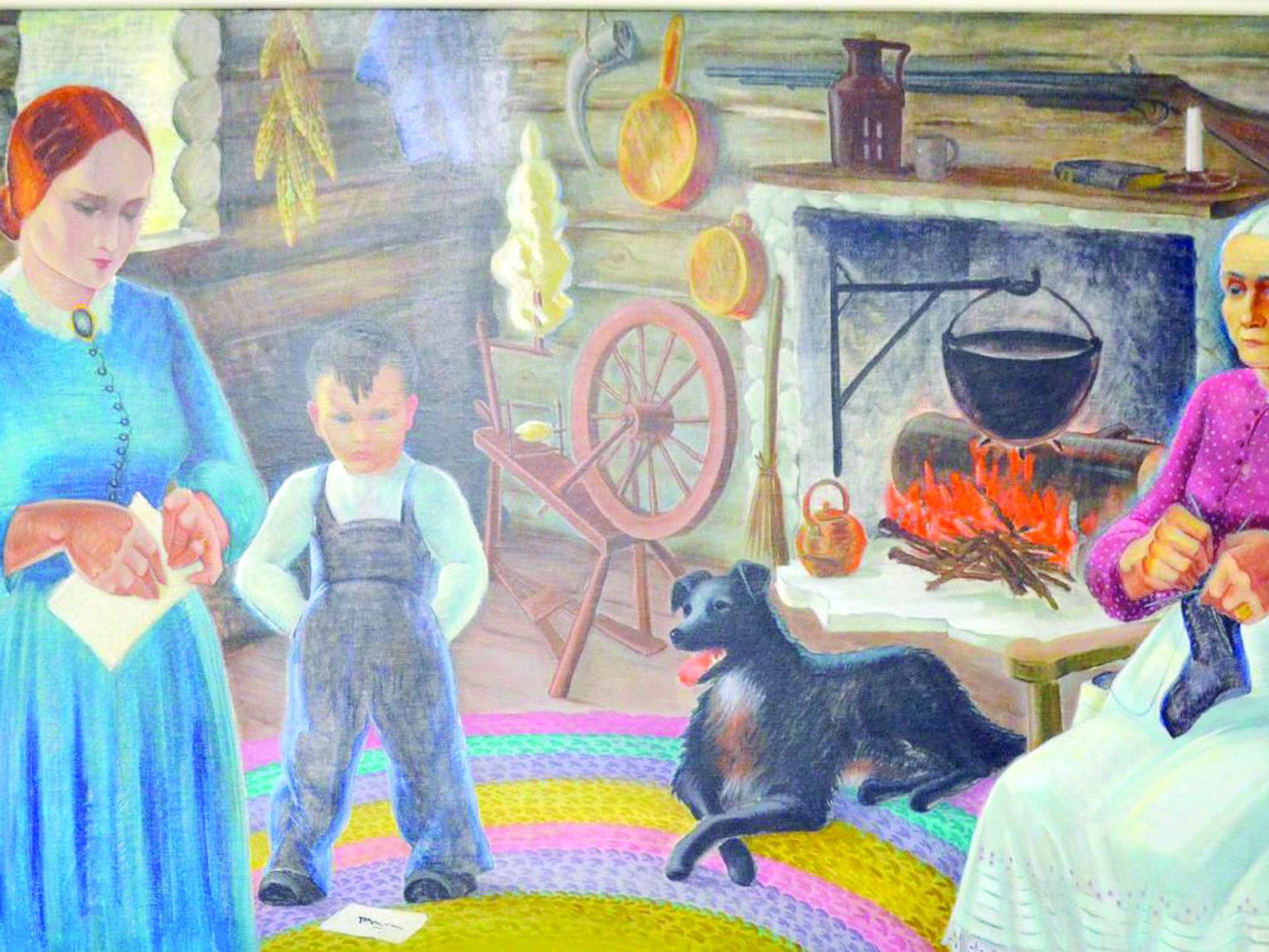
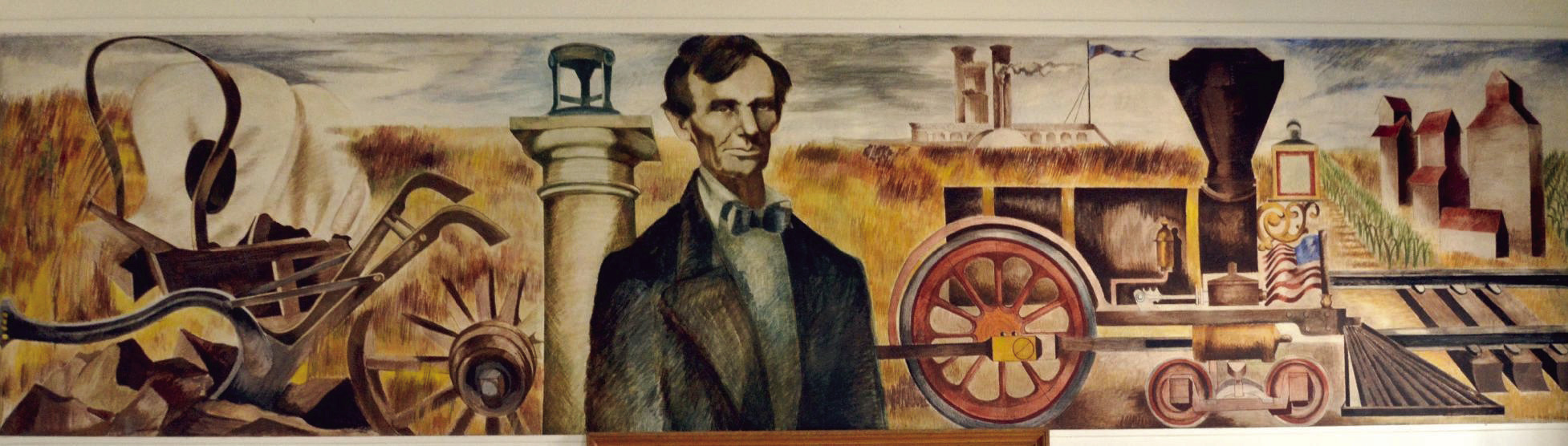
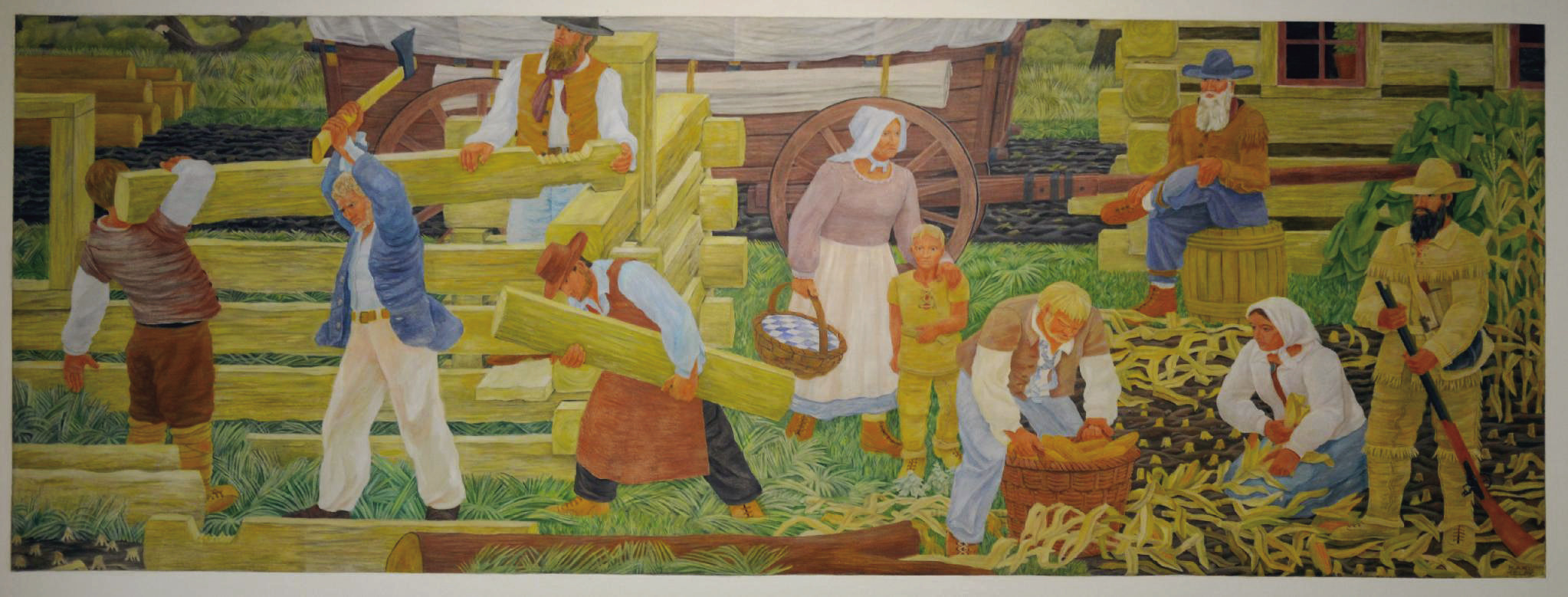
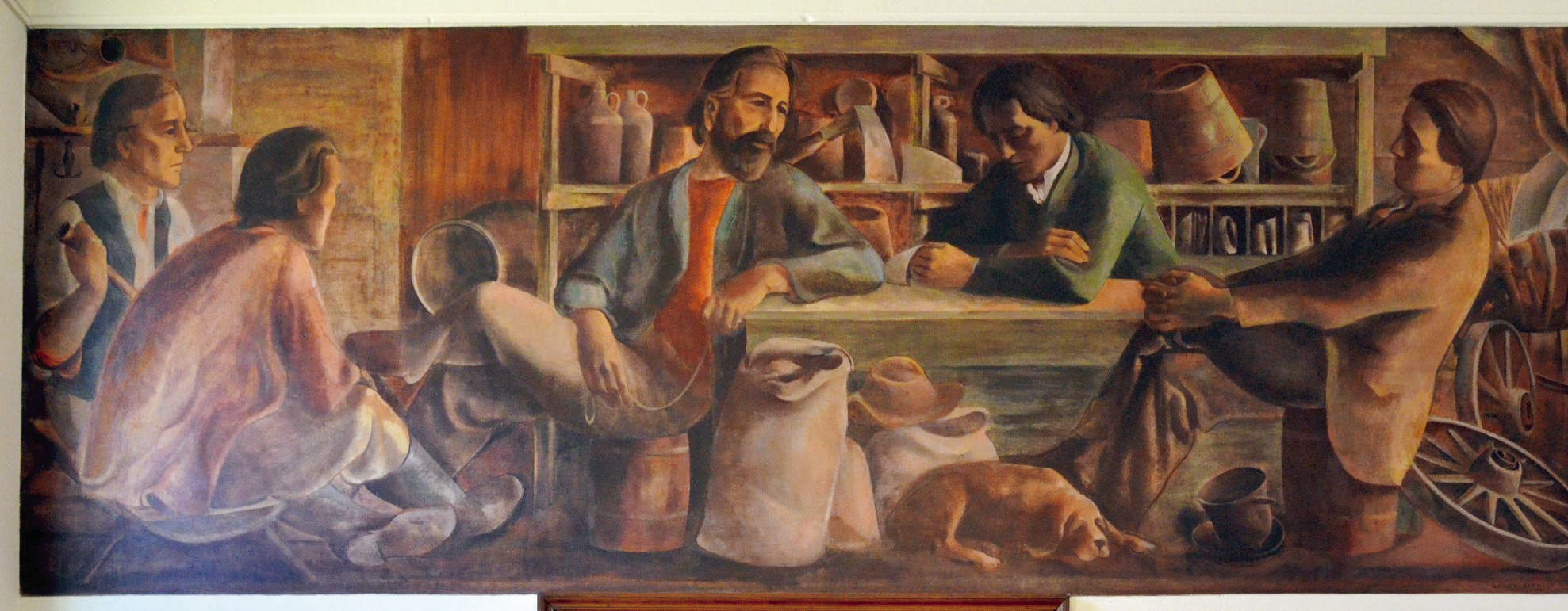
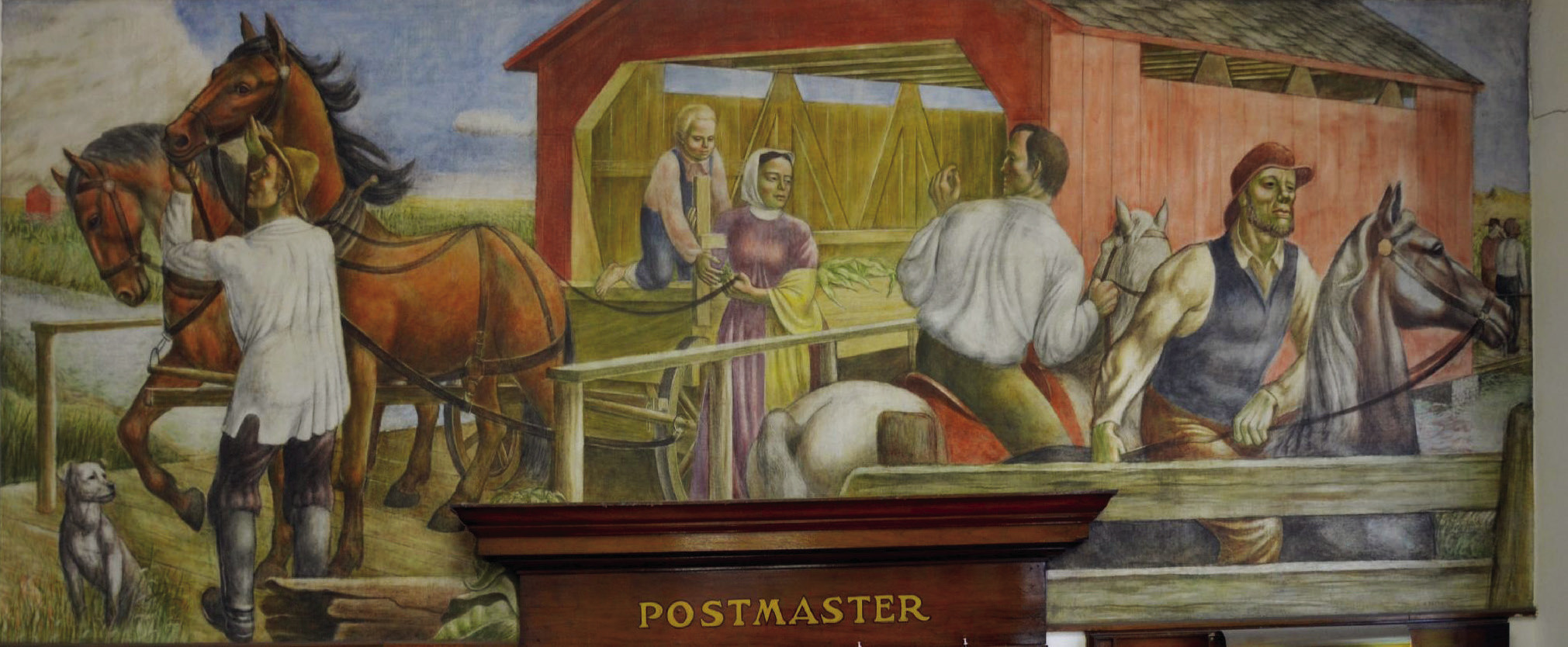
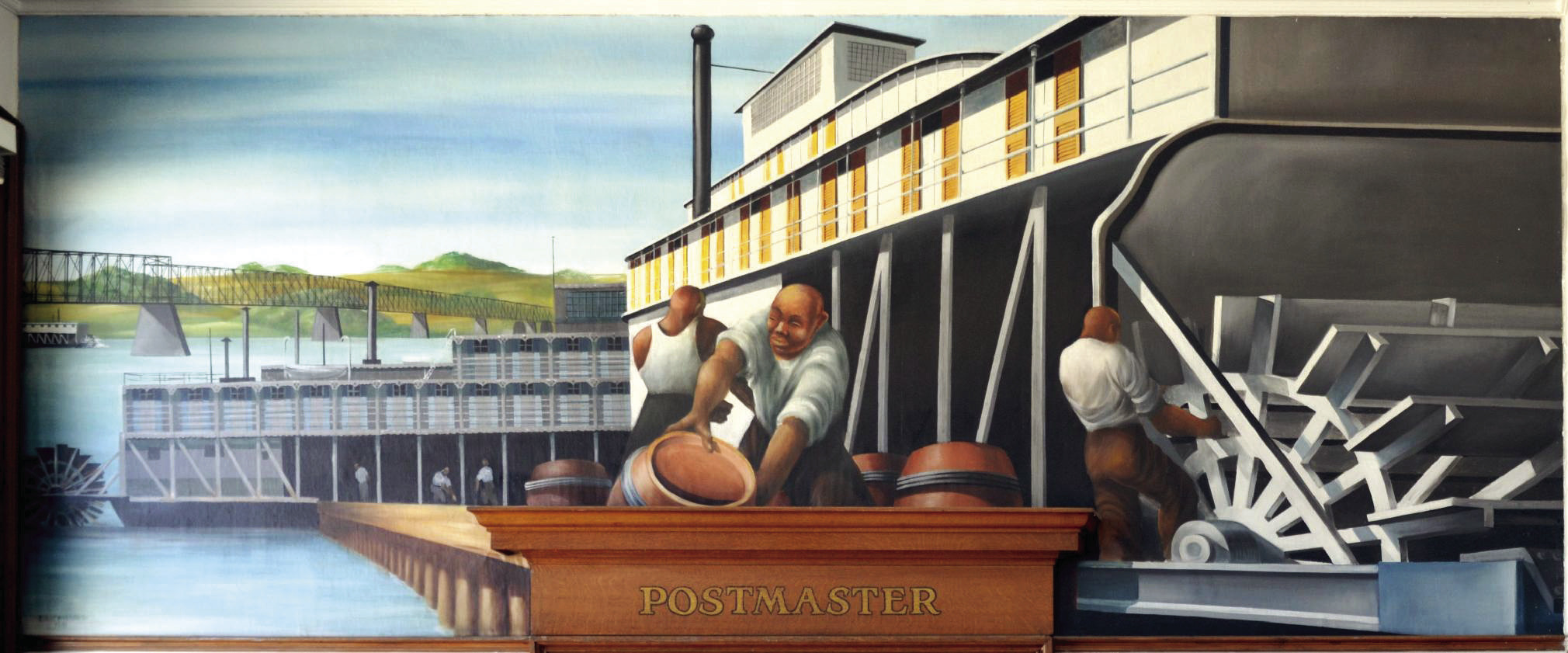
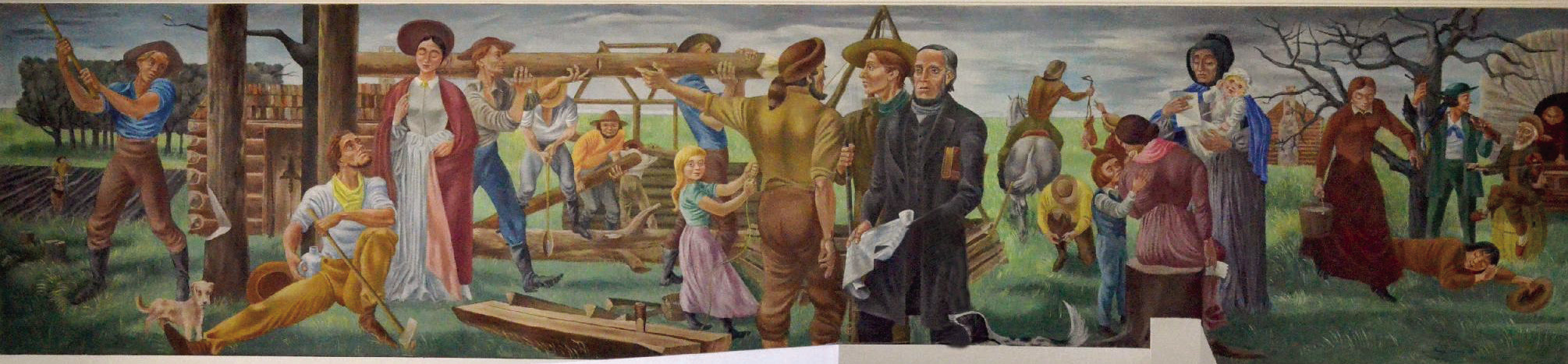
Local Post Offices Feature WPA Murals Locally, seven post offices have murals painted high on the walls of their lobbies — Galesburg, Bushnell, Lewistown, Rushville, Mt.
Sterling, Hamilton, and Carthage. All murals were created between 1938 and 1941. All have dealt with cleanings and restorations.
All are available for viewing during post office hours.
There's also a striking mural of the Champ Clark Bridge in Pittsfield's post office, but that location is a little out of our territory. The Abingdon post office displays a terra cotta relief called 'Post Rider' by Newell Hillis Arnold, but it's not a mural.
From the art work in the local post offices visited, a consistent theme and subject matter emerges. The scenes are invariably rural and historic, usually related to the local communities. Typical of most of the art work produced during the eight-year life of FAP, focus is on 'the common folk' — life on the farm, creation of homesteads and towns, laborers, mothers and families. Rarely is there any depiction of the rich or elite. In fact, many pieces unsparingly depict lives of poverty, but with a sense of determination and endurance. At least, that's what FAP wanted to depict — ambition, righteous struggle, perseverance, a distinctive American determination.
Arts Controversy
This is not to say all of America was on board with subsidizing artists, whether visual, performance, or written word. History Fair's YouTube documentary 'Federal Art Project,' stated that some projects 'were derided as supporting anti-American sentiment,' and the FAP 'was frequently criticized as a boondoggle that subsidized lazy artists who worked irregular hours and produced work on an erratic timetable.' This criticism came from political opponents of the Roosevelt administration's government assistance programs. Of course, the 'dog-whistle' issues of communism, immigrants, ethnic and religious connection were behind much of the animosity.
Many of the visual artists themselves were under pressure to produce stylized regional scenes. Rather than submit art work that depicted a more realistic view of American life, artists conformed to certain artistic themes and techniques. Or risk not getting a commission.
Frankly, the art style on display in the seven area post offices visited for this article is of a sameness, even what might be called propaganda — gritty, hard-working pioneers building America, but not oppressed immigrants, Blacks, Indigenous Peoples, and other minorities suffering under corporate interest or political agendas. It's romanticized 'feel good' art, more amazing because of how it got created through government action than for the artistry itself.
However, one can't deny that evocative art work emerged from hard-pressed artists who captured the spirit of America as it crept out of the Great Depression and marched into world conflict. More importantly, this art is all available for viewing within a 50 mile radius of Macomb.
Sources: All photos taken by Craig Rigg, used by permission of the United States Postal System History Fair, “Federal Art Project” Documentary https://www.youtube.com/ watch?v=3_tp7YZ0x1Y&t=3s “Art of the New Deal” https://www.fdrlibrary.org/ art-detail Jim Zimmer, “Federal Art Projects in Illinois during the Great Depression useum.state.il.us/ismdepts/art/ WPA/pdfs/wpa_article.pdf Tate Museum, “Federal Art Project” https://www.tate.org.uk/art/artterms/ f/federal-art-project Irene Rawlings, “The Legacy of Public Art: Storied Walls” https://www.saturdayeveningpost. com/2024/07/the-legacyof- public-art-storied-walls/ Smithsonian American Arts Museum https://americanart.si.edu/ search?query=cow%20 and%20calf%20macomb%20 post%20office “A New Deal for Illinois: The Federal Art Project Collection of Western Illinois University” https://www.wiu.edu/cofac/artgallery/ pdf/WIU_Catalogue.pdf