Go to main contentsGo to main menu
Friday, June 26, 2026 at 1:34 PM

Industry Opens 1976 Time Capsule

Industry Opens 1976 Time Capsule
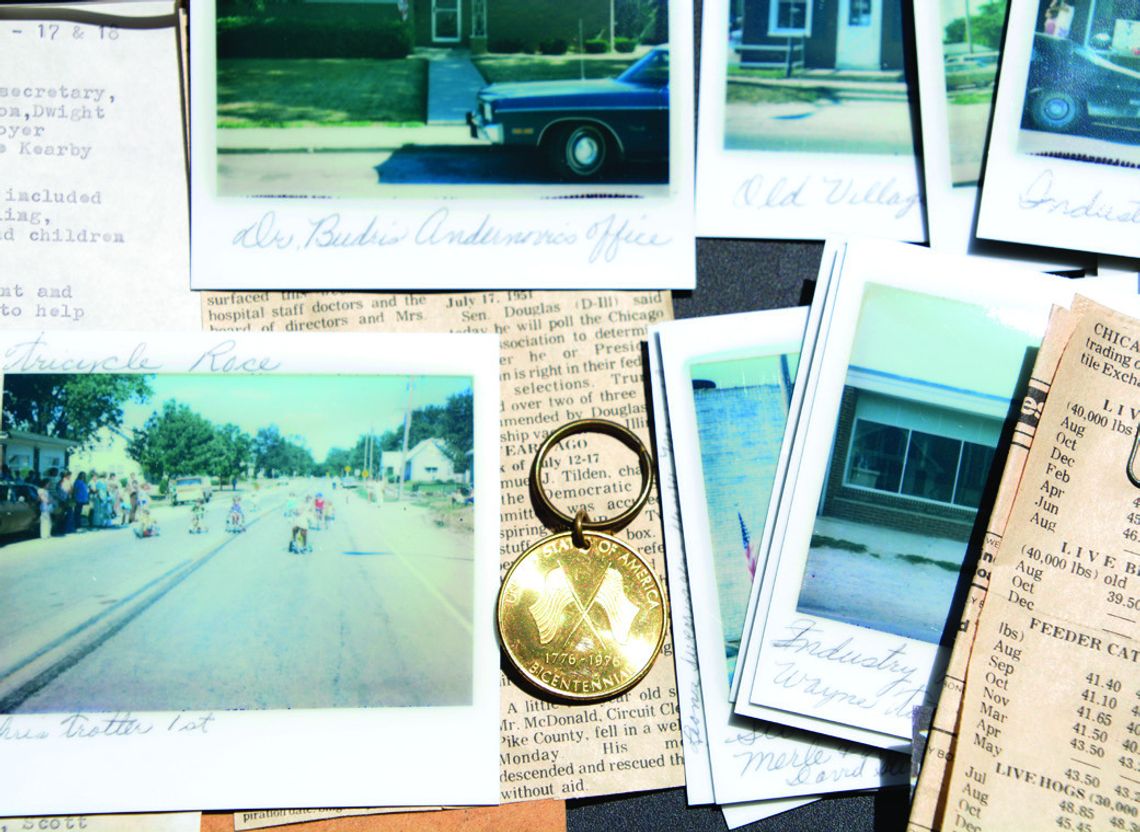
A Bicentennial coin, photo of a tricycle race, and newspaper clippings were just a few of the items in the time capsule.

If you were in Industry— population 515—in the summer of 1976, you could get your car cleaned at B&B Car Wash, pick up a prescription at Vail’s Drugs and groceries at Red Fox Foods, stop for dinner at Bud & Marge’s Tavern & Restaurant, and maybe even hit Bonnie & Clyde’s Restaurant, Bar and Dancing before turning in for the night. None of those businesses are there today, but they all were revived last Saturday at Industry’s Pinhook Days when a 1976 time capsule was opened.

James Trotter unveiled the time capsule’s contents in front of a crowd at the park pavilion. He oversaw the 1976 Pinhook Days, which also served as the town’s celebration of the U.S. Bicentennial. Trotter told the audience that Pinhook Days that year involved closing down the highway through Industry so that the event could be held on Main Street. Any drivers wanting to pass through Industry had to detour around town.

The first item Trotter pulled out of the time capsule’s envelope was a business- card piece of paper: a 1976 shaving permit.

“I’d forgotten about it, but I do remember now,” Trotter said. “All of us guys had a beard. And if you didn’t have a beard, you had to buy a one-dollar shaving permit.”

The 1976 Pinhook Days included a beard-judging contest. Industry, like other towns in America that year, encouraged men to grow beards to mimic the style of early settlers. It was seen as a playful and patriotic fundraiser.


Trotter then displayed a Bicentennial coin with Industry stamped on it.

Next came various Polaroid photos. One was a tricycle race on Main Street.

The winner just happened to be Trotter’s son Chris, who was seated nearby. “Now, he looks different today,” Trotter told the audience.

“What’s he look like today?” someone called out from the crowd.

He then read a program of events and a note that the Bicentennial committee of 1976 spent a year creating things for that celebration.

There were various newspaper clippings, which included market prices for cattle and hogs and an article about the 1976 event and its street dance, teen dance, checker tournament, tug of war, children’s games, potluck dinner, junior and senior queen talent contest, parade, and flea market.

How do you keep a time capsule safe for 50 years?

You could bury it, of course.

But back in 1976, organizers of Industry’s Pinhook Days and Bicentennial worried that no one still around in 2026 would remember where X marked the spot.

They decided instead to keep the time capsule at State Bank of Industry in a safe-deposit box.

But that plan almost didn’t work out. As the decades passed, information about the exact location of the time capsule in the bank was forgotten. Fortunately, about a year ago, Debbie Black, who works at the bank and serves as village treasurer, found the time capsule there. She was glad to locate it a year early rather than a year late.

After his presentation, as the time capsule’s items were moved to a nearby table for anyone interested to examine them, Trotter sat on a bench for an interview with the Community News Brief.

A bingo game, the next event, immediately started, and letters and numbers were called out, carrying through the pavilion. Trotter’s son Chris, tricycle-race champ and now a wellknown building contractor in western Illinois, sat on the other side of him.

James Trotter was happy to be part of the time capsule’s opening. “It was a neat event, (putting) this together,” he said.

He explained that although he was in charge of the 1976 Pinhook Days, he didn’t directly oversee the time capsule or choose which items went into it. He thinks the late Max Swearingen played the lead role in that.

“He was in charge of the bank at the time,” Trotter said. And he would have had access to a safe-deposit box to keep the time capsule secure there.

There had been discussions back in 1976 as to how long to wait for the time capsule to be reopened. “I remember, when we put it together, debating whether to make it 100 years or not,” Trotter said. “And somebody said, ‘Well, let’s make it 50— some of us might still be around.’” 1976 was just the second Pinhook Days. The year before had been the first, and Trotter said Kenny Standard had overseen that, which was treated as a sort of “practice run” before the Bicentennial.

Of those involved with the Pinhook Days of 50 years ago, Standard, Jerry Riggins, Mike Black, and Teresa Brown all still live in the area, Trotter said. “But there’s a lot of us that’s gone.” As for the next time capsule? Trotter said the Pinhook Days organizers are thinking of keeping the items from this time capsule, adding some things from this year, and reopening it in 25 years.

So far there’s no talk of burying that time capsule, either. If State Bank of Industry is still around in 2051, there’s a good chance the time capsule will be there.

The time capsule included many Polaroid photos of Industry businesses no longer in existence.
Jim Trotter opens a 1976 time capsule in Industry last Saturday. Trotter is pictured showing a “shaving permit.”

Share
Rate

Facebook