Before there was Messenger and Facetime, there was a sheet of paper, a pen or typewriter, and a stamp.
Hard copy communications was a hands-on operation when transporting a physical message, requiring a location and a handler. Thus began the postal system in America.
In honor of Colchester's approaching 62326 ZIP Code Day celebration June 23, the following is a brief review of how postal service came to the community.
Early Delivery One might want to credit Benjamin Franklin, appointed the first Postmaster General of the United States in 1775, for creating the postal system. While he did make colonial mail service more efficient, the earliest conveyance of correspondence took place in 1639 out of a tavern operated by Bostonian Richard Fairbanks. In fact, for the next two centuries, postal service likely would be housed in some prominent business in an assigned area. Postmasters often earned their coveted status through political favoritism.
June Moon in her history of Colchester wrote about the rather primitive way letters were handled. 'Claude Rogers has a letter which had been sent to one of his great grandparents. It was addressed to 'Argyle' as there was no post office at Colchester at that time. He says that Mr. Welch, the postmaster at the time, would take whatever letters he received and carry them in his hat until he met the person to whom they belonged.'
When Colchester became a municipality in the late 1850s, politics entered the picture. As reported in the 19 September, 1863 Macomb Eagle, 'The post office at Middletown [Fandon] is temporarily vacated. The last postmaster, Mr. Burton, on moving away, refused to recommend a successor to keep the office and took the property to the postmaster at Colchester. There is a large and populous tract of country around Middletown and the office is one of no little importance. It was to put these people to inconvenience and trouble that Burton acted as he did. He is a union leaguer and probably was only carrying out the principle of the order.'
Thus, it may be said that Colchester's first 'post office' arose out of Civil War political divisiveness, perhaps fueled by the bluntness of newspaper reporting.
Twenty-three years later, the extent of politics in postal service patronage was even more pronounced.
Editor J.H. Bayless of the Colchester Independent, wrote, 'Two years ago W.H.
Neece (a Macomb lawyer and U.S. Congressman from 1883-1887) promised H.H.
Stevens (newspaper editor) the appointment as postmaster at Colchester in exchange for his influence in securing for Neece the indorsement (sic) of the greenbacks for congress. Just how Mr. Neece conciliated matters and how much he paid or what he promised for Mr. Stevens' support this campaign will probably never be known.'
By 1893, the Macomb Daily Journal reported that a resolution was passed that Colchester's postmaster should be an elected position with 'the patrons of the post office to be the eligible electors,' but apparently that vote never came about.
To show that politics was still involved in postmaster appointments, Moon recorded that in 1885 Congressman Neece said that the Colchester position was the hardest to fill 'because if he recommended a Greenback man the Democrats would kick and vice versa.'
Dissatisfaction with Congressman Neece's handling of postal appointments continued with this report in the 8 February 1886 edition of the Bushnell Record: 'Bedford Graham who will go down into history as the man who did not get the Colchester post office, nobly continues his task of tearing down from its fastenings Congressman Neece's political lightning rod. We really fear Mr. Neece's solicitude, for the workingmen of Rock Island will not save him if he does not secure the location in McDonough county of enough post offices to go around among the hungry.'
Though she gives no date in her history, Moon stated that James Taylor was the first postmaster. She also shared Clara Hendel's recollection that a post office was near Joe Carson's store, (south of the tracks) then in the Jarvis Exchange (north of the tracks), then down the corner to Abe Newland's store, then back across the tracks near the Princess Theater until it reached its formal location at the corner of Coal and Market Streets.
The Bushnell Record, 9 August 1901 reported that a petition was circulated and sent to Washington, D.C., to move the post office to the Fraternity Building (north of the tracks) Fortunately, the chaos of politics and establishing a more stable location for the Colchester Post Office was about to be resolved.
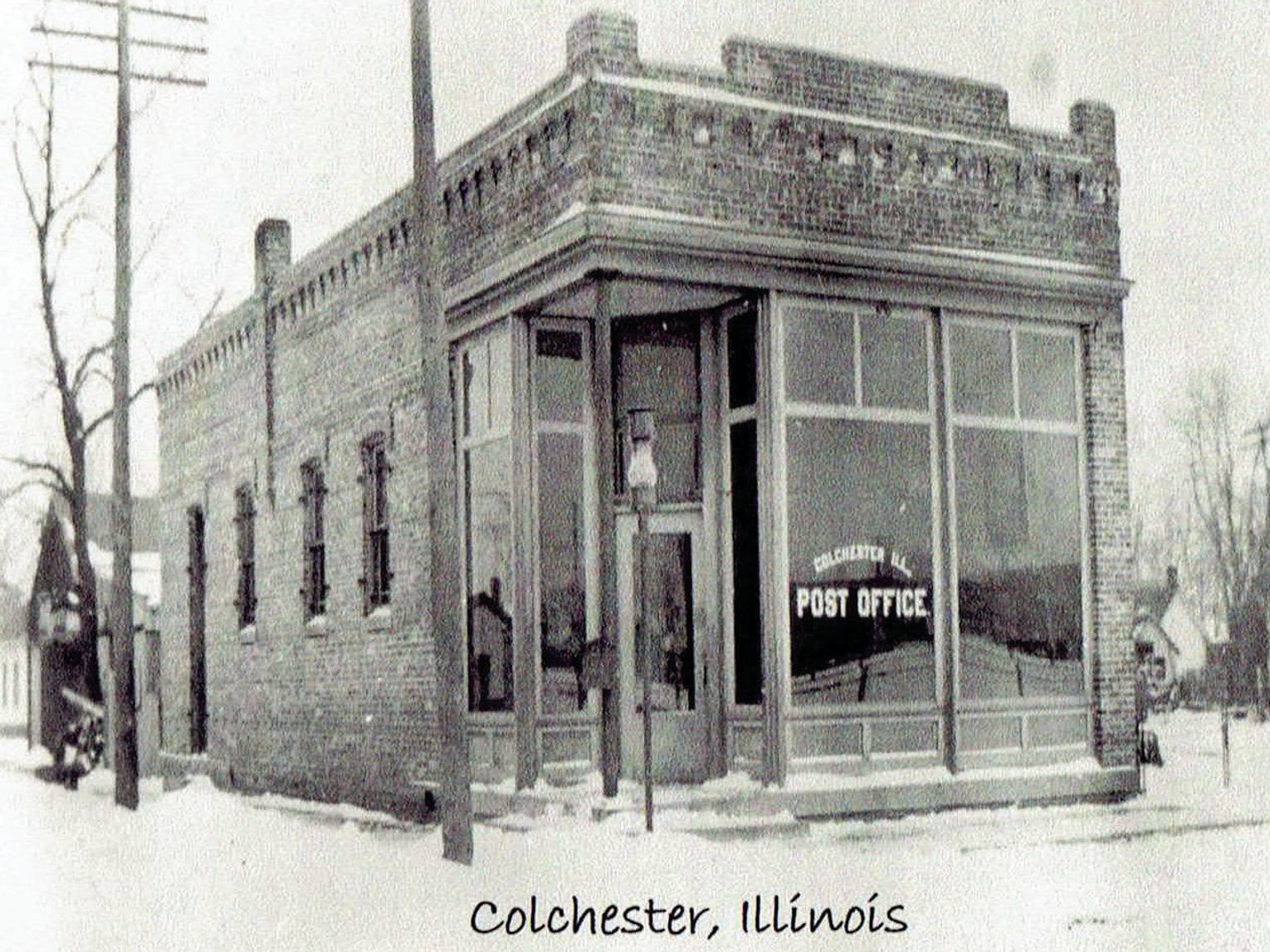
Permanent Location Anyone familiar with Colchester history knows that destructive fires have been a constant problem, mysterious or otherwise. A Macomb Daily Journal article of 19 February 1910 indicated that a fire destroyed the Colchester post office (location not reported) at the first of the month. This prompted community interest in building a permanent structure.
An inspector from the Post Office Department visited Colchester upon request from concerned citizens and accepted the 'proposal' of Albert W. Walty for the erection of a new post office building in Colchester and leasing of it to the Post Office Department for 10 years.
Walty's 'bid' was accepted to construct a 22'x58' brick building, consisting of one story, a basement, and a corner entrance. The cost, not including the lot — $4,000. The Colchester Independent stated that 'It will be one of the finest post offices in the country in a city of this size.'
King Brothers brickyard provided the bricks laid by J.D. Moon. W.W. Wheeler was the carpenter. The interior would feature dark oak with a 14-foot ceiling and include combination lock boxes. The interior fixtures costing $1,800 would be owned by Walty. Groundbreaking ceremonies took place March 24, 1910.
In the next few decades, the operation of the Colchester Post Office at the corner of Coal and Market ran without incident. In 1912, the federal government designated the post office as a postal savings depository.
Patrons could open accounts from $1 to $500 with deposits drawing 2 per cent interest and maximum accounts raised to $2,500 in 1918. The practice was popular with working people and immigrants and reached its peak during the Great Depression when many banks failed. The program was discontinued in 1967.
A New Era
Half a century after a 'real' post office had been built in Colchester, Postmaster Robert Carson announced (in a January 28, 1960, Colchester Chronicle report) that Colchester would be seeking bids for a new structure. Perhaps the old building was no longer suitable or in need of extensive repair. Perhaps it was a sign of the times — prosperity and progress. The century old building still stands as the site of Faith Market Food Pantry operated by the adjacent Tabernacle Of God Church.
The Colchester Chronicle on 5 November 1959 reported that a week earlier Dale Lewis, the Argyle Lake park custodian, received a telegram from Congresswoman Edna Oakes Simpson. She had received word from Postmaster General Arthur E. Summerfield that a land option had been approved for the building of a new post office facility on a 60'x120' lot owned by Myron Hoyt on the south side of Market Street between Coal and Elizabeth streets. Bids for construction involve purchasing the lot, construction of the new post office, and 'renting it to the Postal Department on a long term lease basis.'
Postmaster General Arthur E. Summerfield developed the Postal Modernization Program.
'Investment funds of private enterprise are utilized to obtain needed postal buildings. More than 3,300 new structures have been erected during the past five years.
Construction during 1960 will be greatly accelerated with 1,400 new facilities scheduled for completion and several hundred obsolete post offices modernized and expanded.'
Bids were accepted for the construction of a 2,025 square feet building with a 150 square foot loading platform and 450 square feet of hard-surface parking immediately east of the current post office. The bid from Mr. and Mrs. Frank Kyte of Lansing, Michigan, was accepted. Unfortunately, bids for small-town, mid-century USPS facilities are typically kept as private leasing contracts or closed historical federal archives. The new facility would remain as private property and be subject to local taxes and leased to the federal government for 10 years.
Excavation on the new post office began the week of July 21, 1960, by Orval Torrance of Blandinsville with an expected completion date by October 1, according to the Colchester Chronicle.
However, the Chronicle later indicated that the new post office opened on December 2, 1960, with Robert Carson as postmaster and Mary Ellen Oakman as custodian.
Three and a half years later, the U.S. Post Office launched the ZIP Code, or Zone Improvement Plan system (grammar nerd alert: the three letters ZIP should always be capitalized), And now, 63 years later, postal patrons within the Colchester mailing area will get a once-in-forever opportunity to celebrate their own ZIP Code day — June 23, 2026 — 62326.
(Note: Marilyn Shelley has done extensive research by assembling local newspaper clippings on Colchester's series of post offices. Her work provided the details for this article.)