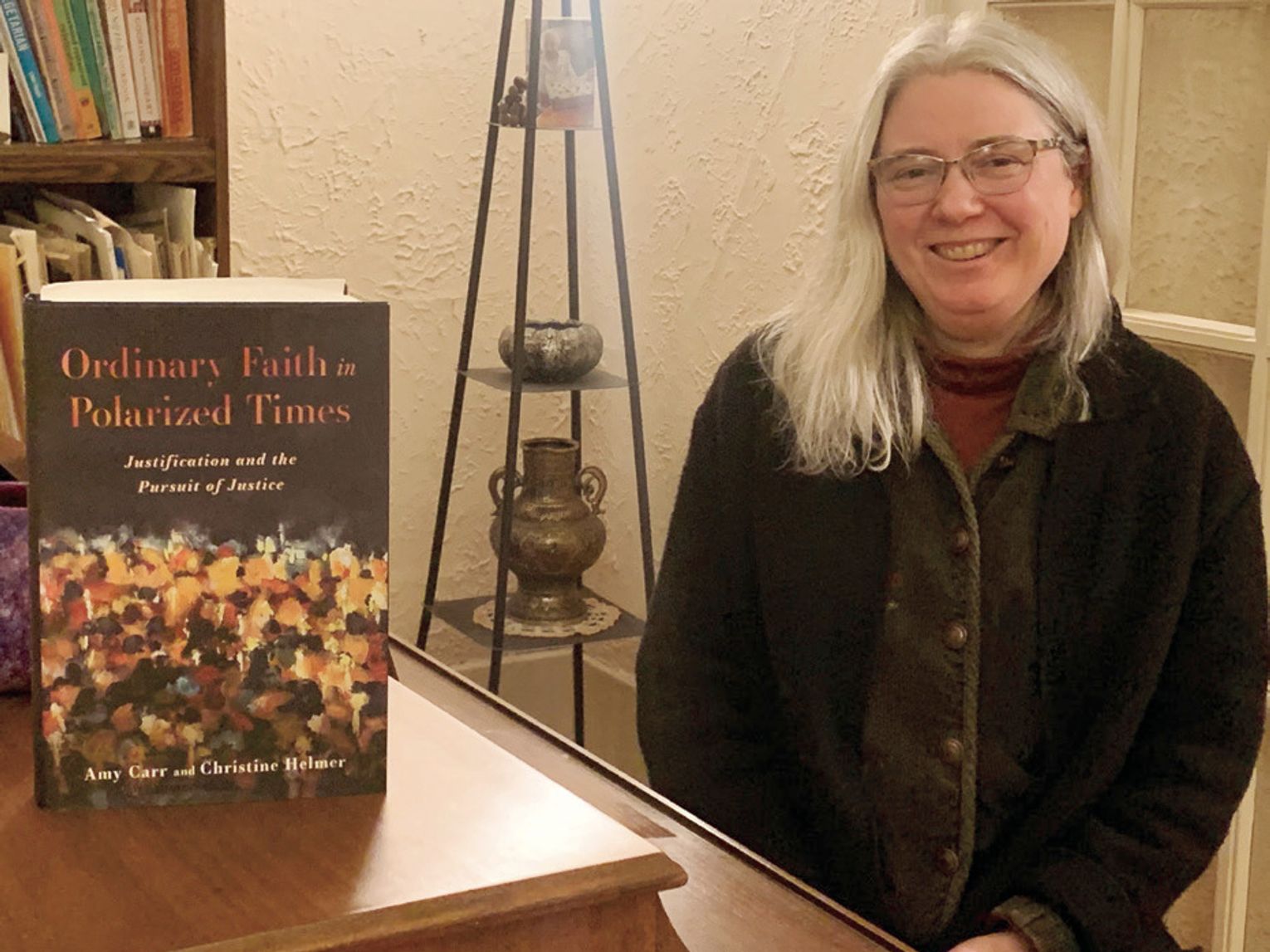
From an early age, Lutheran theologian and Western Illinois University Race, Religion, Gender & Multidisciplinary Studies Professor Amy Carr has known the power of “the word.” As a child of six in L’Anse, MI, she remembers going to a Methodist church on a local reservation and being struck by an inscribed verse from the hymn, “This Is My Father’s World” by Maltbie Davenport Babcock: This is my father’s world, And to my listening ears All nature sings, and round me rings The music of the spheres. Reading the phrase “the music of the spheres” (a reference to the ancient belief that the orbits of the planets corresponded to musical harmonies) immediately triggered in young Amy an experience of the religious sublime.
“The world changed appearance for me: there was a bright light behind everything, I couldn’t make sharp distinctions,” Carr remembered. “That was one of the starts that got me interested in thinking about God and thinking about metaphysical and theological questions, although obviously I didn’t have the language for that then.”
As profound and transformative as this experience was for her, even as a child Carr realized it wasn’t universal.
“I described it to the girl who lived in the trailer next to mine and asked if she saw it too, and she said ‘no!’” Carr recalled.
Carr’s vision inspired her to dedicate a lifetime to studying the divine, and she has since become a respected theologian, a tenured professor, and a published author. However, she has never forgotten that there are those who see things differently.
Carr went on to get her undergraduate degree from Carleton College in Northfield, MN. Enchanted by the power of words, she started off as an English major, but switched focus after taking a class on religion and literature and realizing that Religious Studies was where she could really pursue the questions she was interested in. After a year in Central America as part of the Lutheran Volunteer Core, Carr returned to get her Master of Divinity degree at Vanderbilt University in Nashville. She achieved her Ph.D. in theology from the University of Chicago in 2004.
In 2000, Carr picked up what she thought would be a temporary position teaching at Western Illinois University in the Department of Philosophy and Religious Studies (which is now the Department of Race, Religion, Gender, and Multidisciplinary Studies). She worked while studying for her doctorate and decided to stay on after obtaining her degree, earning tenure along the way as well. Her classes introduce students to the world’s major religions and sometimes delve into more specialized topics. For example, she teaches one class that’s just about the figure of Jesus and how he’s seen both inside and outside of Christianity.
One of Carr’s great strengths as a professor is her open-mindedness. Avery LeJeune, director of Campus Ministries at the Campus Students for Christ, is an alumnus of WIU and one of Carr’s former students. He still remembers taking her classes around 2010 when he was studying for his bachelor’s degree.
“It was pretty clear early on that we disagreed on a lot,” commented LeJeune. “I come from a conservative background, and she’s much more liberal. And yet the conversations were never difficult, and we could acknowledge our differences pretty easily. I remember in class being struck by something she would say and reflecting on it, but then the reverse was true, as well— she would actually take what you were saying and be like ‘oh, I hadn’t thought of it like that before.’” LeJeune made sure to emphasize how Carr’s pedagogy was distinct from the looser, “anything goes” approach from some of his other professors.
“I would describe her teaching as thoughtful and evenhanded, but she’s not going to let you get away with much in your work,” LeJeune said. “She does everything she can to pull as much out of you as she can, and I respected that.”
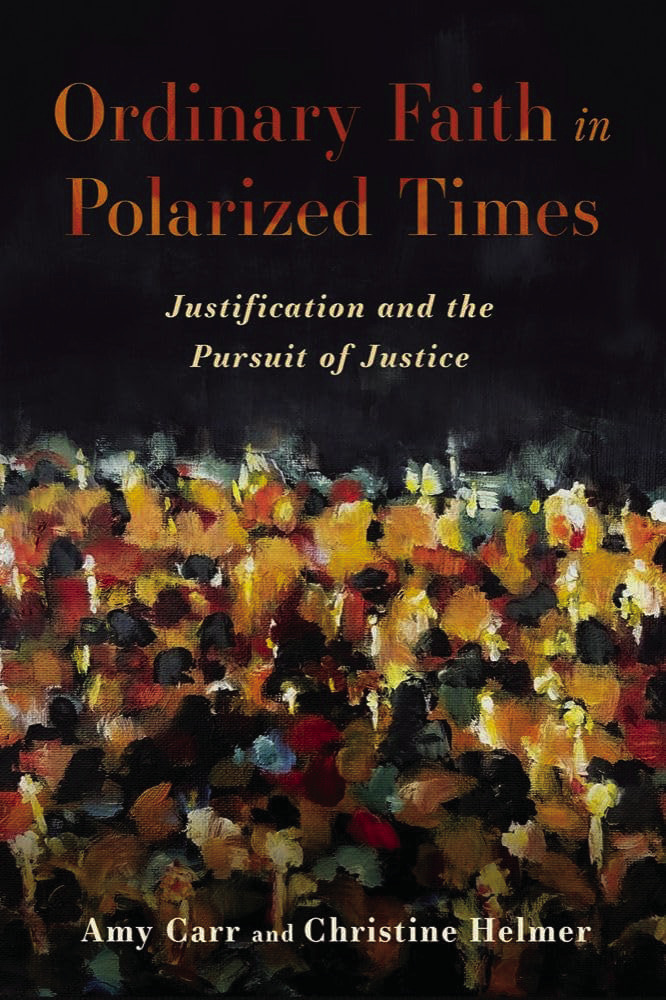
While Carr is willing to deeply consider other points of view, she refuses to do so at the cost of argumentative rigor. Carr carries forward this spirit of careful consideration and measured dissent into her writing, especially her recent book: “Ordinary Faith in Polarized Times: Justification and the Pursuit of Justice,” which she co-wrote with Christine Helmer from Northwestern University in Evanston, and published in 2023. The book was positively received and was a finalist for the 2024 PROSE Awards in the area of Theology and Religious Studies.
The big impetus for writing the book was what Carr and Helmer saw as growing polarization inside the church and the centering of politics in Christian identity. They criticize the growing tendency amongst Christian denominations—both right-leaning and left-leaning— to align what it means to be Christian with having the correct stance on certain hot-button culture war issues: abortion, transgender access, immigration, etc. Not only does this kind of virtue signaling divide the body of Christ and distract from the actual work of justice- seeking, but Carr and Helmer argue it misleads believers from what should be the true locus of Christian identity: justification by faith in Jesus Christ.
“What we’re trying to stress is that that condition of Christian belonging goes back to your baptism,” Carr commented. “It’s justification by faith and grace—it’s a gift, and you can choose to either reject it or grow into it.” She discussed how Christianity has a strong tradition of grace where believers are saved not by good works or right thinking, but through faith in Jesus, who died for their sins. Overpoliticization of Christian identity contradicts this doctrine by instead making church belonging all about who you voted for in the last election.”
Carr and Helmer further argue that when Christian identity is centered on justification by faith, it creates healthier communities and better communication across ideological divides. This is crucial for true justice-seeking, which Carr and Helmer believe is most effective when it is communal. In “Ordinary Faith in Polarized Times,” they criticize modern Christians as seeing themselves too much in the model of the Biblical prophets: extraordinary individuals of faith who bravely speak truth to power no matter how many are aligned against them; Martin Luther is often modeled as the paradigm of this type in Lutheranism, whose “here I stand” perseverance initiated the Protestant Reformation. Lionization of these figures tends to obscure just how much of the work of justice-seeking is done in groups. In Christianity, this is the church, or what Martin Luther King Jr. described as “the Beloved Community.”
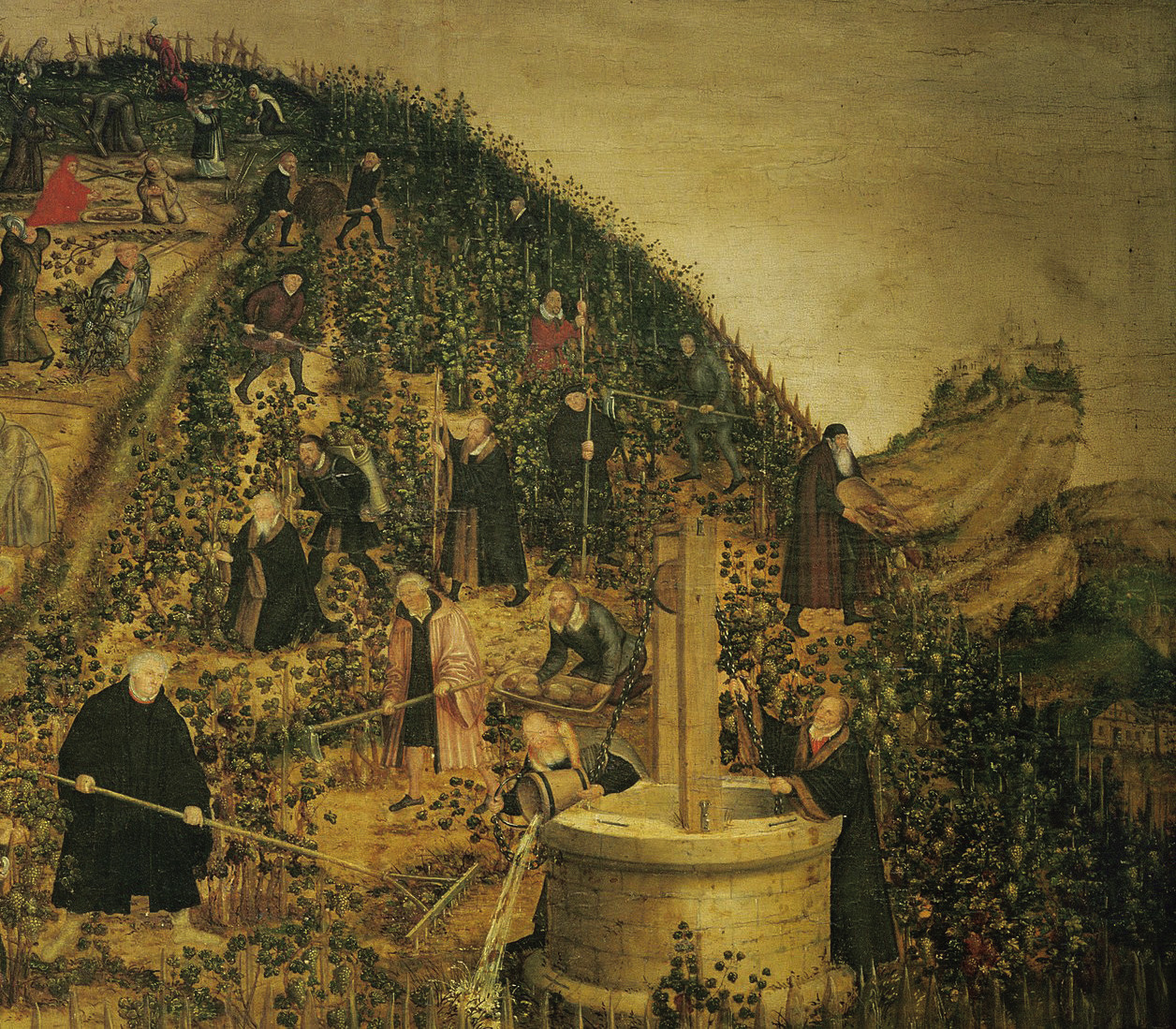
In contrast to the individual prophet, Carr and Helmer encourage believers to think of themselves as workers in a garden. At one point in the book, they reprint the painting “The Vineyard of the Lord” (1569) by Lucas Cranach the Younger, itself a reimagining of The Parable of the Workers in the Vineyard from the Gospel of Matthew. Martin Luther is depicted in the painting, here seen not as the brave prophet-reformer standing his ground against the Catholic powers of Europe, but as a dude with a rake, just one of many working to cultivate the grapes of justice.
“The vineyard of God’s Beloved Community requires all sorts of workers with many tools and talents,” Carr and Helmer write. “There is no one prophet, crying alone in the wilderness, but a group of workers, each important in their assigned task.”
Carr and Helmer illustrate these principles through the issue of abortion. In Chapter 4, they take it as a prime example of one of those culture war issues which has polarized the church. Christians tend to view abortion in starkly black and white terms and routinely demonize those that take an opposing view such that it has become a sort of litmus test for ecclesial belonging—for most churches, being Christian means being pro-life. Not only does this decenter faith in Christ as the heart of Christian identity, but it also creates a culture of silencing in church communities where people—especially women—are afraid to express their true feelings lest they be ostracized. Carr and Helmer have, in fact, experienced this type of ostracism firsthand when they had pro-choice writings of theirs held up by a reviewer as an example of why there should be no female ordination.
According to The Guttmacher Institute, about one in four American women will have an abortion in their lifetime, and many of these women go to church. If even some of them are afraid to share their experiences and perspectives on abortion, then that’s a lot of gardeners not out working in the vineyard. Carr and Helmer argue that communal justice-seeking requires churches not to dogmatically enforce either a pro-choice or pro-life line, but to create spaces where it’s possible for all members to speak their minds and work together across their differences. They write that “identification with Christ draws Christians into heartfelt dispute to work together, to discuss with one another how they imagine justice-seeking in the area of abortion.”
Carr has continued a professional correspondence with Helmer, and they are currently pitching publishers on plans to edit a series of co-authored books, “How to Think Theologically About…” with topics ranging from ecology to masculinity to drugs. The philosophy behind this series is to encourage theologians from different backgrounds to come together and think through a richer understanding of their subject than either could come to alone—in effect, Carr and Helmer are putting into practice the principles outlined in their book.
Independently, Carr is also writing another book titled “Facing Divine Affliction: A Lutheran Theodicy for the Sinned-Against” for the series called Lutheran Reconstructions of Doctrine. In the book, she hopes to address “How to interpret theologically difficult experiences of God in the wake of sexual abuse, domestic violence, difficult often interpersonal abuse.” She also continues to work as a full professor at WIU, where this fall she will be teaching classes about world religions and the Bible.
Towards the end of our interview, I asked Dr. Carr what broadly she was trying to achieve with a book like “Ordinary Faith.” Carr replied that she wanted readers to “share more stories, and listen to ours.”