It’s about living.
That’s how Michaell Zimmerman, registered nurse and director of McDonough District Hospital’s Home Health & Hospice Department, describes hospice care.
“We focus on comfort and living,” she shared. “We want you to be able to live your life without the burden of anything extra.”
One of the main misconceptions that Zimmerman, who has been a part of the MDH Hospice team for over 18 years, wants to dispel is that hospice is intended just for patients with cancer. Rather, hospice is available to anyone who has a life-limiting illness with a prognosis of six months or less. That can be anything from a lung disorder (COPD), dementia, kidney disease, anything that could be considered terminal in nature, she explained.
“The comfort and quality of life that MDH Hospice provides is something I’m so proud to be a part of,” Zimmerman noted. “We have a wonderful team that provides medical care and assistance not only for the patient, but for their loved ones as well.”
The hospice team is composed of a medical director (Dr. Amy Waschull), a hospice doctor (Dr. Julie Shepherd), social workers, certified nursing assistants, registered nurses, volunteers, a supervisor and Zimmerman. Hospice care is provided in the patient’s home, a nursing facility or an assisted-living facility.
“We focus on individualized care. It’s not a blackand- white approach as each person is different and we will tailor the care based on their needs,” she explained. “What is similar is that the patients we’re working with have decided they are choosing to no longer go to doctors’ appointments, or continue with treatment or medication. No more labs, no more hospital visits. They’re choosing to focus on comfort and living their life no longer burdened by appointments and doctor visits.”
While pain relief is part of the comfort-based care, Zimmerman stressed that hospice is much more than “coming in and giving medications to a patient, and that’s that.” They provide emotional support for both the patient and their family members, help with endof- life planning and decision- making, and ensure the patient has what they need in terms of equipment (a hospital bed, wheelchair, oxygen, etc.) and supplies (bed linens, for example).
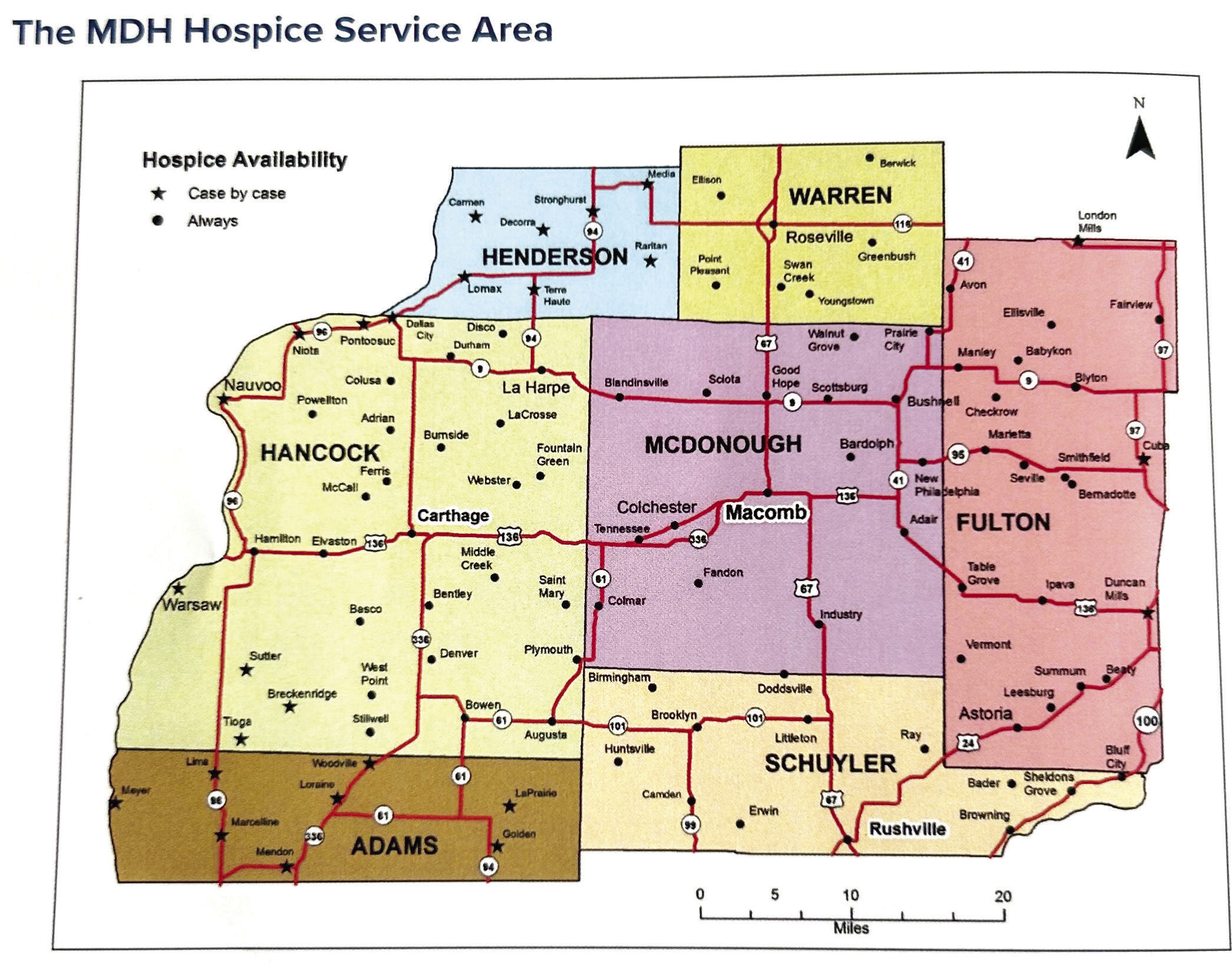
Individuals who have a life-limiting illness are eligible for hospice when they’ve had that conversation with their doctor, who then prescribes the order. The program, which is notfor- profit and is licensed in McDonough and surrounding counties, is covered by both Medicare and Medicaid, and most insurance plans; however, thanks to the generosity of donors to the Hospice Memorial Fund, no one is ever turned away from the program and the patient, nor their family, will ever see a bill from hospice. Zimmerman said the ideal time to have that conversation is sooner, rather than later, because earlier admission into the program provides more time for hospice to ensure comfort at the outset to make the journey a bit less stressful.
“We want to help you have more time to enjoy your life,” she stressed. “If we can help relieve your symptoms so you can feel better so you can play with your grandkids without pain, or get out of the house and go for a car ride, we want to help make that happen.”
And once someone is enrolled in the program, the hospice team takes care of everything. Equipment delivery and set-up, medication and pain management, supplies and more. The team comes to the patient, whatever the need may be, it could be a few times a week or daily. Plus, a hospice nurse is always on call 24/7, so it’s not just a 9-5 service, Zimmerman added.
“Even if we’ve been to see you earlier you in the day, and the situation changes later, we have someone available,” she said. “The biggest myth, besides hospice being only for those with cancer, is that it ‘speeds up death’ or that it’s for someone who is ‘ready to die.’ It is none of those things. Hospice really does focus on living. Once we help get your symptoms under control and you feel better, you can go back to living your life. And we will provide what you need so you can celebrate your life.”
MDH Hospice’s average daily census is 18 patients. In 2025, they assisted 166 patients overall. Even after hospice is no longer coming to the home, services continue for up to 13 months following through the program’s bereavement program for families, which includes a support group. Every November, MDH Hospice also hosts a memorial service for families who have lost a loved one in the past year.
“We are taking care of our neighbors, our friends, our friends’ family and our family. It is an honor to care for the members of our community,” Zimmerman said. “We focus on quality of care, dignity and comfort, and we’re proud to be a part of someone’s life.”