County Law & Legal Discuss New State Referendum
Vote Moves to Full Board to Ask Voters if They’re Interested in Forming a New State
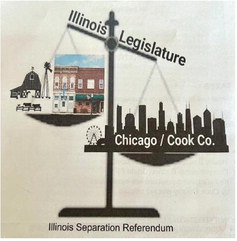
At Monday’s McDonough County Board Law and Legal committee, all but one member voted to place a referendum on the November ballot asking voters if they would consider the “possibility of creating a new state and separating from Cook County.” This, organizers say, give their group an “idea of how many Illinoisans would be interested in moving forward.”
The vote for the referendum to be placed on the ballot now goes to the full board at its meeting on June 17.
Thirty-three other county boards across the state, mostly located in southern Illinois, south of Sangamon County, have approved the referendum on their November ballots.
The wording that will appear is on the “Illinois Separation Referendum” is: “Shall the Board of McDonough County CORRESPOND with the boards of other counties of Illinois outside of Cook County, about the POSSIBILITY of separating from Cook County to form a NEW STATE, and to seek admissions to the union as such, subject to the approval of the people?” A Board Member's Perspective
Board member Clayton Cook (Rep.), who represents McDonough County Board District 2, invited Loret Newlin, director of Illinois Separation, to present her group’s initiative. This organization, which formed in 2016, is not affiliated with New Illinois, another group that is attempting to secede the rest of the state from Cook County. Law and Legal Committee members voting for the referendum to be on the November ballot asking voters if they would consider the possibility were Cook, Travis Hiel, Ryan Litchfield, Terry Thompson, Roger Ward, Riley Smith and Joe Erlandson.
Ken Durkin cast the lone “no” vote, and refuted Newlin’s claims that downstate doesn’t benefit from trickle-down dollars from Cook County.
Cook added during the meeting that a referendum like this should be on every ballot in every election, noting that referendums like this can give local units of government direction, and asking the people what they think about things on board members’ radar every time a ballot is printed.
“It’s an easy way to be more transparent and gives us a look into what the community thinks is important,” Cook explained. “It’s also important for the county board to know because this movement has been voted on by a few of our neighboring or near neighbor counties and is on the ballot for other neighbors this November. There really is no reason that we should not also give our McDonough County voters the chance to answer the same question.”
He told The Community News Brief he invited Newlin to the committee meeting because he requested that discussion and a potential vote regarding the Illinois Separation Referendum be added to the agenda.
“This movement is one of those conversations that comes up, and through conversation with others is how it got on my radar. There is another group, New Illinois, that has a similar idea, and that is probably what spurred some of the conversations and then some Google searching turned up the Illinois Separation Referendum group,” Cook said. “I think it’s interesting because it’s a non-binding referendum.
All that it does is ask the people, should we (the county board) be talking with other counties about things like this, or is the majority of McDonough County not interested in the topic.”
According to Cook, he is interested in looking more into the Illinois Separation initiative, if that is what the people want. If the referendum gets on the ballot, and fails, then it’s not something he would continue to spend time on, he noted. Cook also said he thinks this is interesting how this effort ties into the region’s Forgottonia history.
“We all see the Forgottonia branding in Macomb. Everyone should also know that it was a movement headquartered in McDonough County, with its main activity in the early 1970s. It was mostly created to bring awareness to the fact that we needed to be better included in things the state was doing, and not doing for us, at the time,” he added. “The Separation Referendum is a similar movement, albeit far lower on the scale of severity. Fortgottonia was a secession movement from the United States, the Separation Referendum asks the voters if we should talk about forming a new state, within the United States. If we have more conversations and find out separation is the best way to get better representation and lower taxes downstate then, yes, I would be in favor of it. If the conversations lead us toward something other than separation, but it’s new and helps downstate then that’s what I would be in favor of. We have to start a more serious conversation first, because we don’t yet know all the potential paths to fix the issue.”
Cook said it’s the hope, if this would come to fruition, the benefits would be that there would be better representation at a state level: no gerrymandered congressional districts, being able to write new property and sales tax codes that put Illinois (or the new state) more in line with states like Iowa and Missouri.

“We hope that Chicagoland would be able to create state level laws for itself that work up there, but that would no longer apply to us downstate, where they don’t work as well,” he added. “ The way I look at it is, if we have this large economic engine, in the northeast corner of the state, pumping money down to us then why are our (downstate) taxes so much higher than neighboring states that lack a large city like Chicago? Why when you compare our roads, and schools and other local governments run things to our neighbors, ours seem equal to, or in some cases are in slightly worse shape than our neighbors in Iowa and Missouri. If our taxes are higher than Iowa and Missouri, plus we add in the “trickle-down” money from Chicagoland, that should put us in a far more powerful place than our neighbors, right? In a perfect reality we should be able to have lower sales and property taxes downstate and do the same work, since we have the extra money from Chicagoland, somehow this is not the case. Somehow downstate and rural Illinois can’t seem to operate with lower taxes like our neighbors when we are similar in every respect.”
Excerpts from the Illinois Separation Packet: In a nine-page packet Newlin provided to board members, the Illinois Separation, on page two, states “OUR GOALS OF FORMING A NEW STATE isn’t about skin color (with different color heart emojis) or political party (with a red check box and a blue check box), IT IS ABOUT TAXES, VALUES, REPRESENTATION AND CONSTITUTIONAL RIGHTS.”
Taxes: Illinois has had 57 new or increased taxes and fees since January 2019.
Representation: Gerrymandered Districts (Illinois Senate District, Grade F; House District (Grade B); Congressional District (Grade F); Key leadership positions are mostly held by Cook County Elected Officials.
Constitutional Rights: 1st Amendment – Freedom to Assemble/Worship violated 2020; 2nd Amendment – FOID card and additional gun laws; 4th Amendment – Warrant-less wiretapping, drone spying (this was a law when ISR began, but has expired), Article IV, Section 4.
During her presentation, Newlin told the board the media and others “have put out a lot of misinformation and have misrepresented their group and its efforts.” She stated four things the referendum is not: - It does not include any plan to join Indiana or any other state.
- It is not a vote to separate from Cook County – it’s a vote to look into the possibility.
- This referendum is not the work of another organization called “New Illinois,” which formed two years after Illinois Separation.
- It is not about separating from America, but forming a new state from an existing one, just as four other states have done (in the 1700s/1800s).
Newlin’s group states in the informational packet that “Article 4 – Section 4 Republican Government from the U.S. Constitution states: The United States shall guarantee to every State in the Union, a republican Form of Government, and shall protect each of them against Invasion; and on Application of the Legislature, or of the Executive (when the Legislature cannot be convened) against domestic Violence.”
'Just Powers by the Consent of Government' “Many of us no longer consent to being governed by the Cook County-dominated legislature, which seems unaware of how differently the rest of the state lives, our values and our morals, or how laws for the city of Chicago are often inappropriate and oppressive to the rest of the state,” Newlin shared. “Our goal is to realign the new state with the U.S. Constitution, restore representational government, and return more power to the county level.”
The Community News Brief asked Newlin, via email following the meeting, to further explain the group’s views and message, and how will the rest of Illinois afford its services, programs, education, etc. without the trickle down that Board Member Durkin mentioned during the meeting. In addition, what constitutional rights will downstate “gain” if Cook County was no longer part of the “new state.”
Explaining laws for the city of Chicago as “often inappropriate and oppressive to the rest of the state,” Newlin provided such examples as the 2019 gas tax, vehicle registration fee and trucking registration fee, as well as the 2025 PaintCare fee. She also pointed to a 2019 and 2026 attempt to “slap a per mile fee on us.”
When asked about how the new state would make up for lost revenue as a result of secession, Newlin pointed to numerous out-migration of businesses and people from Cook County.
“I seriously doubt that they are the economic engine that some like to believe they are,” she noted. “Illinois’ overall tax climate, pension obligation and operational costs contributed to these loses. Not only that, but damage to facilities by protestors and concerns for employee safety were also a factor for relocation. There can’t be this much loss of business and Cook County still be a major contributor of revenue.”
As for making up lost revenue, according to Newlin, the new state will be able to continue to charge Cook County for their people incarcerated in downstate prisons.
“Approximately $526 million yearly based on the IDOT website which had 2022 cost per inmate and 2024 population. This is not accurate, but is the best I can do with the resources available,” she added. “Cook County has too many for its jail, so is paying to house overflow in some northern county jails. They would still need that if we separated.”
She also pointed out other cost savings such as few legislators living in an area with the highest cost-of-living, changing legislative pay, switching state employees to a 401K style pension or DIY plan, less corruption and not paying for people who “do not have the legal right to be here,” among others such as capitalizing on the state’s natural resources (oil and coal). As for the “Constitutional gains,” Newlin pointed first to FOID and firearm laws.
“No more FOID cards and other gun restrictions and fees. That is a big one in rural downstate. Article IV, Section 3 rights. The Illinois Constitution says we are supposed to have a balanced state budget, but they seem to be claiming that it is when it isn’t,” she said. “I would want us to be like Texas in that the main reason their legislature meets IS to do the budget, not something that shows up the week it is to be voted on. The Illinois Constitution also says that our legislative districts are supposed to be compact and contiguous. They are neither in the current state, but in the new one, they will be.
“The ones who are for the separation will read the referendum and vote ‘yes,’ because it is really is about taxes, values, representation, and Constitutional rights. That is a clear, simple statement. People who are experiencing the problems of those four understand it without elaboration and experts aren’t going to dissuade them from voting ‘yes,’ Newlin concluded. “There is one more thing. People are sick and tired of the government sticking its nose into so much of our lives and businesses. We just want to be free to live without interference, over-regulation, and unnecessary complications.”
More information can be found by searching Illinois Separation Referendum on Facebook.
The Other Side of the Coin: The Impact of a Secession
“We are aware that debt and pension obligations will need to be divided fairly, and there are universities and prisons to consider,” Newlin said. “We are aware that Cook County contributes a sizable amount to the State of Illinois; however, Cook also has significant expenses. There are areas we would save money by separating. With different laws, we would attract businesses.”
In a 2024 Community News Brief story highlighting similar efforts by New Illinois, which has a chapter in McDonough County, to secede from Cook County, making such a move to form a new state would cost downstate millions in tax revenues reaped from Cook County, noted Chris Merrett, director of the Illinois Institute for Rural Affairs at Western Illinois University. The IIRA researches and studies economic development throughout Illinois, the impact of taxes, business and industry on rural areas and other factions that affect and impact rural regions throughout the state. The Community News Brief once again reached out to Merrett to review the information presented, and to share the impact a secession would have on downstate (outside of Cook County) Illinois.
To put dollars into perspective, for every $1 that taxpayers, including taxpayers in west central Illinois, give to Springfield, they get $1.87 in benefits and investments from Springfield. Going into far southern Illinois, for every $1 that taxpayers pay to Springfield, they get $2.87 in funding, all while Chicago/Cook County receives around 90 cents for every $1 that taxpayers pay, Merrett pointed out.
Merrett noted the data the group is sharing that shows miles of roads and bridges is presented to argue that downstate counties are not getting their fair share of funds to maintain roads. However, he explained, it misses the key point that it is not just miles of roads and bridges in a county that matters. It is the traffic volume that drives on these roads and bridges that matters.
“Gasoline taxes help to pay for the roads, so there are way, way more gasoline taxes collected in the Chicagoland area to support roads that have magnitudes more traffic driving on these roads. However, the state redistributes some of those funds collected in the Chicagoland area to downstate counties, even though downstaters pay fewer gasoline taxes,” Merrett stressed. “So, that data does not give a true measure of road maintenance that is required, nor the taxes that are paid. The implication of that data is that downstate taxpayers are paying more per mile to maintain the roads in their respective counties. But the data they share does not prove that point.”
Merrett went on to say the group doesn’t appear to understand current demographics affecting downstate counties. Many of the counties that have voted on this initiative or plan to this year, have populations that peaked decades ago. McDonough County peaked in 1980, he said.
“Do they think that if McDonough County joined some new state that the population would increase? What do these people think would happen to WIU, which has already experienced enrollment declines. They shared a map showing the Illinois Separation referendums by county,” Merrett said. “Almost all counties that plan to have a referendum or have collected enough signatures to have a referendum have experienced long-term population declines. Henderson county’s population peaked in 1870. Hancock County’s population peaked in 1870. Saline, Hamilton, Brown, Edwards, Wayne, Wabash and Gallatin counties all had populations that peaked almost a century ago.
“These population declines are driven by technological change, for example, in agriculture and mining. It is also caused by declining birthrates and rural outmigration. How will creating a new state boost population, economic development and the local tax base for these counties? It won’t,” he added. “These counties have a median age that is older than the state average. They claim that they will attract new businesses to help spur development in their new state. That is not likely to happen in a county or a new state with a declining and aging population, with a shrinking tax base.”
Merrett also said the information presented is based on the “false” premise that individuals in the collar counties will agree to sever ties with Cook County. The reality is that the collar counties prosper because of Cook County, he said.
“And it is the collar county region that really shares tax revenues with the rest of the state. This movement, if they are being transparent, should be telling their supporters that they are seeking to separate not just from Cook County, but all of the collar counties, because the collar counties depend on their connection to Cook County and the City of Chicago and will never vote to separate from Cook County and Chicago,” Merrett said. “So, my thoughts are that the creation of a new state may create a greater sense of political control. However, it will just accelerate economic and demographic decline in the participating counties.”
An Example to Consider
Using the West Prairie School District as a hypothetical example regarding costs that would shift to the region should Illinois “split,” Merrett shared West Prairie’s total school budget of $13 million, the state provides 18.9 percent of the budget, which equals $2.5 million. As west central Illinois gets $1.87 for every $1 given to the state, they are only contributing 53 percent – or about $1.3 million – to the state’s share of the revenue which is returned to the region.
“If a secession happened, the district would have to come up with additional 47 percent – or $1.2 million – that the Chicagoland region previously provided to maintain the same quality of education in the district,” Merrett concluded. “This would mean higher property taxes to fund this locally, or higher income taxes sent to the new state to make up for the budget shortfall. The other alternative is to reduce the quality of education. The bottom line is that without the added support from Chicago and the suburbs, communities in the new state will either have to raise taxes or cut services.”