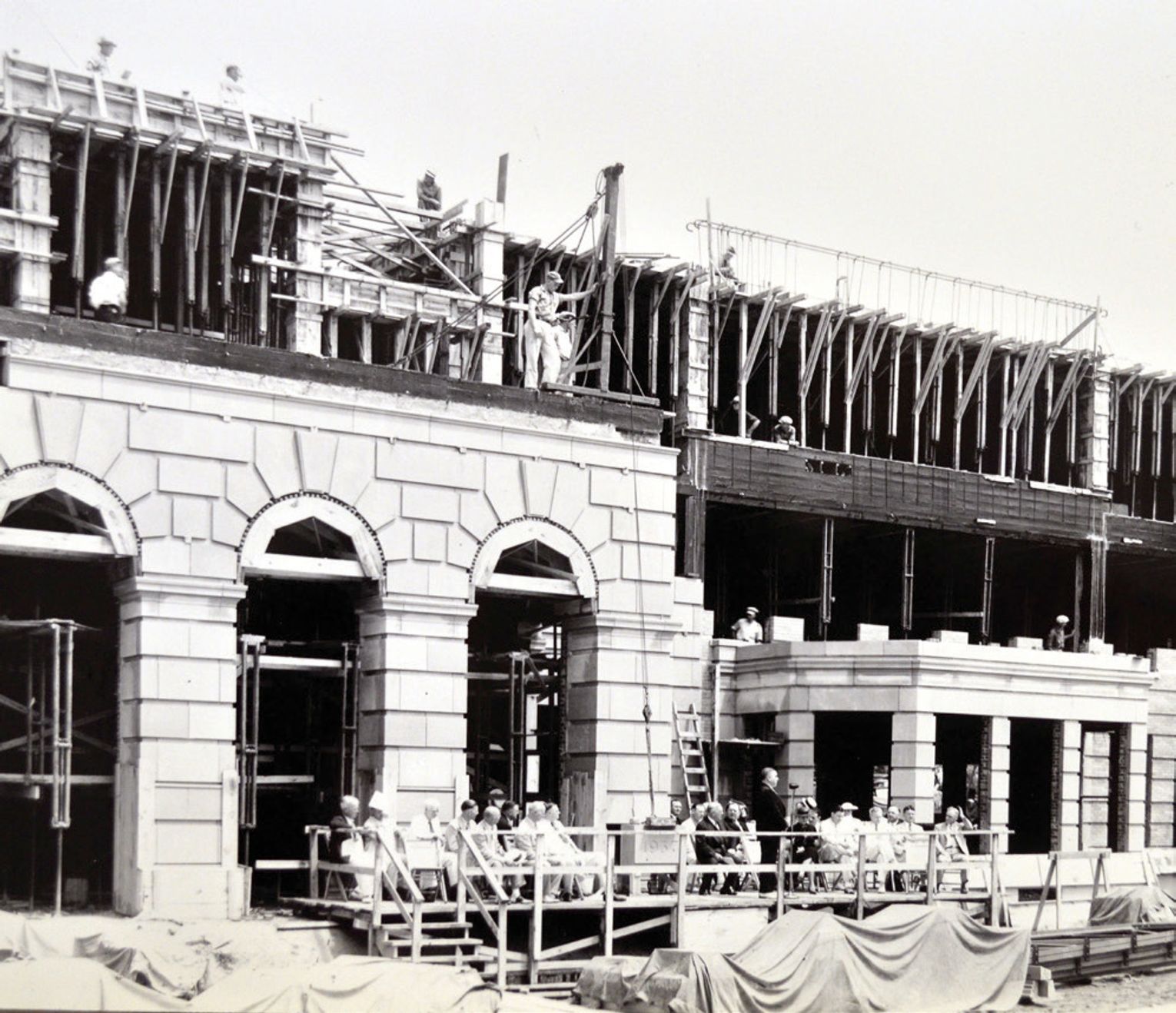
Simpkins Hall
The 'Roaring '20s' indeed earned its name — a time of flamboyance after the horrors of WWI and the 1918 Influenza, a time of gangsters, unenforceable prohibition and its aftermath, and stock market investors with dollar signs for eyes. It all imploded in October 1929.
Out of the despair of the Depression years came an alphabet soup of governmental agencies designed to alleviate the misery of economic devastation. A few of those programs were the Civil Works Administration (CWA), Public Works Administration (PWA), Works Progress Administration (WPA), Civilian Conservation Corps (CCC), and Federal Arts Project (FPA). All of them had the mission to address employment and relief issues.
In Macomb, most projects were restricted to infrastructure creation and repair — upgrading water supply and sewage treatment, turning dirt paths into graveled streets, paving east and West Jackson Street, as well as the courthouse square in Macomb. Other projects out in the county involved building up major roadways such as the one between Blandinsville and Tennessee, Spring Lake improvements, bridge building and tree planting. Once authorized by the government, these projects allowed unemployed workers to gain a sense of dignity as well as a wage.
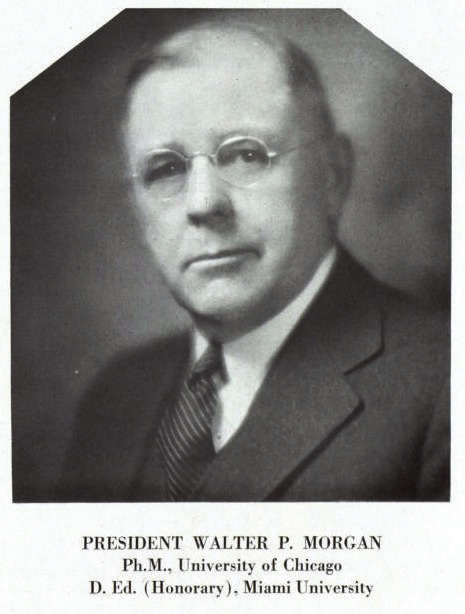
One of the most ambitious of the local proposals, and most highly visible, was the construction of a new teacher training building, or lab school as it became known. Today, the building now known as Simpkins Hall stands as a testament to the hard, long-suffering work of WIU President Walter Piety Morgan and the aesthetic vision of several architects and engineers.
The Beginnings
The Western Illinois State Normal School, later known as Western Illinois State Teachers College, came into existence in 1899 with the goal of training teachers for rural communities. When Dr. Morgan became the third president of the college in 1912, he set out on a two-decade mission to create a separate, state-of-the-art building for teacher preparation.
According to a Macomb Daily Journal October 7, 1936, article, Morgan began planning in 1915, but it wasn't until July 1931 that the Illinois 57th General Assembly appropriated $300,000 for the building and $50,000 for equipment. The state architect and supervising engineer began drawing up plans and completed them by 1933. By then, the Depression was roaring to life, and the State of Illinois treasury simply didn't have enough funds.
Undaunted, WIU President Morgan turned to the emerging efforts of the federal government for financial aid. The first priority of the FDR administration, however, was to provide relief to jobless and struggling Americans. A fancy building for teachers was not seen as a top priority, even though its construction would provide many jobs for out-ofwork men.
David Atkinson has compiled one of the most thorough studies of life in McDonough County during the 1930s and local efforts to coordinate with many of the earlier mentioned governmental agencies. About the role Morgan played, Atkinson wrote, 'Morgan accomplished his building agenda partly through hard work and partly through blackmail.' He worked tirelessly preparing applications, engaging in conversation with politicians and federal administrators, and monitoring federal requirements. Morgan, 'was never reluctant to remind state officials, who were prepared to balk at his requests, that the state had promised, and reneged on, funding much of the construction he proposed.'
Thanks to this persistence, the PWA approved a grant of $326,000 and the State of Illinois came through with $400,000 for 'the most modern and efficient school of its kind in the state' (Macomb Daily Journal, October 7, 1936). Mr. Bourton, state architect, was quoted as saying, 'It's the most detailed and most highly technical building I've ever designed for the state.'
Originally, plans called for the building to be attached to the immediate northwest of Sherman Hall to complement and balance Garwood Hall to the northeast. However, it was decided that more playground space would be needed, so construction shifted further west to grounds formerly used by the women's field hockey team.
The length of the building would be 248.6 feet by 95 feet with no basement. Heat would be supplied from the central power plant north of Sherman Hall. The ground floor would house the first grade, a social room, two work rooms and a gymnasium. First floor would house grades 2-5; second floor would house grades 6-8 with the third floor for the high school classrooms, library, and study hall.
Other major features would include a 70 foot by 48 foot gymnasium with galleries on both sides to seat 250 people. As printed in the June 11, 1938, Macomb Daily Journal, the second floor auditorium is the 'beauty spot.' It was finished in blue and white and seated 404. The stage measured 33 feet wide by 17 feet deep. Directly above it was the third floor high school library and study hall measuring 66 feet by 46 feet and seating for about 300 students.
Preparing the Grounds
Before construction could begin, a massive amount of dirt had to be moved because of the rolling terrain west of Sherman Hall. An estimated 12,000 cubic yards of dirt was moved to level the surface, fill the north side of Lake Ruth for the semi-circular driveway (to complement the Sherman Hall drive way), and to cover the tunnel extension running from the building to Sherman Hall. It would allow students to transit between buildings during inclement weather. During the winter, dynamite was used to break up the frozen earth for excavation by the Roche Brothers firm at Peoria. (MDJ, February 11, 1939).
West of the proposed building, WPA workers graded a new athletic field while other WPA workers laid stone to create a walkway around the swimming pool on the east side of the gymnasium.
The school received a WPA grant of $317,481 to construct a 24-inch storm drain and landscaping (MDJ, November 15, 1937).
Morgan worked with Macomb officials to extend Adams Street and its paving for the new additions westward, though they often butted heads because of each's agenda. City officials were more concerned about a water system, a sewage facility, and streets improvements; Morgan wanted amenities for the new building. Both groups had to wade through the uncertainties of federal and state funding.
Jacobson Brothers of Chicago was the primary contractor and sub-let contracts for cut stone out of Bedford, Indiana, reinforced steel, terra cotta, painting, glass and glazing, and doors and partitions.
The cornerstone was laid July 13, 1937, containing a lead box 15 inch long, 5 inch wide, and 4 inch deep, filled with numerous papers and sealed with lead. Today, it is located just to the right of the main entrance next to the '1937' marker stone. Whether this box will ever be retrieved and opened, perhaps on the building's 100th anniversary, remains to be seen.
To construct the upper floors, a 100-foot steel tower was erected to the north of the grounds to lift steel, concrete, and building materials. The Daily Journal reported on October 28, 1937, that the tower was last used to lift red slate to complement Sherman's roof, supposedly making it fireproof. Workers also installed glass in the skylights over the third floor study hall.
Details Matter
When construction finished, the final result lived up to every prediction that it would be the 'most detailed and highly technical building.' Oddly, given its construction during the later years of the Depression, the training school was not built with economy in mind. Many structural details and embellishments required painstaking artisan skill and hours of close attention. Rather than assemble a plain brick utilitarian building (like windowless Sallee Hall years later), the architects and engineers, along with Morgan and other college officials, wanted a show piece.
Some of the architectural details that likely go unnoticed include corniced dormers at the east and west end of the south face, each featuring four bas relief tablets depicting a beehive, a horse-drawn chariot, an hour glass, and a wheat shock. Above the east and west ground floor entrances are two symbolic keystones — brick-framed bas relief of a rising sun, stars, Aladdin's lamp, and an open book. The roofline sports gargoyles and intricately detailed faux Ionic Greek capitals. The cement embellishments look every bit as pristine today as the day they were installed.
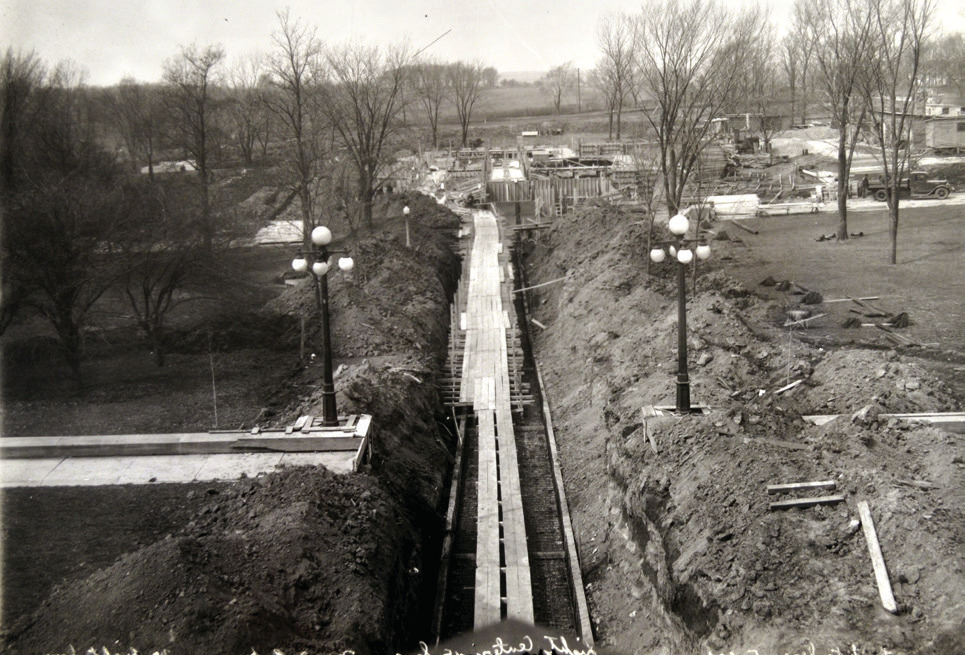
Photo from the tunnel build.
Imagine the complications and time-consuming process workmen in 1937 and 1938 faced, likely as passionate and proud about detail as any craftsman creating European cathedrals centuries ago. One can only imagine what the hard-pressed local community thought of the highly ornate building rising out of terrain along West Adams Street.
Attention to detail inside boggles the mind: be-ribboned bas relief fruit branches and leaves; geometrically designed window panes encased in arching frames; elaborate cast iron radiator grates, capped urns poised on swirling mantels; twisting wrought iron stairway bannisters; floors and baseboards of gray granite. An 'unnecessary' expense? Perhaps, but also aesthetically uplifting.
In Nicole Banks's excellent history of Simpkins Hall, she quoted former English Department chair Dr. Robert Jacobs during the '70s and '80s said, 'When this building was constructed under the federal plan, it was as if they designed a battleship.'
It's estimated that over 200 men worked on the project during its 17-month construction; however, only a few men from Macomb were part of the crews, likely as laborers. Skilled masons, stoneworkers, steel workers, plumbers, electricians, glaziers, tilers made up the majority of the work force and many of them were hired from throughout the Midwest for the project, thanks to WPA funding.
Dedication Day and Dr. Morgan The training school building was dedicated on May 26, 1939, with many notable people in attendance, among them D.H. Kennicoft, Regional Director of PWA and Hon. Ross E. Noper, 32nd District Illinois Representative from Good Hope who represented Gov. Henry Horner. Several dignitaries gave speeches, including President Morgan who surely basked in the grandeur of the building behind him as he stood at a podium on the steps of the south entrance facing placid Lake Ruth. As Atkinson's study indicates, Dr. Morgan couldn't avoid adding a few digs at the politicians who first promised then withheld funds, resulting in the quarter century delay in construction.
In fact, Atkinson, who reviewed Morgan's official papers located in the WIU Archives at WIU's Malpass Library, discovered that after construction, Morgan urged instructors and custodians to report any problems or deficiencies in the new facility. He frequently toured the building himself and once took a photograph of a leak in the tiny tunnel basement. Atkinson states that 'he even held the Beckley-Cardy Company, suppliers of drapes, curtains, and window shades, to account by analyzing the weight and threadcount in the window shades.'
Certainly Morgan was a stern and unforgiving micro-manager. Atkinson noted that 'On New Year's Eve in 1938, almost two years short of the first day of work, all of the bills were examined. After adding the extras and subtracting the credits, Morgan discovered that the $715,000 allocated for the building and $50,000 for equipment met all but $346.66 of the actual cost.' (These figures represent over $18 million in today's dollars.)
Atkinson continues: '[T]here was some spillover benefit from all the building activity on the Western campus. The projects provided a much needed outlet for some of the unemployed in McDonough County. ... Many of the projects at Western fell under a state work-relief quota. The workers who could not get work-relief jobs in the county because the county quota was full had the opportunity to work because of the proximity of the college.
'As a result, Western reaped many benefits from the PWA and WPA. Combined, these agencies financed all or part of nearly $1 million in new construction and deferred maintenance. While the lab school represented nearly three-fourths of this total, the remaining projects were both extensive and much needed to make the college a better place to teach and learn. ... The reason can be traced squarely to the shoulders of [WIU President Walter Piety Morgan]. He saw the potential and exploited it.'
Afterword
In 1968, the training/lab school/Western Academy moved to its new facilities at Horrabin Hall. The building was handed over to the English Department, then the largest academic department on campus. Such a move required a new name for the building, which officially became Simpkins Hall in honor of Rupert R. Simpkins, former head of the Department of Education. A bronze plaque at the foot of the grand staircase recognizes his contributions to WIU.
Next time, New Deal projects at Glenwood Park and Spring Lake Sources Macomb Daily Journal 1937-1939 David Atkinson, Relief and Recovery without Strings: The New Deal in McDonough County, Illinois, 1933 1940. WIU Archives, Malpass Library Nicola Banks, 'History of Simpkins Hall' <wiu.edu/ cas/english/documents/simpkins.php> Early photos and materials courtesy of WIU Archives
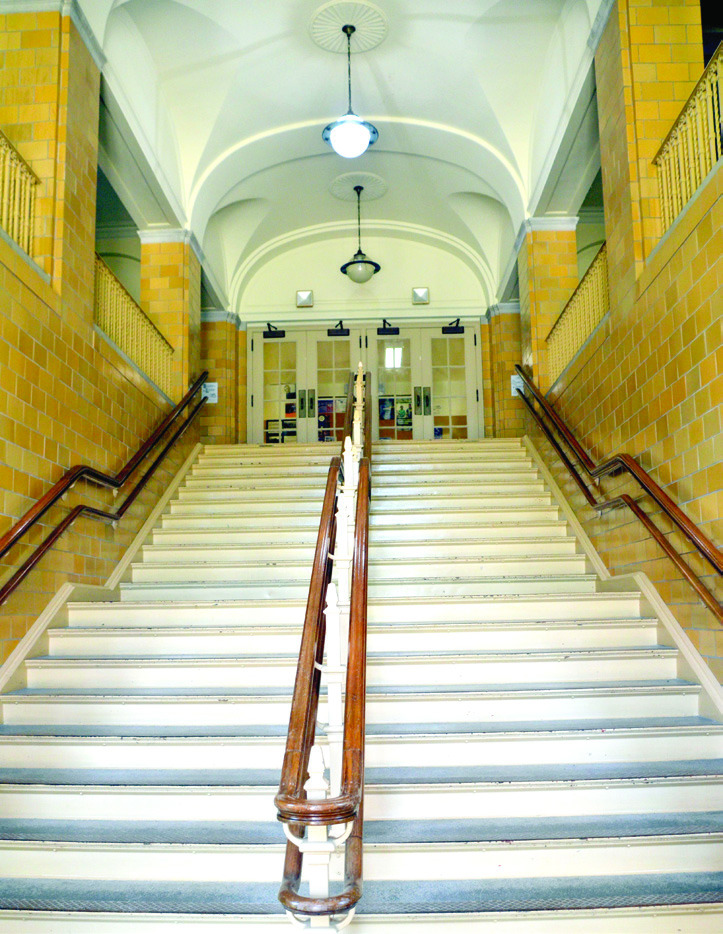
Grand stair case
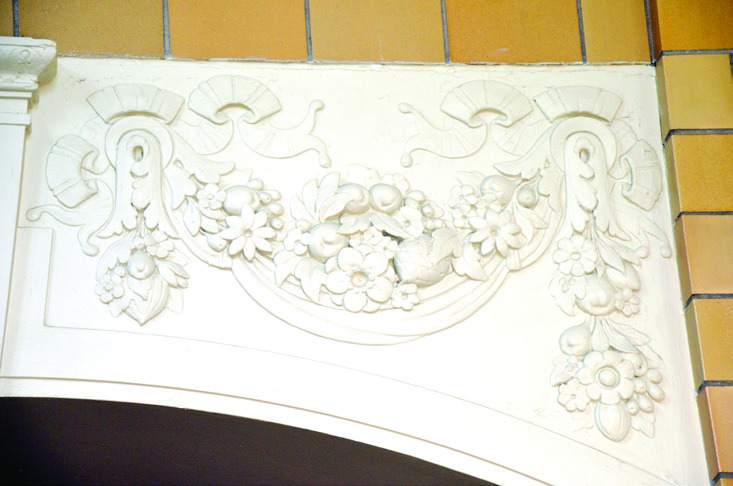
Archway bas relief
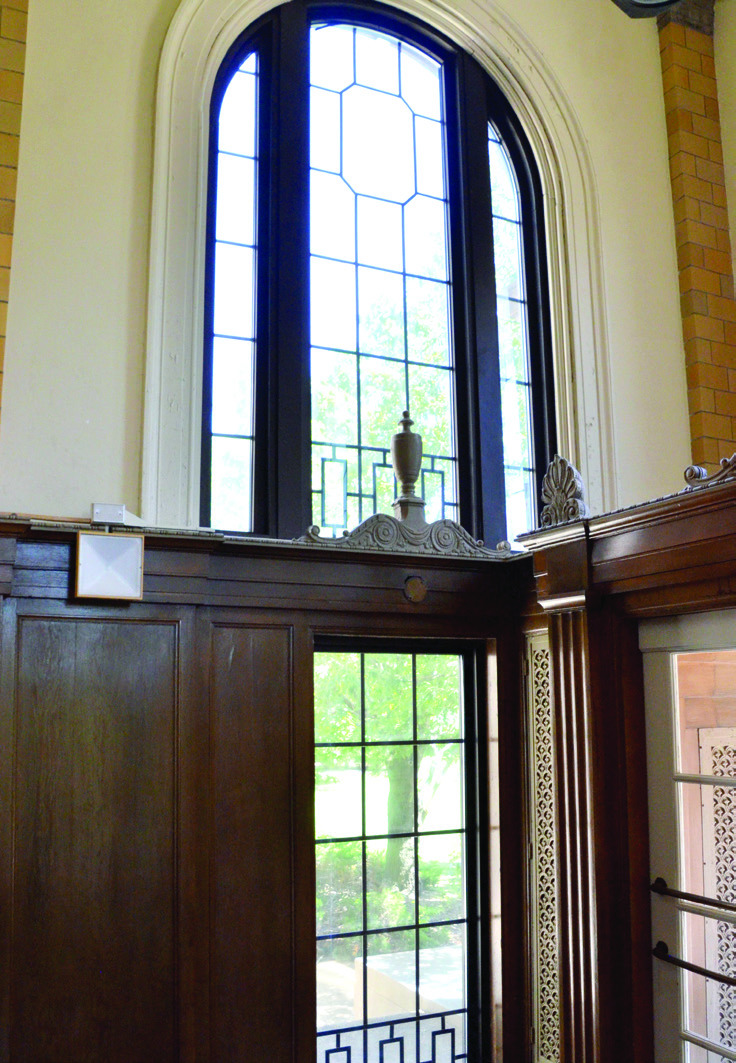
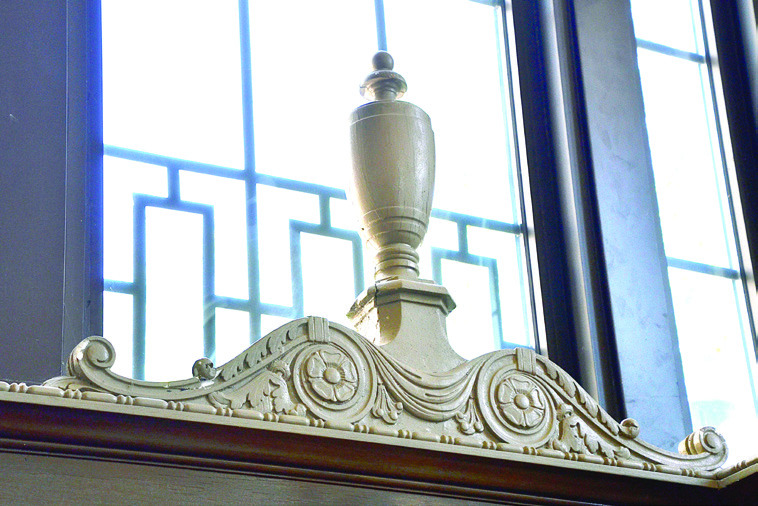
Pictured above and to the right: Urns poised on swirling mantles.