“The strangest part about nostalgia is how ordinary those days felt when you were living them. You didn’t know they’d turn into the moments you’d spend a lifetime aching to go back to.” -- Lewis Howes Many people call it the shortcut to Canton or Peoria, and it is a highly-traveled blacktop that is kept in decent shape.
Somewhere along the line it was dubbed the “Murphy Blacktop”, after the Murphy families who lived on each side of the road just as you turn off Highway 41. The Murphys were a large extended family and the name stuck.
The gravel road was paved many years ago and the road will probably always be called the Murphy Blacktop, whether the Murphys live there or not. That’s just how we do things around here.
The first few miles of endless farm fields call McDonough County home, with their numbered addresses for emergency purposes. Some of the houses along this stretch of road are new builds, some have been there since I was a child.
But then things get interesting. As you pass into Fulton County, those that named the roads of many years ago got creative. They named their roads for what THEY knew them as, which is fun and makes some sense.
First you will reach County Line Road, where McDonough and Fulton counties meet and pass the baton. That makes sense.
Then you encounter Barnes School Road, where there used to be a one room schoolhouse, which my father attended. Followed by Cucumber Holler, Tater Holler, Seven Hills Road, and eventually Checkrow Road.
Having lived on Seven Hills Road as a child, I can vouch for the number of hills on that road, which leads north eventually intersecting with Highway 9.
Seven Hills Road, back in the day, was quite scary, with large trees serving as a canopy over the road on a dark, moonlit night. It was a car ride that delighted us as children, as long as we were with adults and inside of a vehicle. And at the beginning of Seven Hills Road was none other than a run down country cemetery, about a football field away from our house, at Maple Front Farm. We had it all.
Now, Seven Hills is just another road, the trees have been bulldozed, but at least the seven hills are still there. I think. How the holler roads got their nicknames is beyond me, I will have to look into that. I assume they grew cucumbers and taters on those roads.
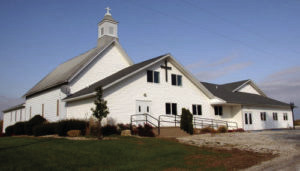
Approximately eight miles east of Bushnell, still on the Murphy Blacktop, one encounters the beautiful Checkrow Community Church. The church has anchored the rural Checkrow area for many decades, ministering to local farming families and residents and still thrives today. The church is located on Checkrow Road, and is a landmark for travelers.
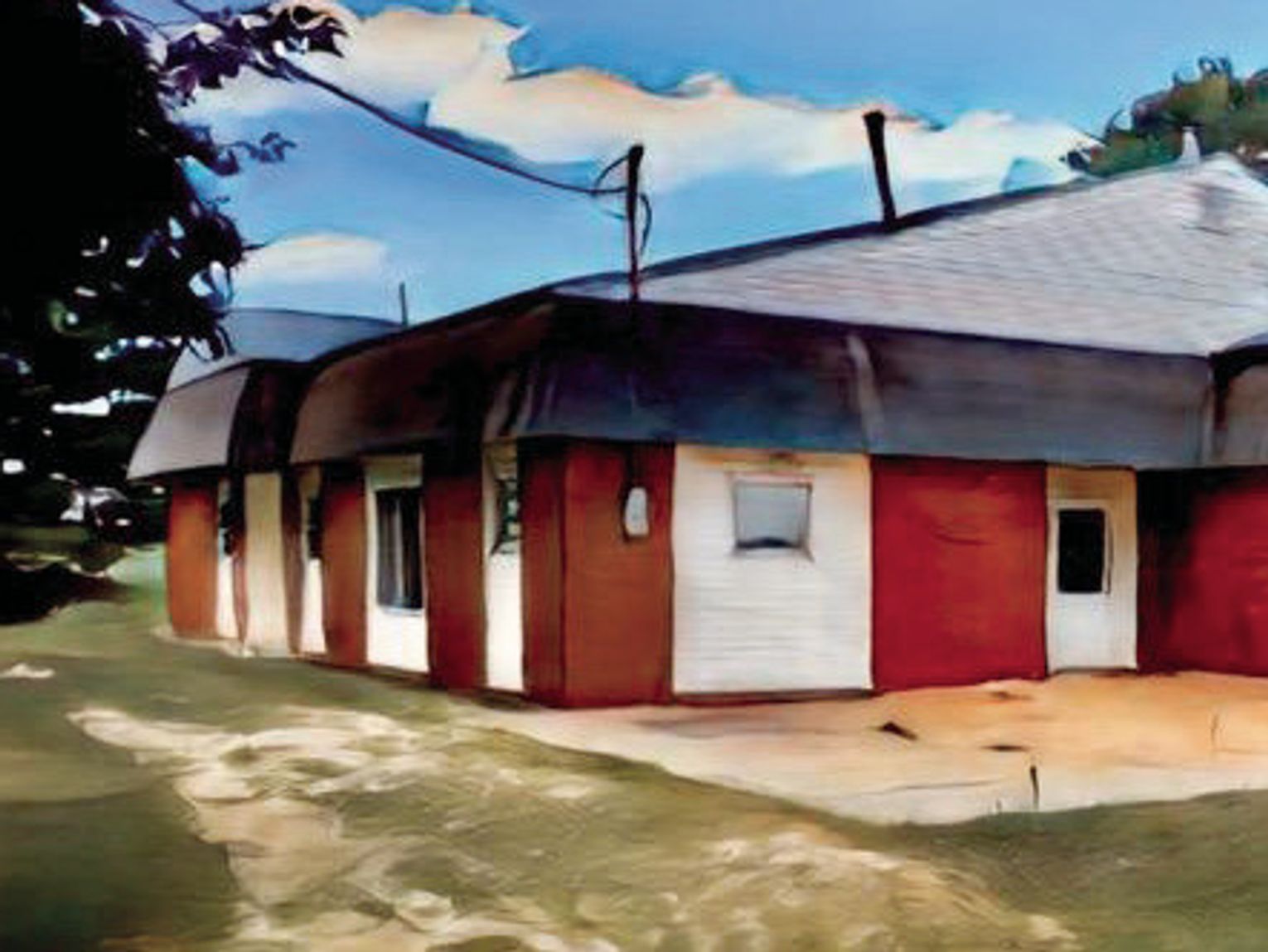
On down the road about a half mile is another piece of Checkrow’s heart and soul, the Red Brick School. The school is now privately owned but still standing and in remarkable condition. The flag pole still stands in the front, the same flag pole where Carolyn Ridle, a student, lowered the flag to half mast on November 22, 1963, in shock and recognition of President John Kennedy’s assasination.
The church and school were the heart of the village of Checkrow.
Yes, Checkrow was a full blown village with businesses. But where on earth did it get that name?
“Old” Checkrow was located one mile south of State Route 9. When settlers first came to Lee Township in the early 1800’s, it was generally just to pass through on hunting trips and land surveys.
Explorer Nicholas Van Zant reported that the area did have some positive qualities. There was a great quantity of stone coal in the banks of the Spoon River. The river itself was not suitable for large boat travel, due to its rapids and falls, but it was a fine source for fish. The timber resources held great promise for settlers, especially those coming from wooded Pennsylvania and Kentucky.
The biggest incentive for settlers to come to Lee Township was the fact that the United States government was offering free land to soldiers and sailors who fought in the war of 1812, as an act of appreciation. The only drawback was the presence of Indians. After the Black Hawk War of 1832, a flood of settlers poured in.
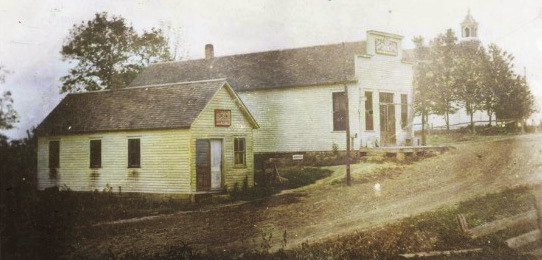
Checkrow was one of the early villages. It had a blacksmith shop, a general store, a post office, a church, a sorghum mill, and a cemetery. Most important of all, Checkrow had a school.
The first school in Lee Township was built in 1839 and the location is unknown. The Sixteen School was in existence in 1850. By 1871, the following schools, in addition to Sixteen School, were open: Council Corner, Virgil, OakGrove, Pleasant Hill, Babylon, Sweney, Checkrow and Barnes.
In 1950, a new brick Checkrow School was built, mainly to accommodate the growing number of students. The school lasted 14 years, and closed in 1964. It was believed the city schools had more developed programs, such as gymnasiums for physical fitness, band programs, kindergarten, specialized teachers and that the move in the long-run would save the district (Bushnell) money. Most of the children from Checkrow were then transported by bus to Bushnell. Some accounts, however, state that a portion of the students, probably depending upon where they resided, were transported to Avon and Cuba.
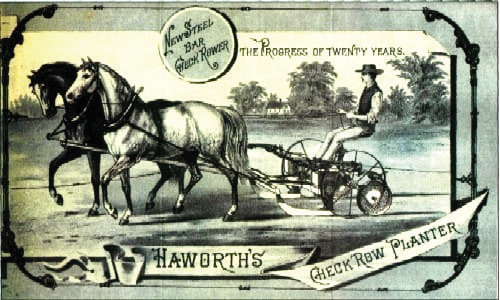
How did the Village of Checkrow get its name? It came from, of all things, a method of planting corn. Check-rowing was a system of planting where each hill had two, three, four seeds and was exactly the same distance from adjoining hills.
A field of check-row planted corn had the appearance of a checkerboard, with a hill of corn stalks at the exact intersection of each line. That made it possible to cultivate the rows in several directions and made it much easier to keep a field free of weeds. With the advent of chemical weed control, check-rowed corn fell out of favor and is rarely seen today.
While the Village of Checkrow began disappearing in later years as transportation improved, the fact that Checkrow had its school until 1964, and still has its church, has kept the community alive. The red brick school is privately owned today by a farmer. Several years ago John Spangler allowed a small group of former students to walk through their old school.
While the building has been modified at one point to be a house, the basic bones of Checkrow School are still there. In this writer’s primary classroom the frames from the chalkboards still remain on the walls. The asphalt checkerboard tile still covers the cement floor.
The building was constructed to be fireproof. Its interior walls were made from flame retardant blocks and faced with brick. The building contained three classrooms, a lunch room, a kitchen and two restrooms. There was a pay phone in the lobby. The building was heated with a hot water system and oil was used for heating fuel. A deep well met the water needs. Neil Hummel, general contractor, built the school for $50,330.92. The heating and plumbing was an additional $11,287.14, and electrical work cost $2,147.63. Adding in architect fees, seeding and gravel, and fence brought the total of the new Checkrow School to $55,594.75.
The PTA raised funds for kitchen equipment, donated canned goods and organized the lunch program. Mothers of Checkrow students helped the school cook by volunteering on a rotating basis to peel potatoes, etc.
When passing by the former Checkrow School today, one might feel a sense of sadness. One more example of something from a bygone era that is no longer - the rural school But in the case of Checkrow School, it was never, for one minute, forgotten by the 100’s of children that passed through its doors.
In June of 2023, the “Checkrow kids” reunited for the first time in 59 years. Over 40-50 classmates found their way back, bringing with them spouses, children, and friends. A total of 141 attended. I believe the only way to explain the positive turnout was to realize the impact Checkrow School had on the children in that neighborhood. We were impoverished, but at Checkrow no one judged. Everyone (average total count of grades 1-6 at any given time was around 37) at Checkrow everyone knew each other’s parents, grandparents, siblings and the like. No one made fun of anyone’s clothes, shoes, or lack of hygiene, on the contrary I believe we were taught to be compassionate.
There were no cell phones then, and many did not have phones in their homes. If someone got hurt or injured they might have to call an uncle or neighbor or grandpa to come get them, and in one instance we recall the bus driver taking a bleeding third grade boy to the emergency room in the school bus because they couldn’t find his parents. We were fairly isolated, miles from the nearest medical help.
There was a closeness in that tiny brick school like none other. Looking back now, we realize that we were bonded for life.
Once again, on June 13, 2026, the Checkrow kids will reunite for the Second All-TimeCheckrow Reunion. The numbers coming in so far are looking to exceed the last reunion.
Think about this. We’re not referring to a college reunion. Or a high school reunion. This is a reunion of children getting together again with the very first friends they knew in the world. This is a reunion of the babies we were. Ages five-eleven.
Since our last reunion less than three years ago, we have lost ten Checkrow classmates. If that doesn’t make one stand back and take notice of the passing time, I don’t know what does.
We have classmates coming from many states this June, back to the little brick schoolhouse and the little white church on the Murphy Blacktop. So perhaps now, you the reader, will know “the rest of the story” about that little red brick building you have passed many times traveling to Canton or Peoria.
If buildings could have memories and emotions, I believe in 2023 Checkrow School knew its kids had come back, that they had never forgotten it. It probably could not believe it’s eyes when it saw us walking up the driveway. Checkrow School was the “house that built us”.
In Memory of Martha Sweney