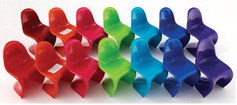
The Vitra Design Museum celebrates the Panton chair with colorful miniature versions.
A chair is a chair is a chair, isn’t it? Four legs to stay on the floor, a high back to keep the sitter upright, and a base for support. And everything is made of wood, of course, with variety coming from upholstery, decorative carvings, or the shape of the legs. That may have been true up to the 20th century. Furniture changed dramatically when designers took advantage of new materials that opened up previously unheard-of possibilities: plastics.
Man-made plastics were used for household implements by the 1920s, but it wasn’t until after World War II that the potential for functional plastic furniture was realized. One of the most famous plastic chair designs was the Panton chair, named after its designer, Danish architect Verner Panton. Considered the world’s first molded plastic chair, it is a cantilevered chair made from a single piece of plastic. Its shape and weight distribution allow it to be made without back legs.
Panton came up with the design in about 1960, but it wasn’t until the middle of the decade that he found a manufacturer, German furniture company Vitra, that would make it. Vitra started producing the Panton chair in 1968. Later, the Vitra Design Museum commemorated the Panton chair with sets of miniature versions in 1:6 scale. A group of 14 sold for $100 at an auction by Eldred’s; a bargain when compared to the price of a full-sized Panton chair. The chair is still in production today, and designers are adapting it to contemporary sensibilities by creating versions in eco-friendly materials like bamboo and rattan.
Q: Can you tell me about my deck of “Go Fish” children’s playing cards? The box says “Copyright 1951” and “Mfg. by Ed-UCards N.Y.,” but I haven’t been able to find out more information about the company or the cards’ value. I was also told that there is a toy museum that accepts donations of very old toys.
A: The Ed-U-Cards company started in the 1940s in Long Island, New York, and operated until the 1960s. As the name indicates, they made educational card games for children. These included flashcards and memory games to teach subjects like vocabulary, basic math, science concepts, and history. They also made related toys like puzzles and anagram tiles. Some of their card games were less overtly educational, like sports games and trading cards. Decks of Ed-U-Cards decks can be worth anywhere from about $10 to $50, depending on their subject matter and condition. Games with pictures of historical figures or famous fictional characters usually sell for the highest prices. There is a toy museum called the Strong National Museum of Play in New York (museumofplay.org) that accepts donations of old toys. They are known for their Toy Hall of Fame, which annually inducts a selection of classic toys.
TIP: Plastic furniture from the 1950s often scratches. A good polishing with automobile wax might help cover the blemishes.
CURRENT PRICES
Toy, hamster, Goldy, standing, light brown and white, name tag around neck, button in ear, Steiff, 1960s, 20 inches, $180.
Advertising, sign, Foster’s Freeze, “Old Fashion,” Pints, figural, pint container, blue and white, porcelain, 7 x 7 1/2 inches, $405.
Porcelain-Chinese, tray, oval, outdoor scene, figure, holding fan, verse, gilt rim, early 20th century, 10 x 8 inches, $1,680.
For more collecting news, tips and resources, visit www.Kovels.com.