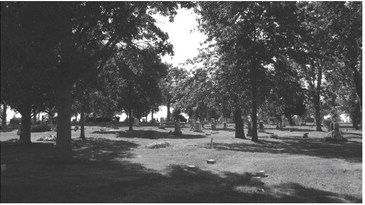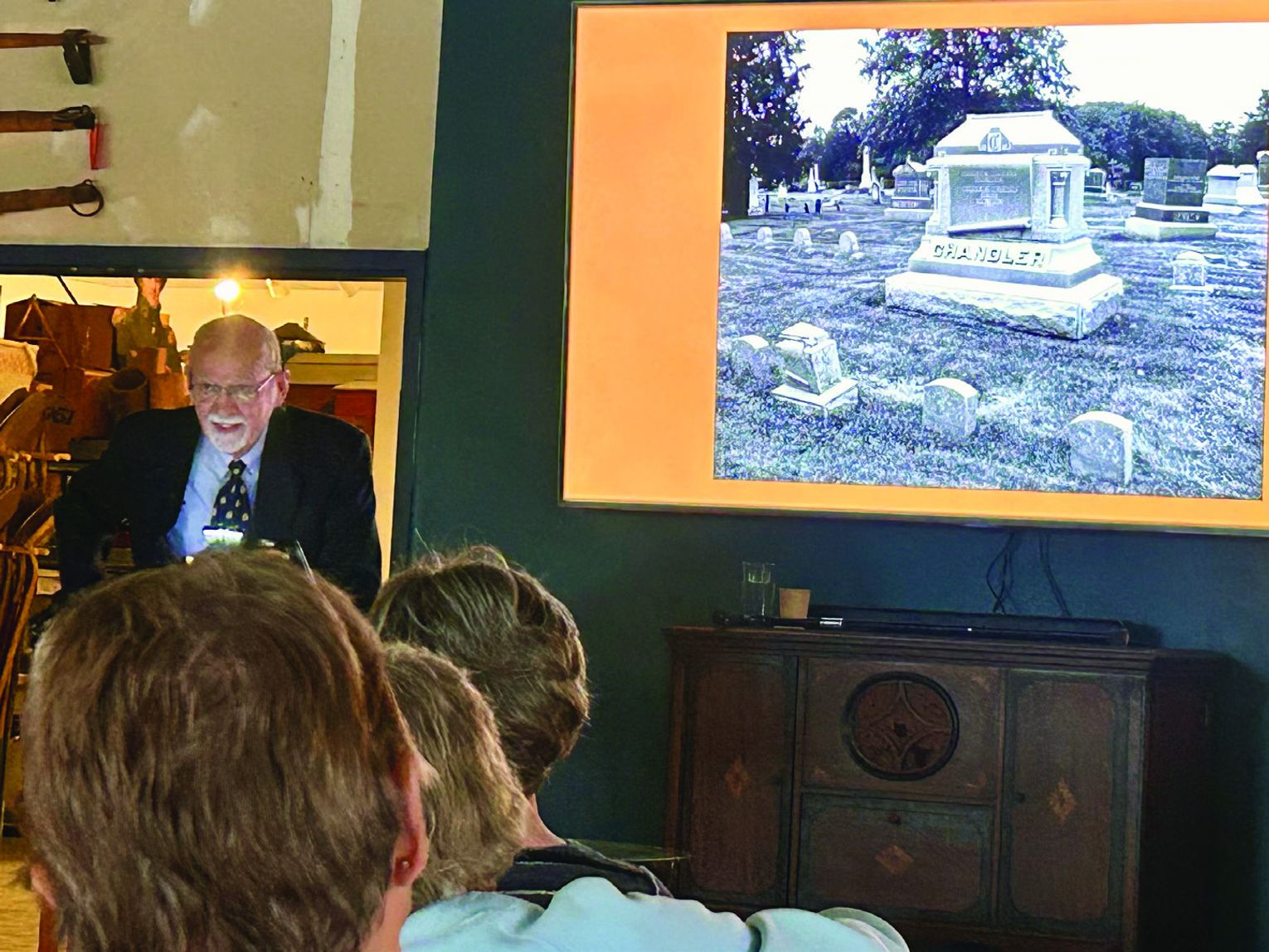
If the gravestones in Macomb’s Oakwood Cemetery could talk, they’d have many tales to tell of the 15,266 people buried across 47 acres on Macomb’s north side. Some of those tales first came to light in 2012 in the book “Here to Stay: Reflections on the Dead in a Small-Town Cemetery” by Macomb historian, archivist and Western Illinois University Distinguished Professor Emeritus John Hallwas, and are now back in the public eye thanks to a new Western Illinois Museum exhibit.
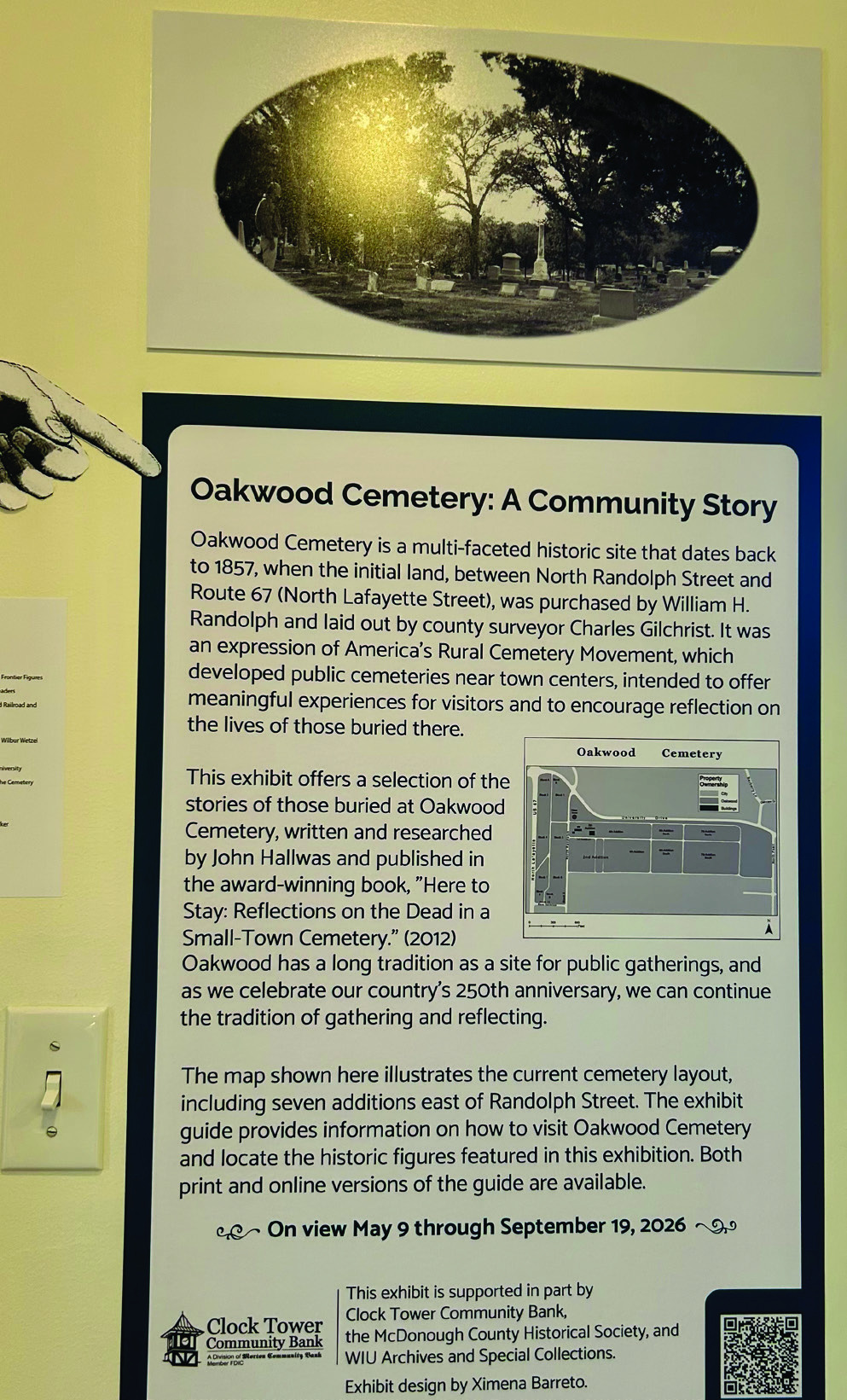
As part of its McDonough County Bicentennial programming, the Western Illinois Museum is hosting an exhibit focused on Oakwood Cemetery, which is an official state-sanctioned historic site. The exhibit opened May 9, along with the presentation by Hallwas. The Oakwood Exhibit will be on display in the Museum’s Walkway Gallery through Aug. 8. The exhibition features 50 photographic documents of headstones that illuminate the lives, stories, and traditions connected to the cemetery.
May 9, 2026 marks the eighth anniversary of Oakwood’s official recognition as a historic site. Hallwas opened the Saturday evening keynote with a brief preview of the significance of the community’s public cemetery, which was first established as a privately- owned burial ground that was available for anyone in the area. William H. Randolph purchased the land that once belonged to the parents of his bride, Matilda Jane Brooking Randolph, in 1857, and he also moved the graves of Matilda’s family to that plot of land.
William, who was the deputy provost marshal in charge of the draft in this area, was murdered in 1864 when he was trying to track down a draft-evading man, John Bond, in Blandinsville. Bond and his two brothers shot Randolph, and it took six years to bring them in. Matilda ran the family hotel, The Randolph House, as well as continued the upkeep of the cemetery, after her husband’s death. In 1877, she sold the cemetery to the city, and it became a well-known public cemetery.
“Wow, there are a lot of stories connected with the cemetery,” Hallwas noted. “There is every Macomb generation in the cemetery from the frontier settlers of the 1830s on. Every generation is very well-represented.”
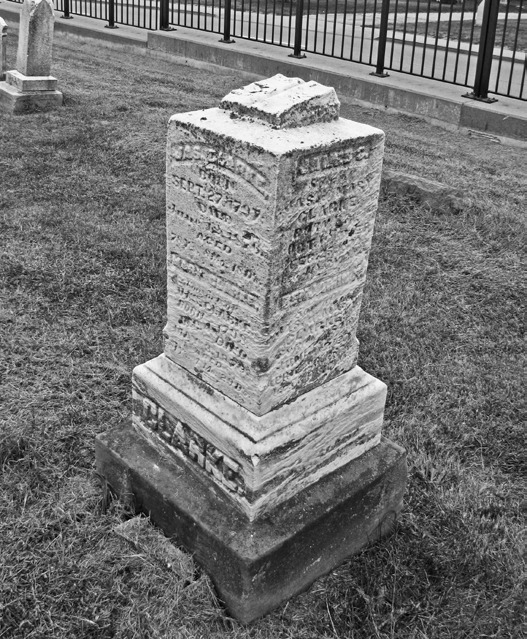
Hallwas highlighted a few of the prominent folks who were first laid to rest in Oakwood, including the earliest settler and co-founder of Macomb, and its first county clerk, James Clarke and James Campbell, the first clerk of the circuit court and first store-owner, to the first freed slaves living Macomb, Milford and Dica Daniels, who were buried in what was called Potter’s Field, to measles serum inventor Dr. Ruth Tunnicliff, and banking legend and acclaimed businesswoman Mary Ewing, as well as the late, great WIU basketball coach Leroy “Stix” Morley, and countless figures in-between.
“James Clarke’s monument in Oakwood Cemetery features a stone version of the Bible, showing the early impact of Christianity,,” Hallwas shared.
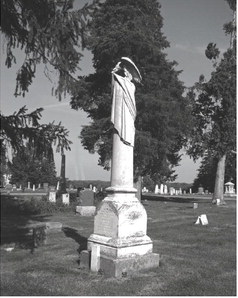
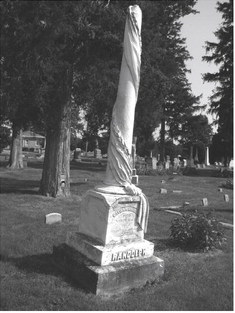
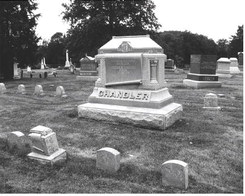
While Clarke founded Macomb, it was Campbell who had an even bigger impact on the new community, as did Charles Hayes, who was the county’s first medical doctor. The Chandlers and other wealthy businessmen who made their way to Macomb from the East Coast, joined the original settlers, many of whom hailed from Kentucky and Tennessee. The headstones and monuments of these successful businessmen and city leaders are often ornate, with carvings reflecting cloth covered urns, obelisks and other symbolic items that reflect a “rise to heaven,” Hallwas explained.
Many individuals who were the “firsts” made a name for themselves in Macomb, and it’s in Macomb they are buried, including John Wiley, who brought the first threshing machine to the area, and with Charles Dallam, built threshers in Macomb. Dr. W.O. Blaisdell was a well-known horse-breeder who was the founder of the McDonough County Agriculture and Stock Association.
“Dr. Blaisdell, who grew up on a farm in Maine, used to talk about the large boulder behind his family’s home, on which he had played, and when he died, his son paid to have the 5,000-ton boulder removed from that boyhood farm and shipped by rail to Macomb to be inscribed as his tombstone,” Hallwas told the crowd.
Some outstanding women who broke glass ceilings back in the day to serve the public, and who are buried at Oakwood include McDonough County’s first female physician Dr. Elizabeth Miner, who was born Dec. 25, 1867, in Blakesburg, IA. She rose against significant odds to be a statewide medical leader. Dr. Miner opened her practice in Macomb, and was the first secretary of the McDonough County Medical Society, as well as the president of the Illinois branch of the American Women’s Medical Association.
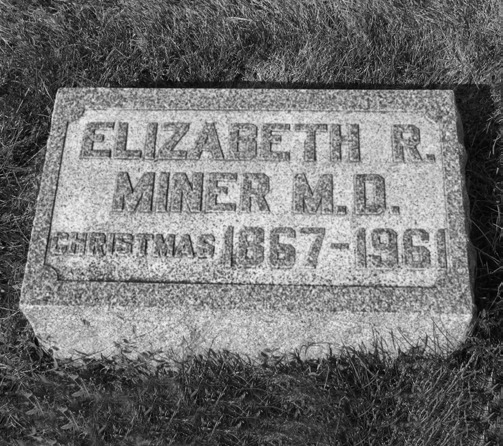
“The sign outside of her office said ‘Mrs. Dr. Miner,’ because she was also a wife,” Hallwas wryly said.
Rose Jolly, who was born in 1876, became the organizer and most active leader in the county’s noted social organization, the McDonough County Humane Society, in 1909.
She and Josie Westfall established and opened Macomb’s first orphanage.
Clara Kern Bayliss established The Child Culture Center in 1907, and she also started the Macomb Chapter of the DAR, serving as its first regent.
“Mary Ewing, who died in 2001, is perhaps one of the most noted female business leaders and activists in Macomb buried at Oakwood Cemetery.
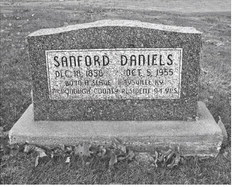
She ran a bank with her husband, Dewey, and she was a volunteer and civic leader. She raised money for the orphanage, the Girl Scouts, Salvation Army and Altrusa,” Hallwas said. “She told me once, ‘If you have commitment to others, your own life will have wholeness.’” Oakwood Cemetery is the resting place for members of the Allison and Blazer families, conductors of McDonough County’’s branch of the Underground Railroad, as well as Dica and Milford Daniels, and their son, Sanford Daniels, the first freed slaves to live in Macomb. Milford was a well-known carpenter, and the Daniels made their home on Macomb’s east side.
“They had to live there because Macomb’s residential areas were segregated, so that many of the community’s Black residents, as well as the poor, were made to live on the east side of town,” Hallwas pointed out. “It’s interesting to note that the Daniels’ son, Sanford, lived in Macomb for all of his 94 years, dying in 1955. He was born into slavery and even in his 90s, he could recall his family’s life in slavery.
He was most likely the last former slave in Illinois when he died in 1955.”
Oakwood also had a section called “Potter’s Field,” in which Black residents, as well the poor and the indigent who could not afford a tombstone, were buried. But perhaps one of the most notable aspects of Macomb’s public cemetery are the many graves of about 300 Civil War soldiers who hailed from this area, as Hallwas indicated.
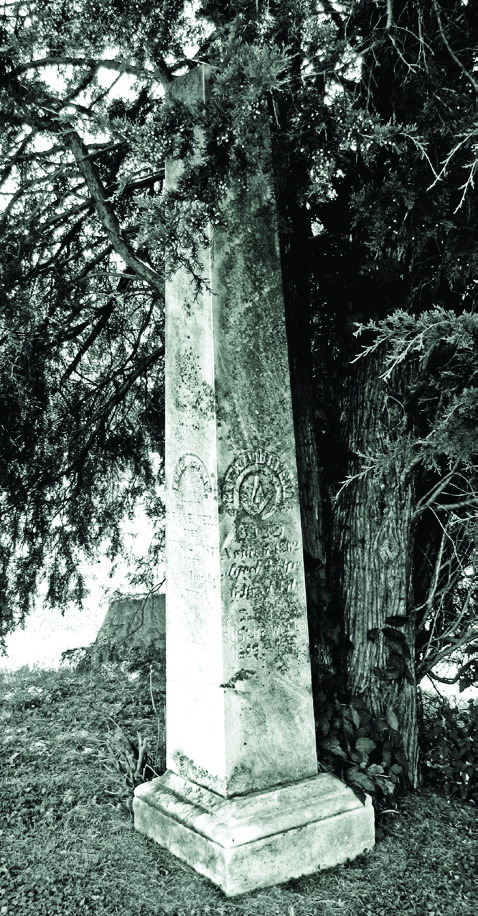
“David Wells was the first local soldier who died in the Civil War. A Hemlock tree was planted at his grave by the Masonic Lodge, and that tree stands today, almost obstructing his gravestone,” he added.
However, one of the most renowned figures of the Civil War buried at Oakwood is Gladden L. Farwell, who had been a bricklayer in Macomb before going off to war as captain of the 29th Illinois Infantry. He was wounded, and word came to Macomb that he had died, and his obituary appeared in the local paper. However, he had actually survived and was captured by the Confederates, who later paroled him.
“A few months after his obituary appeared, he showed up in Macomb,” Hallwas said. “He stepped off the train and people couldn’t believe it. He could’ve been elected to almost anything after that!
He was elected sheriff and remained a legend in the town.”
Farwell’s only son, John, died while at West Point, and his classmates donated money for one of the cemetery’s most famous gravestones: a monument topped with the replica of “Old Abe,” an eagle that was the mascot of a Wisconsin regiment during the war.
A noted sculptor named Leonivadas Volk created the monument and the likeness of the famous eagle, “Old Abe,” Hallwas shared.
“Oakwood Cemetery had played a prominent role in the history of Macomb,” Hallwas concluded.
The exhibit is supported in part by Clock Tower Bank, the McDonough County Historical Society, and WIU Archives and Special Collections. The exhibition was researched and curated by Hallwas and WIU Archivist Kathy Nichols, and designed and installed by Ximena Barreto. Located at 201 S. Lafayette Street, just south of Macomb’s Courthouse Square, the Western Illinois Museum is a nonprofit organization dedicated to preserving and sharing the history, culture, and traditions of McDonough County. The Museum serves as a community hub for exhibitions, lectures, music, and public programs that connect people through shared history.
For more information, visit wimuseum.org or follow @wimuseum on social media. Contact the Museum at 309-837-2750, text 309-837-2613, or email [email protected].