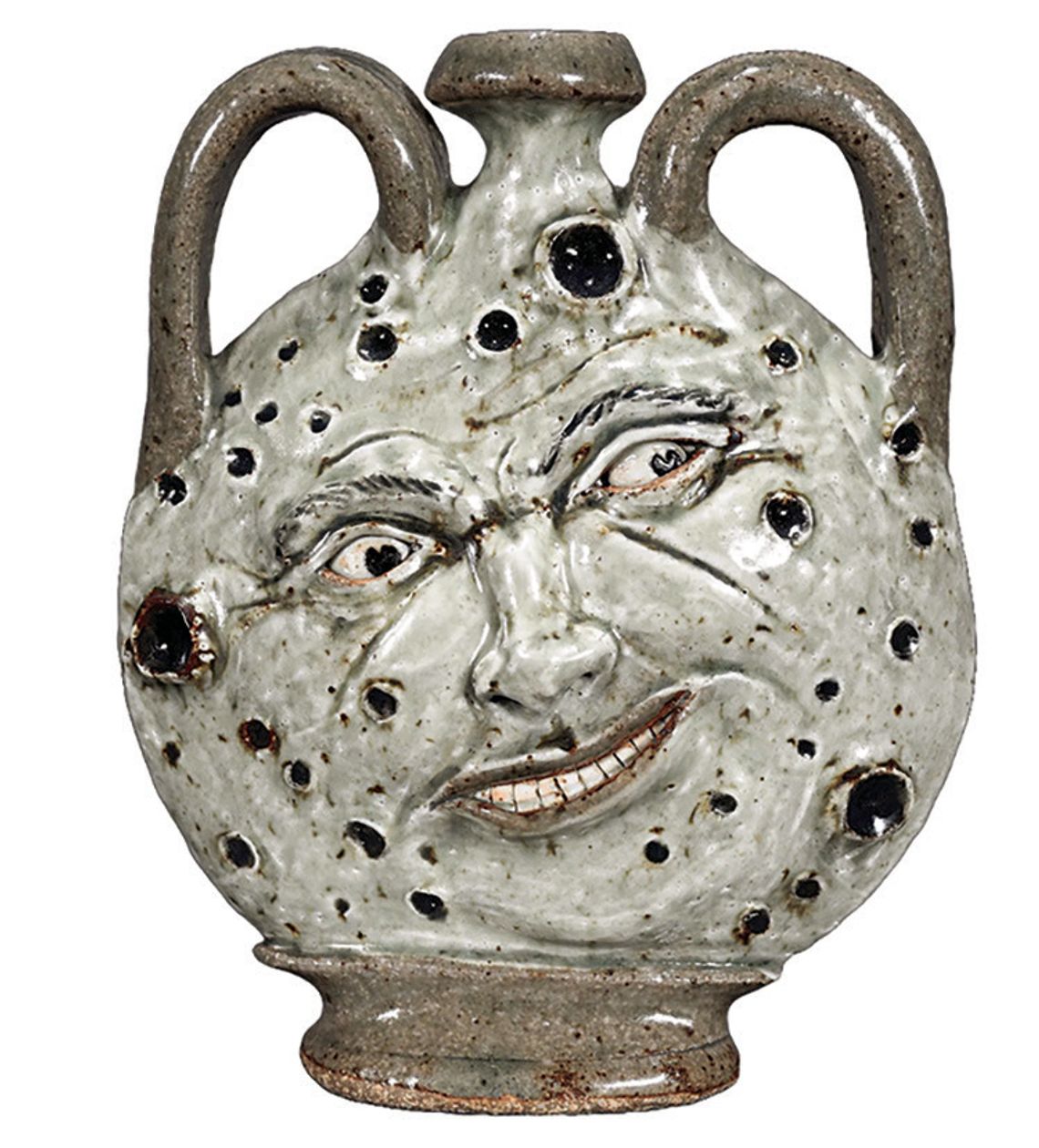
Some of the most interesting works of art come about when contemporary artists put their own spin on well-established forms and techniques. The man-in-the-moon jug pictured here is the work of contemporary South Carolina potter Michel Bayne. It fits in with the longstanding Southern tradition of face vessels.
While artists around the world have decorated ceramic containers with human, animal or mythological faces since prehistory, the face vessels made in the southern U.S. are believed to have originated in African traditions practiced by enslaved potters. The distinctive style had strong appeal, and, by the 20th century, Southern face vessels were mass-produced for tourists.
Local artists continued making them as folk art, and still do today. Bayne follows the tradition of making his pottery by hand out of local clay, and the man-in-themoon jug shows the grotesque features and exposed teeth characteristic of Southern face jugs. However, the man on the moon isn’t a common subject, and this jug’s round, flat shape suggests a completely different ceramic style from farther away: Chinese moon flasks, or moon vases. The combination of the moon flask shape with Southern folk pottery caught a buyer’s attention; the man-in-the-moon jug sold for $1,143 at Slotin Folk Art Auction against an estimate of $200-300.
Q: I found a box of cigarettes taped to the underside of the bottom dresser drawer that belonged to my mother- in-law. The dresser is approximately 100 years old. The box is 4 1/2 inches from side to side and 1 inch deep. There is a colorful print of a view of the city and the word “MOCKBA” on the front and Russian writing on the back. The number “3935-58” is on the back lower left corner. Can you tell me anything about it?
A: The number you mentioned is a regulatory code and the last two digits tell you the year the regulation standard was set. So your box of cigarettes is from 1958, during the time of the Soviet Union. This a good reminder to always check the drawers and cabinets in antique furniture! “MOCKBA” is “Moskva,” Russian for Moscow; which is the city depicted in the print. Colorful prints are characteristic of Russian cigarette boxes from the 1950s; packaging became more decorative after the end of World War II.