Alexandria, Egypt, had one, but it was destroyed with untold losses to history. The U.S. Congress has one of its own, which is the largest in the world. Thomas Jefferson sold his to the U.S. government (6,487 volumes for $23,950) upon the destruction of Congress's library by the British during the War of 1812.
These are libraries, the depositories of world knowledge and for centuries the measure of the vibrancy of a community. Even with the arrival of electronic storage and retrieval of the information, hands-on contact with the printed word (and so much more) still stirs the imagination.
How did the means of gaining free access to learning and entertainment come about in each of McDonough County's four public libraries?
Macomb
The Macomb Woman's Club is credited with starting the first library in Macomb, according to Director Dennis Danowski. Then, on November 10, 1881, the Macomb mayor appointed a library board of nine members. It was opened April 18, 1882, in the upper floor of the Stocker Building at 109 S.
Side Square (above Book Swap). One of the requirements was that the board of directors had to read and approve any book before it could be added to the collection. The first librarian was Mahala Phelps.
Eventually, the library outgrew its space. After the City purchased the building at 108 South Lafayette, the library moved to the second floor, a location sharing space with the City jail. However, matronly patrons decided that having children walk by a city jail was inappropriate.
That's when the City of Macomb got involved with the Andrew Carnegie library plan. According to Danowski, Van Hampton, editor of the Macomb Bystander, personally visited Carnegie and presented a plan for a separate library building. The proposal was accepted and $15,000 awarded for construction, but with the stipulation that the City institute a 'maintenance' tax to ensure upkeep.
Danowski joked that it took 10 votes to finally select the site for the new building because each of the 10 aldermen wanted the structure built in his ward.
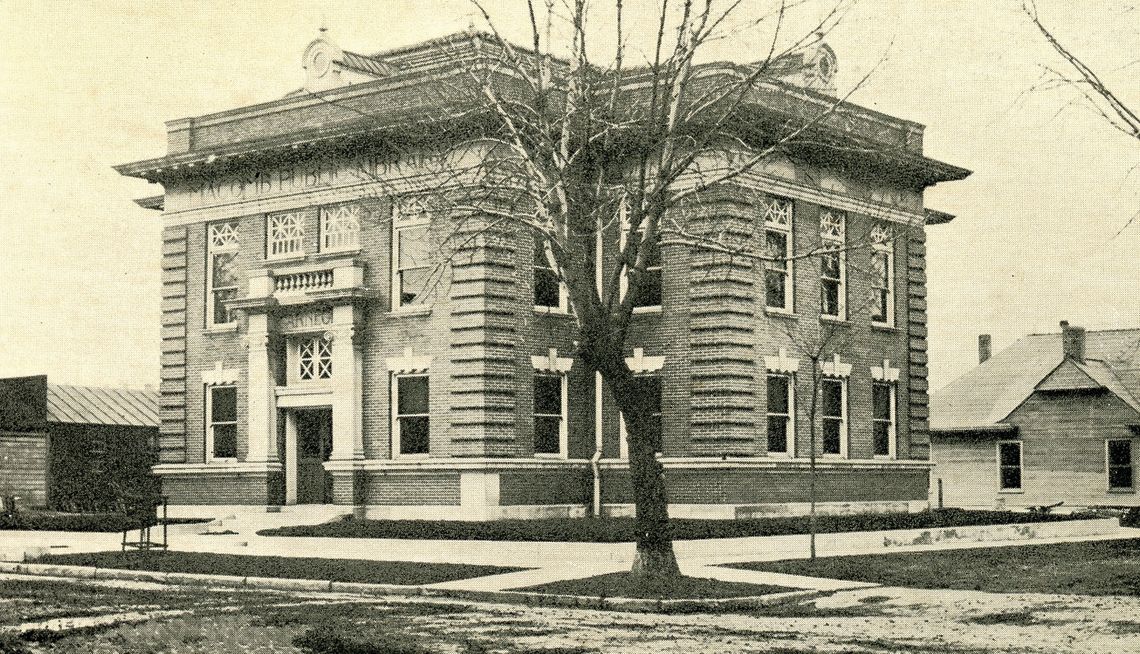
On October 28, 1904, the Macomb Library opened in its new facility at 235 South Lafayette. Danowski noted that it currently is one of few Carnegie libraries still in existence for its intended purpose. It also is one of very few Carnegie libraries with an inside wooden staircase to access the second floor. Most original Carnegie libraries were built with a flight of concrete steps leading up into the main area.
When it was first built, the first floor was unused, a dusty, cobwebbed facility. Patrons had to ascend the staircase to access the children's library (to the left) and the adult library (to the right). The library operated with closed stacks, meaning that patrons had to ask desk workers to locate their book requests and bring them out. Eventually, said Danowski, the adult patrons thought that the children's section was too noisy, so plans were made to move it elsewhere.
For years a stable and carriage shop operated just north of the new library. Eventually, that lot was turned into a tavern. However, as Danowski recalled, former Mayor Bob Anstine discovered a city ordinance that said no tavern can be located within 100 feet of a public building. Therefore, the city bought the tavern property July 20, 1980, and turned it into a children's library. Because patrons using the children's library had to bring their selections out of that building and into the library for checkout, the library board built a passageway July 3, 1983, connecting the two structures.
On July 1, 1992, the Macomb City Library became the Macomb Library District. The library board applied for a State of Illinois Library grant to build the latest addition, which was completed in 2014.
Dennis Danowski, Director, 235 S. Lafayette St., Macomb, 309-833-2714, macomblibrary.com Colchester
When the State of Illinois enacted the Public District Library Act in the late 1960s, the residents of Colchester relied on a bookmobile provided by the Western Illinois Library Services, operating out of Monmouth. The bookmobile visited the town twice a week, parking on the north side of the railroad tracks on the Prairie. The cost was $250 a year.
On March 5, 1974, Colchester Mayor Larry Patterson appointed a group of citizens to investigate creating a library in town. The first board consisted of Don O'Harra, legendary newspaper editor, as president; Dean Reeverts, secretary; and Mary Garlick, treasurer. Other board members were Betty Webster, June Moon, Charles Cavett, Traudi Roth, Sherry Vawter, Patricia Potter, and Steve Altenbern. (Note: Altenbern is still serving on the library board, in his 52nd year.)
The first board meeting was held May 21, 1974, with Irma Bunt serving as the first librarian. However, she resigned after two months to be replaced by Barbara Zimmerman. The only problem was that the new library didn't have a home. As a result, the library continued to utilize the services of the bookmobile.
Given this dilemma, the City of Colchester then allocated space in the City Building to house a collection on the first floor of the west side. The City Council met upstairs, but the City Clerk's offices were on the first floor north of the area assigned to the library. The police department and fire house were housed in an attached building to the east.
After much volunteer labor in preparing the facilities, Roger Roberts, industrial arts teacher at Colchester High School along with his students, created book stacks. The library officially opened January 6, 1975, with an open house February 2.
For historical context, in 1887, S.D. & Amos Mills were given a contract by the City of Colchester to build a two-story, 24x60 building located on a lot purchased from George Guy, Sr, for $700. Prior to this time, the City Council met in a number of other town venues. The new brick structure called for a stone foundation and a tin roof for a cost of $2,595. The lower floor was used as the police magistrate's room and jail consisting of six cells for prisoners. The upper floor reserved one room for City Council meetings and a second roof rental property. Today, 139 years later, the current library is still operating out of this ancient building.
The City of Colchester did have a Works Projects Administration (WPA) library in the 1930s, located on the second floor of the City Building with Nelson Myers as librarian. Alice Irish delivered the WPS 'rotating collection' to Colchester and other towns.
The library changed from the Colchester City Library to the Colchester District Library January 1, 1987. It purchased the building from the City in 2009 when the City moved its operations to Friendway Park.
Over the years, the library has had the following individuals serve as directors: Irma Bunt, Barbara Zimmerman, Susan Hunt, Dodie Wessell, and currently Debbie Sullivan.

Details likely supplied by first board president and newspaperman Don O'Harra.
Debbie Sullivan, Director, 203 Macomb St., 309-776-4861 colchesterlibrary.com Blandinsville-Hire
Of the four district libraries in McDonough County, Blandinsville- Hire is the only one whose boundaries cover both townships. The other libraries boundaries are within their respective cities.
In early 1952, a committee gathered at the Methodist Church in Blandinsville to discuss the formation of an area library. While a WPA library had been in operation years earlier, its role was being phased out. That April, Blandinsville officials agreed to allow the town hall to be used for the library. In May, plans were made to form a library district, which could then assess a tax, and place the issue on the May 1953 ballot for approval within the two townships. The measure barely passed the sparsely attended election.
Upon approval from the County Board of Supervisors, a library district was created with a board of directors consisting of Iris Kempher, Barbara Borum, Mable Martin, Betty Herzog, Blanch Hainline, and Wallace Soule. Hainline soon resigned her position as trustee to become the first librarian with Clara Null named the director.
At first, the district borrowed books from the Illinois State Library to augment donations of over 600 books within the community and fund-raisers. The Macomb Kiwanis Club donated 800 books.
In 1960, trustees were to be elected by the voters of the two townships rather than appointed. That board consisted of Alma Markham, Clara Null, Barbara Borum, Iris Kempher, Betty Herzog, and Patricia Schwerer.
When the collection outgrew its room in the town hall, the library location was moved to the Meeks building on the east side of Main Street. Another move was made, due to limited space, to the district's present location in the Davis building, which the district rents, and the old Post Office building on the west side of the street. A large doorway was constructed between the two adjacent buildings as the main entrance. The library still continues to operate at this location.
Details supplied by Diana Curtis. Terry Brandt, Director, 130 S. Main St., 309-652-3166, bhpubliclibrary.org Bushnell
Noted historian S.J. Clarke in his 1878 history of McDonough County stated that 'a library association [in Bushnell] was organized in January 1869 under action of the legislation approved March 3, 1845. The association gathered 1,000 volumes comprising the principal standard works and popular works of the present day.' Officers were W. J. Frisbie president; Solon Bemfel, secretary and librarian; and J. R. Kay, treasurer.
According to Rollene Storms and Peggy Hood's book A Look Back ... Bushnell, Illinois 1854-2004: A Sesquicentennial History, Bushnell expanded its venture into public library service in 1896 when members of the Bushnell Woman's Club gathered their books for all members to share. Eventually, the collection was moved to the Reformed Church, located at East Gridley and Crafford Street. Another move took place in 1903, this time to a rented location downtown, with all members paying 50-cents a year.
In 1912, the City of Bushnell took over the 1,000 volume collection and instituted a tax. In 1920, the library board purchased a building located on the south side of E. Hail Street between East main and Crafford Streets. This site housed the library for the next 45 years.
By the 1960s, the library had outgrown its space, so the board planned to construct a new building in West Side Park. Fern Spiker Lewis donated $15,000 in memory of her father James Spiker, founder and president of the Farmers and Merchants State bank. Another $55,000 was raised from the public to build the current one-story library designed by local architect Karl Rauschert and built by Hummel Construction. In 1984, an 800-square foot children's room was added on the north side.
The library purchased the library site from the City after becoming a library district in 1991.
Jessica Starcevich, Director, 455 N. Dean St., 309-772-2060, librarylearning.org/bushnell-public-library- district