The Bushnell Opera House story came together quite easily. The lovely lady was well-documented, complete with many photos, ledger lists of performers, restaurant menus, building owner’s stories, and even a paper fan used to combat what was likely sweltering heat in the 1883 building.
Her sister, across the tracks, proved to be a little more difficult. I have found the history of Bushnell’s old buildings very interesting, the building at 401 West Main did not disappoint. She is chock full of intriguing finds, and surpasses the Opera House in mystery.
“There’s something hauntingly beautiful about abandoned homes and buildings. They stand as silent witnesses to the lives once lived, stories now faded and dreams left behind. Their crumbling walls and peeling paint echo the inevitable passage of time.” Mattias Klum.
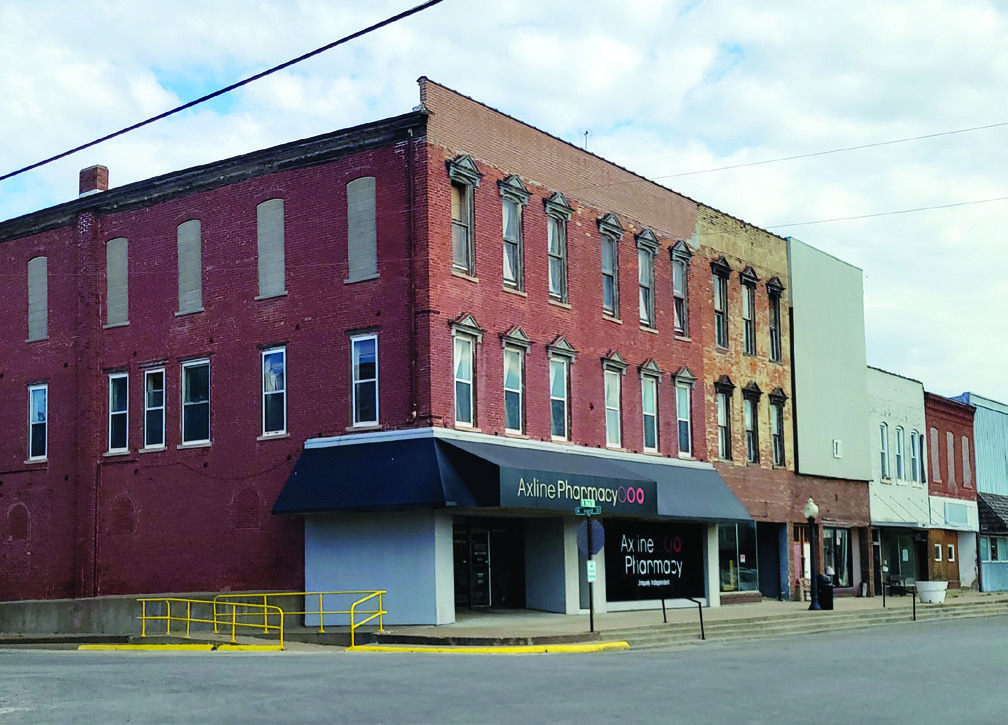
The Overview - Axline Building The building that stands at the corner of Hurst and West Main Street in Bushnell, Illinois is far from abandoned. The lower floor is a well-maintained and thriving Axline Pharmacy, which serves the Bushnell and surrounding rural communities.
Axline Pharmacy is owned by Troy and Deeda Williams of Bloomington, Illinois. Upon purchasing the building from Robert Morrow in 2014, the Williams’ built a wall which cut the size of the store in half. They also replaced all of the technology with updated versions to enable the Bushnell Axline store to become a telepharmacy, and became one of the first three telepharmacies in Illinois. A telepharmacy uses telecommunications, allowing pharmacies to review, dispense and counsel patients via technology. It increases access in rural/underserved areas, lowers costs, improves efficiency, and offers 24/7 care.
Outside, they tore off the old Glash Drug awning and replaced it to match the Axline colors, while also tinting the unused window and adding their logo. Later they hung curtains in the top two floors of the building to give Axline a homier feeling.
As probably is the case with most buildings over 100 years old, other issues were found that needed attention. The roof needed repairs, bricks needed tuckpointed or replaced, and the lighting and wiring needed upgrades.
The long-empty apartments on the second floor are still recognizable as homes people lived in as late as the 1970s. The clawfoot bathtubs are still there, as are the floor to ceiling white kitchen cupboards. Six foot tall windows look down upon the unsuspecting residents of Bushnell. The apartment dwellers had a choice of entrances each with a large number of stairs; the front entrance (on West Main) or a back entrance (on Hurst) which led to the alley. The upper two floors of Axline Pharmacy seem frozen in time, which in essence they are.
But wait. I earlier mentioned that the Williams’ hung lace curtains in the top two floors to give the building a warmer, homier look. If the pharmacy is on the first floor, and the apartments are on the second floor, what is on the third floor? That is where this story begins.
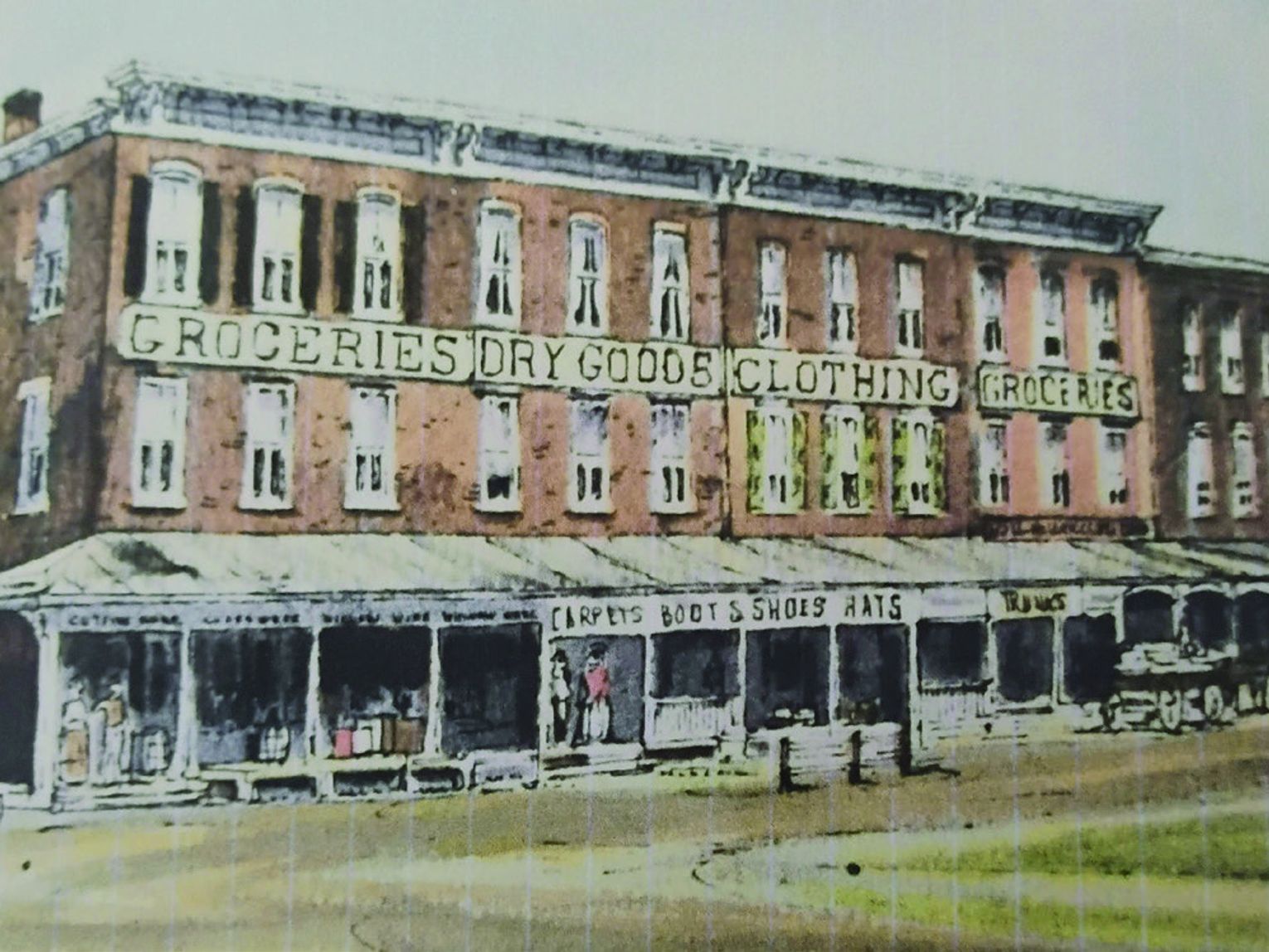
The History: From Dry Goods to Pharmacy Unlike the Bushnell Opera House, which is above Batson’s Ace Hardware, it seems as though very little information exists on what I will call the Axline building, for lack of knowing what else to call it. The Opera House was built in 1883, so it is a fair guess to assume that the Axline building was built around that time or at least before 1900. Its address at that time was 97 West Main Street, while the address today is 401 West Main. I could not find a name for the newly constructed three story building, hopefully someone will know that information and send it to me.
Over the 1900s, the Axline building was inhabited by many businesses. It is known that The Crane Store was in operation there for quite some time. The Crane Store was a large clothing and dry goods store. An auction found on eBay shows that in 1914-15 the store put out a mail order type catalog that advertised its fall and winter clothing. The catalog, besides advertising clothes, promoted their upcoming fall fashion show at the “Big Store on the West Side, Bushnell, Illinois”, a slogan they used in most of their ads. Photos advertising their fashion show acted as a centerfold poster, folding up to fit inside of the 8 ½ inch by 4 ¾ inch by 1 inch booklet.
It is documented that around 1929, J.C. Pennys occupied the building, followed by Monmouth-based Brown Lynch Scott. Brown Lynch Scott was a small retail chain that operated stores in 35 cities in Illinois and Iowa. They sold farm equipment, home goods, tires, auto accessories, and clothing items. In its 1924 catalog they offered such items as steel kitchen stools and ovens.
Around 1948, Gambles moved into the West Main building. Gambles was a major U.S./Canadian retail conglomerate known for hardware, auto supplies, and appliances. They were headquartered in Minneapolis and operated hundreds of stores, often in smaller sized towns such as Bushnell. The Gambles chain folded in 1984.
Though there may have been more stores in the Axline building over the years, Glash Drug Store is the next documented one, having moved across the tracks from East Main Street to the bigger West Side building. Bob Morrow bought Glash Drug Store in 1973 and he remained the owner until 2014.
The Third Floor Ballroom
Now back to that third floor. Of the numerous people I contacted for this story, no one really knew what the third floor was intended to be when the building was constructed. Each had guesses, but the reality is that no one really, factually knew.
To get to the third floor of the Axline building, our tour guide and Axline employee Janiene Keene entered a locked door off of West Main Street. We climbed a steep set of stairs which brought us to the hallway of several apartments. After browsing the apartments, we encountered another set of stairs which led us to the mysterious third floor.
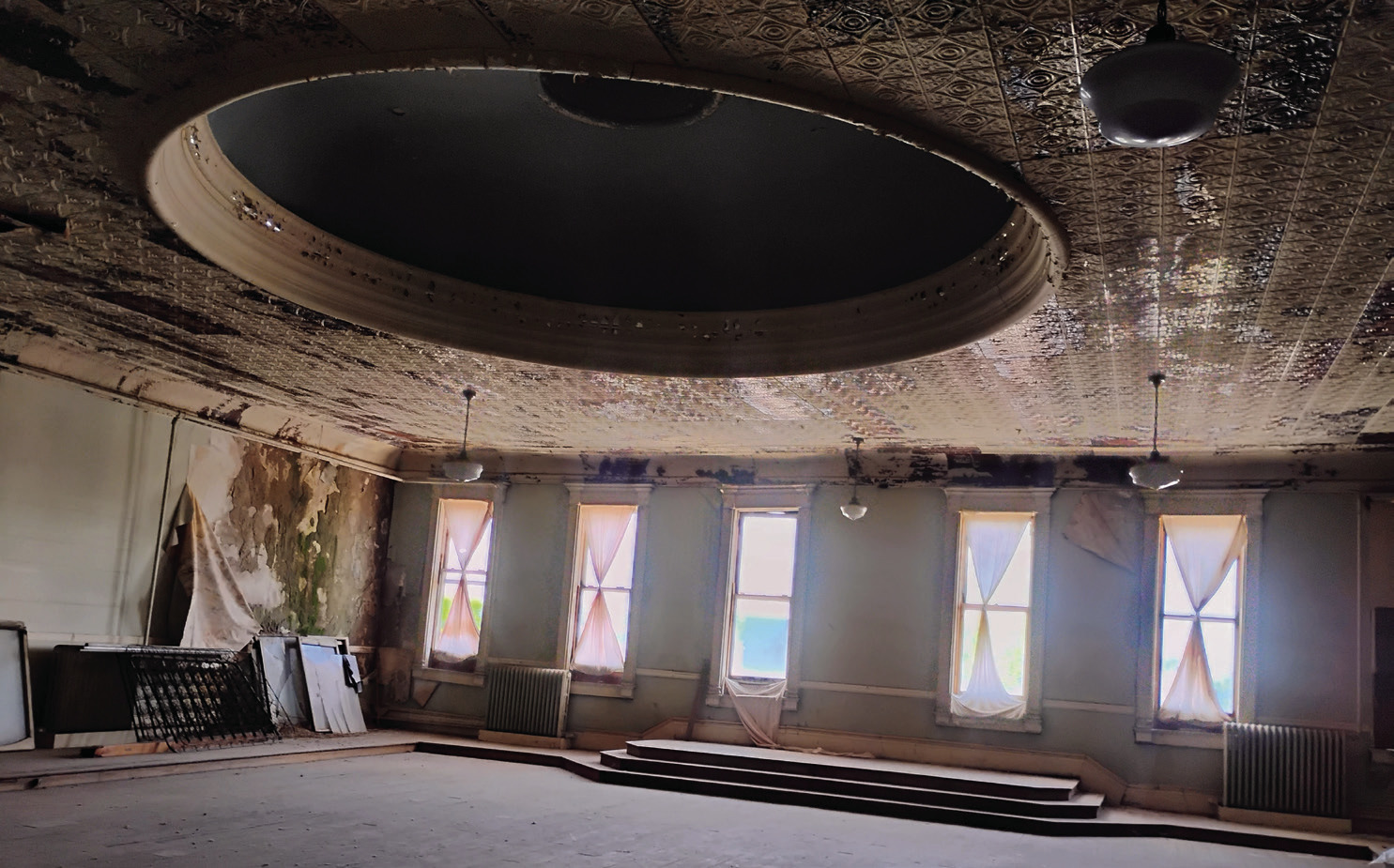
Ahead of us were two sets of tall wooden doors, doors which had a small hole drilled in them either to be used as a peephole or where a doorbell used to be. When Keene opened those locked doors, what appeared before our eyes was somewhat shocking. Before us was a beautifully preserved, what I could only describe as… well…a ballroom.
Your eyes are immediately drawn to a 20’ x 20’ dome in the ceiling of the center of the room. Under the peeling paint one can see the dome was originally silver metal in color, and you realize that at one time inside of that dome there was a huge chandelier.
The entire tall room is covered by a beautiful tin ceiling, which appears under peeling paint to be bronze in color with an Egyptian/Pegasus/running horses theme. In its day this room had to be absolutely gorgeous.
At the front of the room is a stage. Original light globes still hang over the impeccably laid wooden floor. Lace curtains adorn the six-foot tall windows, the lace curtains the Williams’ hung to make the Axline building look homier.
Several members of the Bushnell Historical Society were with me, and we began speculating what purpose the room had in its earliest days. Was it a ballroom/ dance hall or a type of community center?
In its later years we assume it was used by a lodge. In the back of the “big hall,” inside a kitchen cupboard, written on the door in pencil, is a list of names. The heading on the list says “Carrier of the Keys” and is dated 9/25/28. Eastern Star is listed with a date of 1943. For privacy reasons, even though they’re surely deceased, I am not going to divulge the 16 names penciled on the door.
The room had a hole cut high up on the back wall where a movie projector had been. When we walked around to the back of the wall, a ladder went straight up the wall into the projection room, which was only a few feet tall. Whoever was showing the movies had to be on their knees, sitting or lying down. The building’s beautiful six-foot windows face both south and east. The trim around the windows is quite ornate and would be cost prohibitive today.
In many communities, the Odd Fellows thrived earlier than the Freemasons, and it was common for Freemasons to meet at the Odd Fellows lodge for 10-20 years before they could build their own. The Odd Fellows tended to build lodges in conjunction with social halls, such as opera houses, while Freemasons leaned towards building lodges in commercial and banking areas. In the 1800s and early 1900s, men often belonged to both organizations.
It is known that in later years the third floor was used for a number of club meetings, an example being the Order of the Eastern Stars/Rainbow Girls. Next time you are in Bushnell, look up at the third floor of the Axline Pharmacy building. Up there frozen in time, is a ballroom that must have been stunningly beautiful in its day.
Note: Axline Pharmacy cannot take people up to the third floor due to time and liability restraints.
This writer would love to know more information about the “Axline Ballroom.” Any further details about the third floor would be appreciated and can be sent to me at this newspaper.
Credits: Bushnell Historical Society , Bob Morrow &, Terry Morrow, Janiene Keene