Newspapers that appeared years ago reveal much about community development and cultural change through the generations, and they often provide essential information about people and topics from the past. Our county has published dozens of them, but they are rarely discussed by historians.
Although McDonough County was founded in 1826, it did not have a newspaper until 1851, when the McDonough Independent originated in Macomb. It was politically neutral, in a culturally divided county that had settlers from the North and the South. When the Independent changed, in 1855, to become the McDonough Democrat (advocating the Democratic Party, which was then conservative), T. S. Clarke and D. G. Swan started the more liberal Macomb Enterprise (which several years later was re-titled the Macomb Journal). The Democrat was soon replaced, in 1856, by the conservative Macomb Eagle, which lasted until 1915.
As this suggests, early newspapers commonly reflected political views. And they were efforts to influence the local public and promote their town and county. But the Macomb Enterprise was also devoted to literature— printing stories and poems on page one. And naturally, it also carried advertisements, especially for local stores, hotels, and blacksmith shops.
Such early newspapers were weekly publications, usually just four pages long.
The early Macomb Enterprise price was $1.50 per year, and the circulation did not exceed 400. So, like most other newspapers from that era, it provided little profit for the owner.
But that newspaper had various talented editors over the years. An early one was lawyer Louis H.
Waters, whose editorials advocated the temperance (i.e., anti-drinking) cause and supported the coming of the railroad during the 1850s.
He later became the well-respected colonel of the 84th Infantry Regiment during the Civil War.
James K. Magie came to Macomb in 1861 (the year when the war started) and soon became the new editor.
It was he who changed the newspaper’s name to the Macomb Journal. He covered the war especially well, and he also advocated President Lincoln’s policies. (As I mentioned in a recent article about the Civil War era, the Macomb Journal and the Macomb Eagle often clashed over the war and its underlying social issues.) Magie also later joined the Union Army and often sent letters to the Journal about the great military conflict that he was so committed to. His 1865 series of letters was titled “Life in the Army.”
Another noted editor was B. R. Hampton, an attorney who was a great champion of both freedom and social responsibility. He took over in 1867 and provided the Macomb Journal with a new motto: “Equal and Exact Justice, Rights, Duties, and Privileges for All, under the Law, Regardless of Race, Creed, Color, or Previous Condition of Servitude.” As this shows, too, the early Journal was a great advocate of American values. Hampton also reflected the history and culture of McDonough County, and he wrote articles of political and social satire under the pseudonym “Pawl Pry.”
But the greatest Macomb Journal editor was W. H.
Hainline—who had also been a Civil War soldier. And he brought the Journal to new heights of community awareness and appreciation for the past. During his long tenure as owner and editor (1870-1924), the Macomb Journal grew from four pages to eight pages, by the 1880s, and then to twelve pages by the 1890s. And under Hainline’s leadership, the Journal became a daily newspaper in 1894. The content changed as well. Obituaries became more common, articles about locations beyond Macomb appeared, and his commentary column reflected local concerns. For example, in an 1893 article he vividly depicts a Macomb family that had just lost three children, in a diphtheria epidemic, and the parents were profoundly distressed. He also promoted local organizations and public programs (such as Memorial Day events and 4th of July celebrations). On December 19, 1903, he even created a special issue that was devoted to the county’s history, reflecting frontier life, the Randolph House Hotel, early businesses, noted lawbreakers, and more. So, the Macomb Journal effectively characterized both Macomb and McDonough County.
Hainline’s great work is conveyed in a book, Memory and Community: The Life and Writings of W.H. Hainline.
This brief overview of the Journal in the nineteenth century also reflects purposes and developments that were common in other county newspapers. Various ones were published in the 19th century as residents of nearby villages strove to promote their communities.
One town that established several newspapers was education-oriented Prairie City. As early as 1857 the Prairie City Chronicle was launched there, but it only lasted for about a year. Later, the Prairie City Herald operated there from 1870 to 1882. Then the short-lived Prairie City Bugle 1882 and 1883, and it was followed by the Prairie City Transcript, in 1884, which continued for several years.
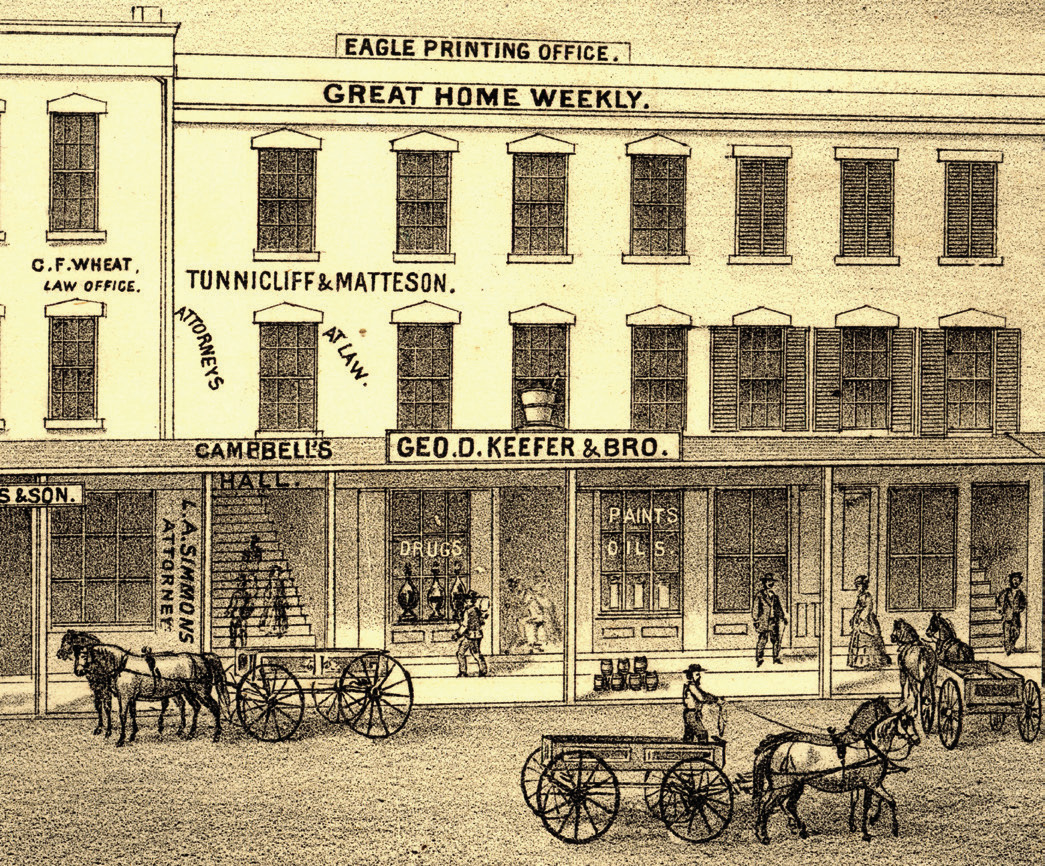
This lithograph shows a portion of the north half of the west side of the Macomb square as it is pictured in the 1871 Atlas of McDonough County, and it features the printing office of the Macomb Eagle.
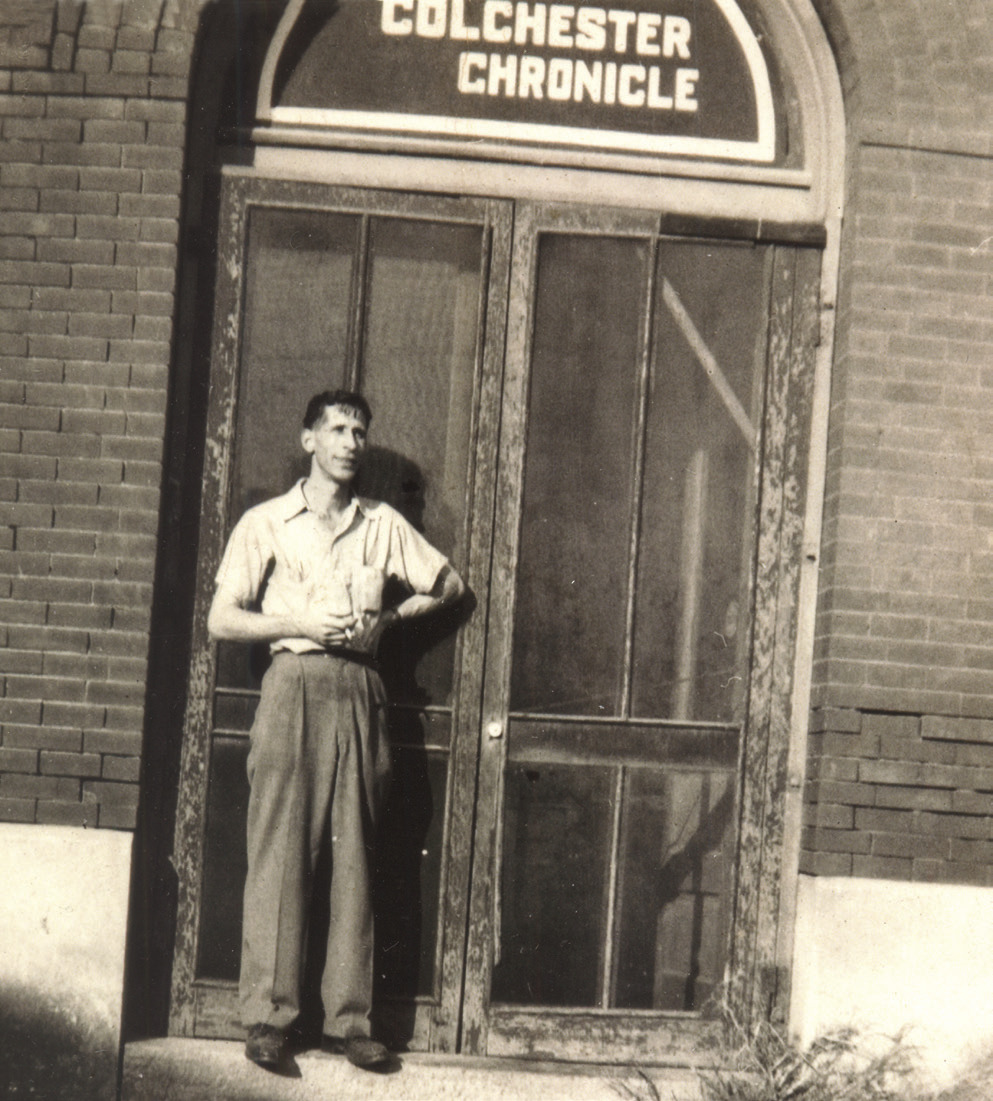
Macomb native Donald O’Harra founded the Colchester Chronicle in the early 1950s, discontinued circulation of the newspaper after a few years, and started it again in 1975, when he was sixty years old. He loved small-town life, wanted to maintain a sense of community in Colchester, and realized that, as a small-town editor, he was the last of a dying breed.”
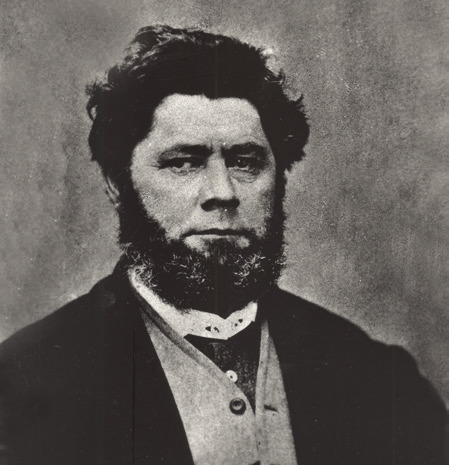
When B.R Hampton died, in 1886, W.H. Hainline published an obituary for his longtime associate, which is a remarkably sensitive assessment of his character: “A more courteous partner or true and steadfast friend than Mr. Hampton cannot be found. . . . Rough-spoken and often severe in public, he was altogether the reverse with his intimates. .. . .” Without a doubt, Hampton left a lasting impact on his colleague.
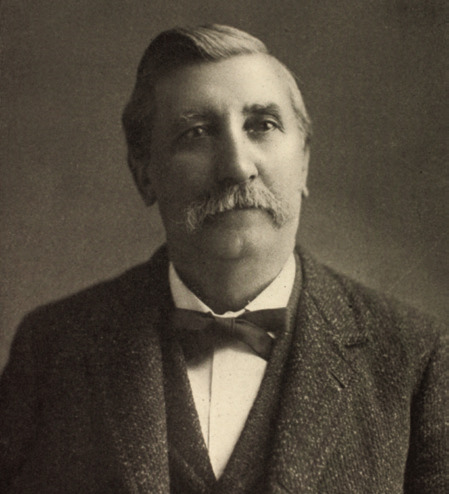
During his years as owner and editor of the Macomb Journal, W.H. Hainline dedicated the front page of his newspaper to national news, but his focus was always on the local, and as John Hallwas says in Here to Stay, “his best writings were acts of intense appreciation, and through his effort, the community and surrounding county became a vibrantly realized, intensely unified place.”
During the 1880s and 1890s the Prairie City News and the Prairie Citizen also appeared.
In the 20th century, the longest-running newspaper printed in that town was the Weekly Beacon, which started in 1918 and operated for sixty years.
Among the other villages that produced late 19th-century newspapers was Bushnell, where a short-lived newspaper called The Gleaner appeared in 1883, and another titled the McDonough Democrat started there in 1885 and lasted into the 1930s. It was later re-titled the Bushnell Democrat. Also, the Colchester Independent began in 1880 and operated for almost one hundred years. In the early1950s the Colchester Chronicle appeared there as well. Likewise, in Good Hope The Index appeared in 1885. After several years it was followed by The Reflector during the 1890s—which continued into the early 20th century. And much later, one called The Good Hoper began in 1941 and continued well into the 1970s.
And several miles west of Good Hope, the village of Blandinsville had a briefly published newspaper, the Blandinsville Argus, as early as 1857, but that lasted only a few months. Then in the late 1870s and early 1880s there was another McDonough Democrat newspaper in that town, followed by the Blandinsville Star Gazette, which appeared from 1896 to 1910.
The tiny village of Tennessee also produced the Tennessee Messenger during the 1880s and early 1890s, as well as the short-lived Tennessee Clipper in the mid-1890s. The village of Bardolph produced the Bardolph Gong in 1869, but it soon faded out. Later, the more successful Bardolph News started in 1893.
Various other villages in our county didn’t have a newspaper until the early 20th century. The town of Industry, for example, had the short-lived Industry Enterprise, starting in 1902, followed by the Industry Weekly News, launched in 1910. But its most successful newspaper was the Industry Press, operating from World War I to the 1970s. Also, in the northeastern part of the county, the tiny hamlet of Walnut Grove produced the short-lived Walnut Grove Banner in 1901. A fairly long-lasting newspaper published in that eastern part of McDonough County was the Adair Weekly Beacon, which started soon after World War II and lasted until the mid-1970s.
In any case, most of the smaller towns in our county did venture into newspaper publishing, and some of those weekly periodicals did manage to serve village and rural residents for a significant number of years. But as the twentieth century continued, and the rural population in McDonough County (and elsewhere in Illinois) declined—and Americans were increasingly impacted by radio, television, computers, and cell phones—the helpfulness of local newspapers slowly faded, for some residents.
However, a variety of well-respected Macomb newspapers have been published in the twentieth century, aside from the wellknown Macomb Journal,
mentioned above. One that only some older residents will recall is the McDonough Times. Created in 1932, by Carle Crabb and his wife, Lida, it continued until 1977.
It was very focused on many local matters, in Macomb and McDonough County.
In a four-page section published in 1933, for example, titled “Macomb and Vicinity,” Carle declared that “Macomb and McDonough County could well lay claim to the title ‘The Garden Spot of Illinois,’” and he also emphasized the area’s “forever increasing devotion to public welfare.”
In addition to the McDonough Times, Carle Crabb acquired, or established, five other weekly newspapers over the years, including the Industry Press, the Prairie Citizen, The Good Hoper, the Colchester Independent, and the Adair Weekly Beacon.
After Carle’s death in 1950, Lida Crabb began her column titled “A Day At A Time,” in which she conveyed her efforts to continue newspaper work and interact with many other residents. It continued for twenty-three years, until her death in 1981. In more recent times, the McDonough County Voice has been very popular. It began in 2009, when the Gatehouse company combined the Macomb Journal and Macomb Eagle to form the Voice. It is also available online.
And in the present day, the Community News Brief, owned and edited by McDonough County native Lynne Campbell, is very popular. It began in 2017 and appears twice a week, but also has a shorter free copy available each week, too. It recently became available online as well. As readers know, that newspaper simply avoids covering national news, which is available from many other sources.
Rather, it focuses intently on local events, organizations, schedules, sports, deaths, and more.
Many of the newspapers mentioned in this brief overview are available on microfilm at the Archives and Special Collections unit of WIU’s Malpass Library. So, for people who are looking into our county’s heritage, for whatever reasons, the local newspapers that have been published here can sweep readers back into the experience of earlier residents.
One thing that the newspaper history of McDonough County clearly does reveal is that the best of those publications have strengthened the sense of meaningful belonging that comes with awareness of local issues, nearby developments, and other residents.
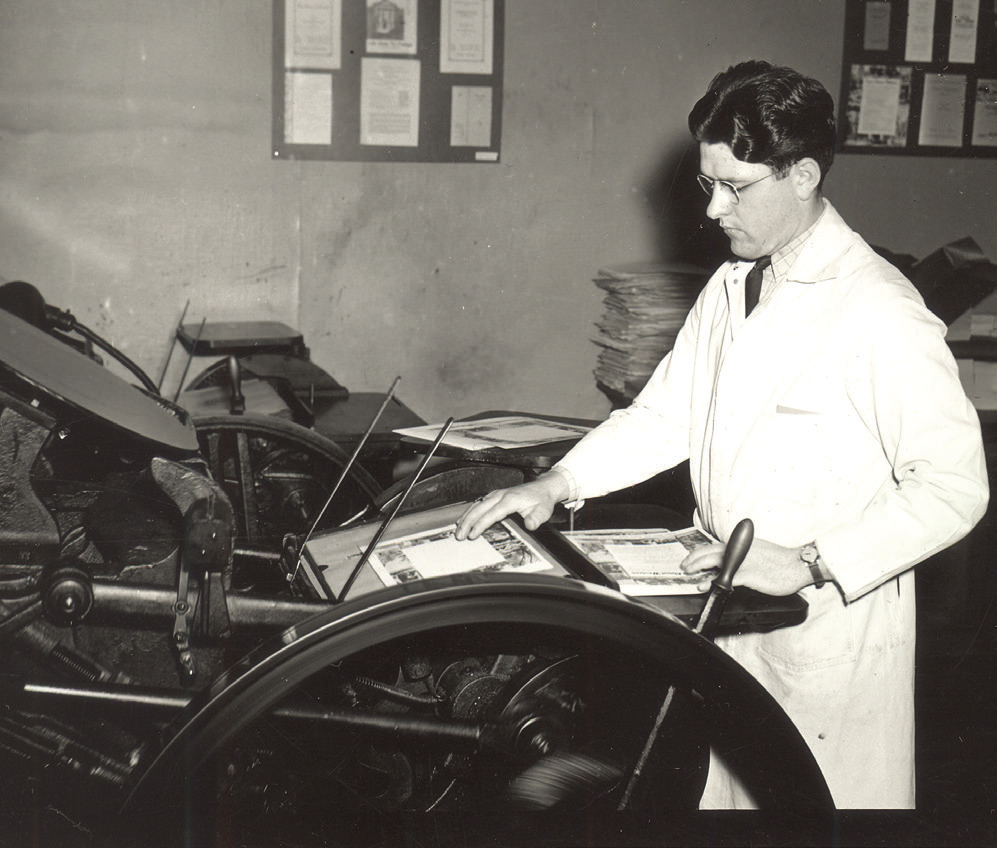
Pictured here is Francis Eddington at the press in the Bardolph News office in the 1930s. The newspaper was established in August, 1893, by Bardolph native William A. Maxwell and operated until at least 1946.
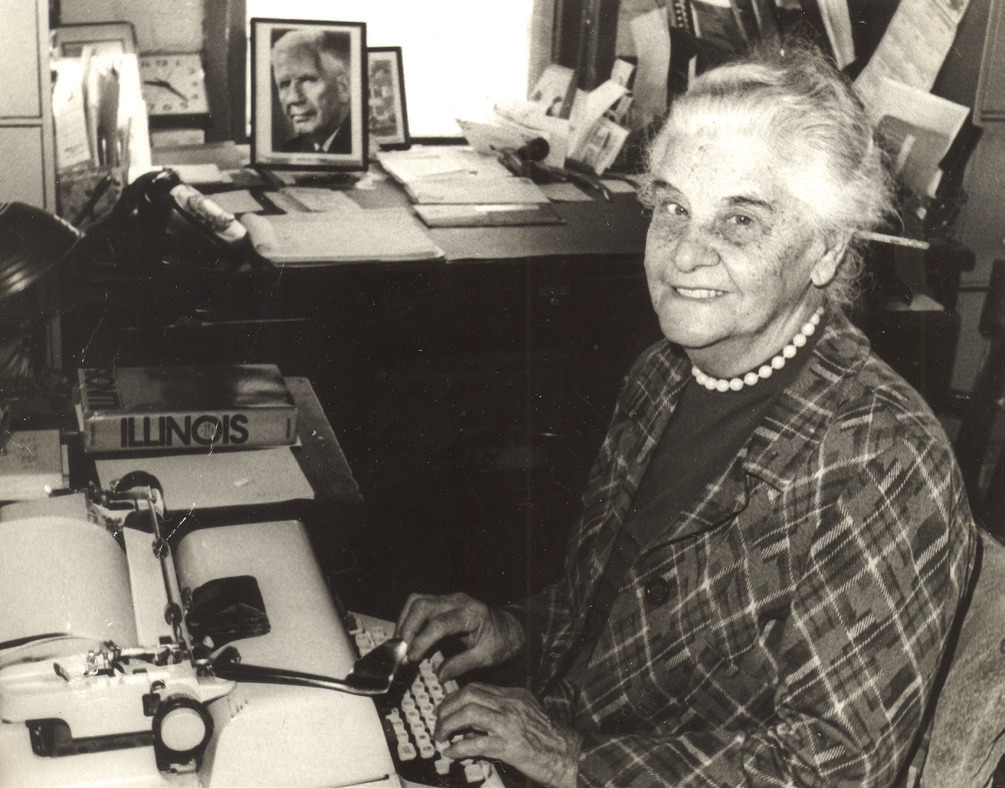
Shown here is Lida Crabb, seated at her desk in the Mc-Donough Times office. The newspaper carried some national news, but nearly always in the context of the lives of local people. It was essentially devoted to the purely local—the construction of buildings around town, the opening of new businesses, and the births, marriages, deaths, and other events that served as milestones in residents’ lives. The winter 2013 issue of the McDonough County Historical Society Newsletter was focused in its entirety on the Crabb family and its newspaper work.