Lesson on Early Female Educators in West Central Illinois
You're never too old to learn, a fact which retired teachers learned at their April 10 meeting at the Western Illinois Museum, where Director Sue Scott shared a 'history crush' lesson on three female educators in a presentation called 'Lessons from the Prairie: Early Women Educators in West Central Illinois.'
Scott began her presentation with an ice-breaker, asking retired teachers to question each other about what motivated them to become teachers. From there, she identified three women who chose to become 'educators' in their own ways — Jane Addams, Lizzie Maggie, and Cora Hamilton.
Jane Addams's story is well known. She was born and raised in a wealthy and influential family, with contacts in the Abraham Lincoln administration. She grew up and attended Rockford Seminary in Rockford, Illinois, one of the first institutes to award college degrees to women. From her experiences in Europe with settlement houses, she returned to the U.S. and began working to establish similar houses in Chicago, specifically in the Little Italy area of west Chicago.
Addams's contact with John Dewey and his educational philosophy led her to institute a more hands-on approach to education with respect for immigrant cultures and traditions. When the turbulent times during the Haymarket riots emerged, she was called on as an intermediary because of her status, her political connections, and her educational approaches in the troubled communities.
Scott noted that all three women were born within four years of each other. In Lizzie Maggie' s case, she was born into less fortunate circumstances. Her family moved from Macomb when Lizzie was only six months old. They faced many hardships with her father working as a newspaperman during tough times. The family eventually ended up in a camp when Lizzie was 13. She had to quit school and became a stenographer, one of the few 'careers' open to women. Ironically, she moved to Chicago and lived within 10 blocks of Jane Addams and her projects, but they never knew each other personally.
However, there was a connection — the Haymarket riots. Lizzie's father was deposed and interrogated about what he knew of the uprising, either as a reporter or as a possible activist. Lizzie was thrust into the middle of labor crises, workers' rights issues, and social upheavals. This led to her interest in landlords and taxation, the resultant effects on society caused by monopolistic practices combined with tax avoidance. Thus, she created The Landlord's Game. Unfortunately, she never received the recognition and financial reward for creating what someone else would 'borrow' and turn in the board game Monopoly.
Scott stressed that while Lizzie didn't have the education and means that Jane Addams enjoyed, her social activism led to her desire to affect change in a time of progressive ideas.
Which leads to the third of these female educators — Cora Hamilton. Many of the retired teachers knew nothing of Cora's life, but she had a huge impact on the development of Western Illinois University. She was born on the east coast and enjoyed frequent travels with her father who encouraged her education. He became involved in Knox College in Galesburg where Cora was raised. Scott shared a couple of stories of Cora's early experiences as a teacher. It would be well-worth everyone's time to listen to Scott's audio commentary on Cora (tspr.org/tspr-commentaries/ 2025-10-15/commentaryi- have-a-new-history-crush).
More importantly, Hamilton rose to prominence in administrative positions throughout the state, especially in Joliet, Illinois, where she, like Jane Addams, participated in a progressive cohort of women striving for more progressive advancements. Scott quoted Hamilton as saying, 'If we don't have someone like a teacher to introduce us to things, then we can't take the next steps.'
At the age of 40, Hamilton came to Western Illinois State Normal School in 1902 as the first principal of the teacher training branch. She would spend the next 20 years growing the program of training future teachers in rural areas and beyond.
Scott concluded her presentation by saying, 'All three educators had their hearts in social change and social service and in helping people prepare for a time when things were changing rapidly. We owe a lot to these women to help us find a kind of meaning and purpose in our lives. So, thank you, teachers.'
A regular business meeting followed Sue Scott's presentation, the most important item being the presentation of officers for next year. The membership approved the slate of Virginia Kessler and Barry Witten as co-presidents, Marybeth Speer as secretary, and Patti Bloom as treasurer for the 2026-27 school year. Installation will be at the May 8 meeting. Also at that meeting, Julie Terstriep will present a program on 'Camp Ellis — Western Illinois' Contribution to WWII' at Trinity Lutheran Church.
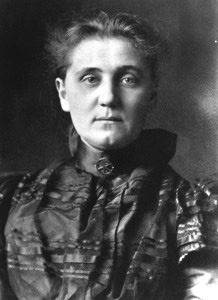
Jane Addams
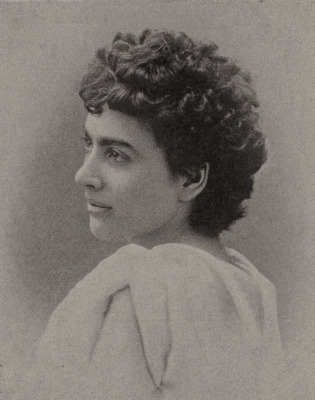
Lizzie Magie