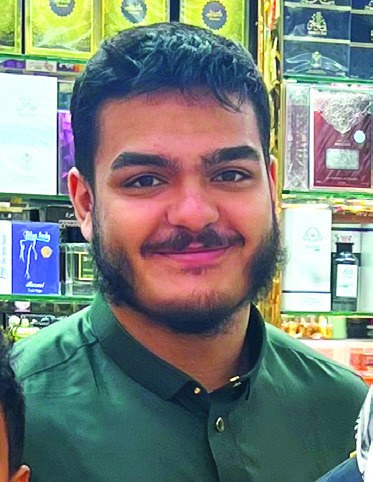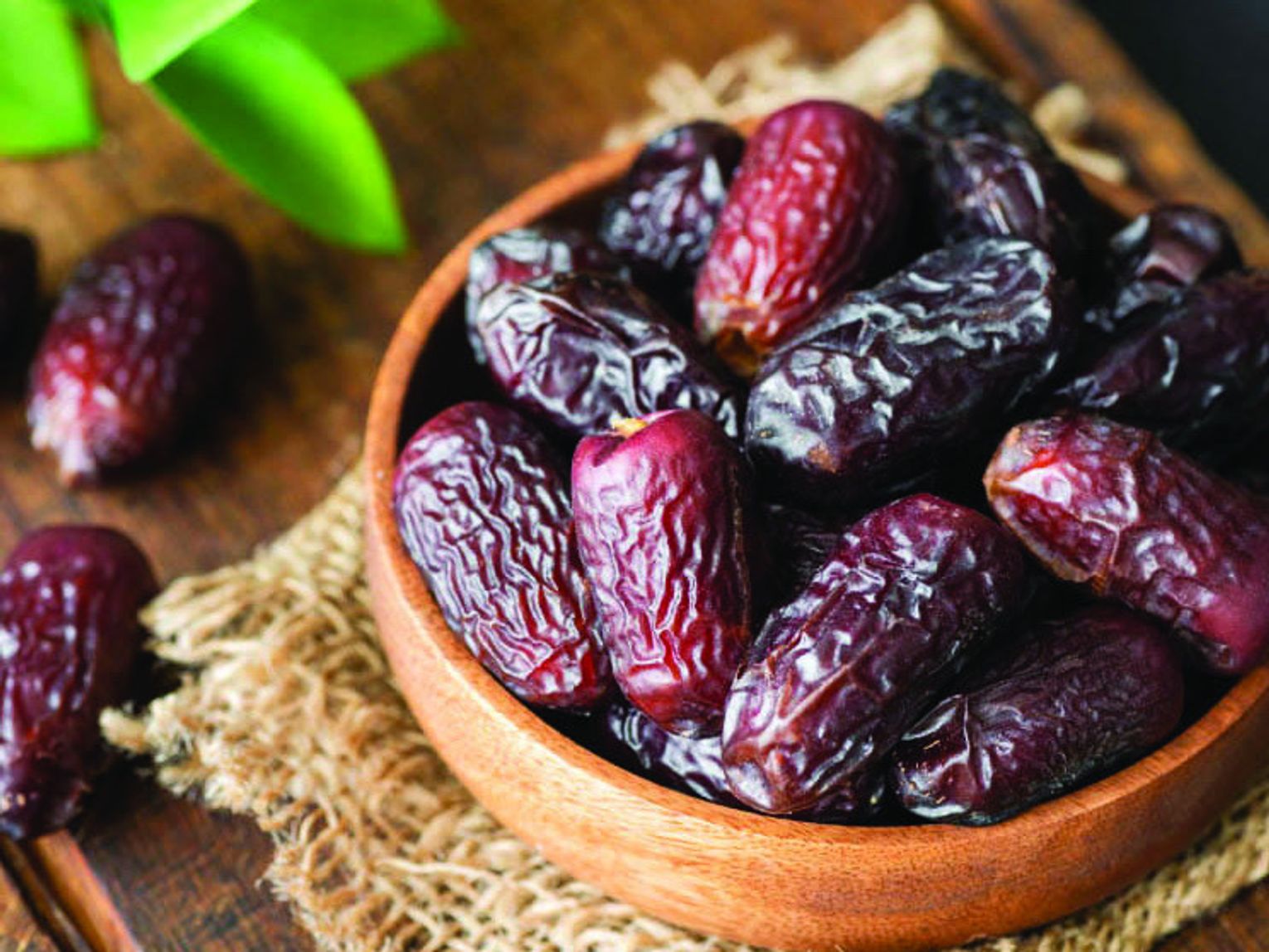
The night I met Abdullah Ballout, he fed me along with about fifty other people. But before we got to the roast chicken, the yellow rice spiced with saffron, and the fried balls of dough soaked in syrup for dessert, everyone ate a single palm date. I had been invited to an iftar on March 10 with some of McDonough County’s local Muslims during Ramadan, Islam’s holy month of fasting and prayer. Iftar is the sunset meal when observant Muslims, who during Ramadan will not eat or drink during daylight hours, get to break their fast. Traditionally the fast is broken by eating dates, a practice established by the prophet Muhammad about 1400 years ago.
So, Abdullah had a lot of hungry fasters counting on him. The night before he’d barely slept. He’d been up praying for Ramadan, and he started his own fast before sunrise. He got a couple hours of sleep, but as a WIU student, he had to wake for classes at 9:30 AM. He caught about an hour of sleep afterwards, but he had to hit the road by noon to drive to Indian Café in Iowa City to pick up food for the Iftar. He made it back around 5 PM. He didn’t listen to music or a podcast in the car; he did the Quran the entire way.
“Helping somebody to break their fast has so much reward in Islam,” Abdullah commented. “I got to feed everybody that day. Maybe I didn’t pay for it, but I paid for the gas!”
Abdullah is a Palestinian American who was raised in Orland Hills in Chicago’s southwest suburbs. His father was born in Amman, Jordan to a Palestinian family. His mother was born in the United States to parents who had immigrated from the West Bank. Both sides of his family have their roots in the territory of modern Israel, which they were forced to flee during the 1948 Arab-Israeli War (called the Nakba, or “the catastrophe,” by Palestinians).
Abdullah is currently majoring in Law Enforcement and Justice Administration at WIU. He is slated to graduate with his bachelor’s degree this May, and he is applying for work with police departments across Chicagoland. I got in contact with two of his professors at WIU, Dr. Vladimir Sergevnin and Dr. Christopher Bitner, and they commented that Abdullah was an engaged and personable student who took the material seriously. They both remarked that he had a talent for opening up discussions with his fellow students. Sergevnin wrote, “Abdullah is not only respected as a student but also genuinely liked as a person. He is an astute observer of human behavior and cultural dynamics, and he interacts comfortably with individuals from diverse backgrounds. This is a significant asset, particularly for someone pursuing a future career in law enforcement.”
I asked Abdullah why he wanted to become a police officer, and he told me that as a kid he’d always enjoyed watching police procedurals like “Chicago PD,” “Law and Order,” and “9-1-1” with his mom. What really made him decide this was a profession worth pursuing were the George Floyd protests in 2020, when police across the United States were fiercely criticized, and the most popular slogans of the era were “defund the police” and “ACAB” (all cops are bastards). Abdullah thought these criticisms were deeply unfair, but what so moved him was what he saw as the unwavering dedication to duty by police despite these criticisms. “It was so inspiring to me that a cop’s attitude is that ‘even if this person hates me, I’m going to do everything in my power to save them.’ That way of thinking really spoke to me,” Abdullah commented.
Abdullah was originally considering employment amongst several branches of law enforcement—homeland security, state police, border patrol—but he gravitated towards local policing because of an internship he did at his hometown, Orland Hills. He was impressed by how tightknit the police force was and by the bonds it had managed to forge with the local community.
I asked Abdullah what he thought about living in Macomb as a Muslim, and he commented that there were positives and negatives. He feels that Macomb as a broadly conservative Christian community tends to respect faith and religious values like his more in general than around Chicago, but he was surprised by the level of unfamiliarity with Islam: before coming to Macomb, Abdullah had never met a person who didn’t know what a mosque was or how Muslims fast for Ramadan. He reported occasional awkwardness when having to go perform one of Islam’s five daily required prayers and getting funny looks sometimes while wearing his thawb, a long, ankle-length robe for men popular in the Arab and Muslim worlds.
One thing Abdullah wished more Christians knew was how revered a figure Jesus is in Islam. Jesus is understood by Muslims to have been one of the greatest human prophets, and his mother Mary even has an entire chapter dedicated to her in the Quran (called “Maryam” there). Where Muslims differ from Christians is that they don’t believe that Jesus died for their sins, and they reject the idea that Jesus was God or the Son of God. Abdullah did not mince words in his opinion that this belief is deeply idolatrous, citing verses from the Quran which state “The heavens almost rupture therefrom and the earth splits open and the mountains collapse in devastation / That they attribute to [God] a son” (19:90-91). Sunni Muslims also believe it is sacrilegious to create images of any of the prophets, and Abdullah often finds himself shocked by the flippant ways Christians depict Jesus: “I only say that for me as a Muslim, I believe in all the prophets and I have a great respect for them. So when I see somebody walking in the cafeteria and they are wearing like a T-shirt with a picture of Jesus dribbling a basketball crossing over the devil, I feel that is so disrespectful. But how can I say anything when the person wearing it is a Christian and thinks even higher of Jesus than I do?”
Abdullah explained that from the Islamic perspective, all such images of religious figures—not just the silly ones of Jesus playing sports—are sacrilegious because they distract from God and encourage worship of the image or icon itself.
Christians themselves have not always been so accepting of images of Jesus. Dr. Amy Carr, a Lutheran theologian and professor of religious studies at WIU, commented that, in fact, Christians and Muslims (along with Jews) have an intertwined history when it comes to iconography.
“After Islam began to spread in the 7th century, Christians began to debate their use of icons of Jesus,” Carr wrote. “Perhaps pressured by Muslim opposition to images of the divine, in the 8th century, a Byzantine emperor forbade Christians to use icons. Christian iconoclasts smashed icons of Christ, regarding them as idolatrous. But in the last of seven ecumenical councils, in 787 CE, at the Second Council of Nicaea, it was decided that because of the incarnation, it is acceptable to make a physical image of Jesus Christ, who is the Son of God (the Second Person of the Trinity) made visible in human flesh. Only divine essence is to be adored, but physical icons of Christ and the saints (who form the Body of Christ, the church) may be venerated. But the Assyrian Church of the East (centered in Iraq) did not agree, and broke communion with the Catholic/Orthodox church. Like some (much later) Protestant churches, this ancient church still does not allow images of Jesus or saints.”
Abdullah also had a lot to say about current affairs in the Middle East. He was deeply critical of the State of Israel and its treatment of the Palestinians (understandable given that he still has relatives living in the West Bank). He also expressed that he is strongly anti-Iran and Shia theology (Shiism is the sect of Islam endorsed by the Iranian government; Abdullah is a Sunni Muslim). While acknowledging that not all Shias believe the same things, he thinks there are some tenants associated with Shiism—he cited the doctrine of the Twelve Imams as an example—that he sees as simply incompatible with Islam. Some Sunnis support Iran regardless because of its opposition to Israel, but Abdullah refuses to do so because of how the Iranian regime has backed groups like the Houthis and Hezbollah, which have committed atrocities even against fellow Muslims. He believes America’s best course in the current war between Iran and Israel would be to pull out and “let the oppressors fight the oppressors.”
In my conversation with him, Abdullah struck me as a kind and voluble, but very restless young man. He was eager to get a job as a police officer as soon as possible after graduation, and he wants to marry and start a family soon. He also lives his faith in a very intense way. He doesn’t drink alcohol or listen to music because he believes both of these things are prohibited by Islam (there’s a broad consensus amongst Islamic jurists about the former, but the latter is more contested). He spends a lot of his time studying scripture and praying—last Ramadan, he read through the Quran twice—and he is always on the lookout for more ways to serve God. He commented several times to me that all that earthly life is just a test before the afterlife. One of the hobbies that Abdullah does allow himself is video games—in fact, he used to be quite a serious video game streamer back when he still had the time for it—and he said that all of life is no more significant than the lobby in the game Fortnite where players wait before the start of an actual match.
Towards the end of my interview with him, I asked Abdullah what his favorite part of the Quran was, and he immediately named Surah Maryam, the 19th chapter which relates the birth of Jesus. Abdullah was able to recall some of the surah from memory, and he gave me the verses I cited earlier expressing outrage at those who have assigned a son to God. I, however, would like to close with what is my own favorite part of the surah. The Quran’s version of Jesus’ birth is similar to the New Testament in several ways— Mary is approached by the angel Gabriel; Jesus is born of a virgin—but there are several key differences. In the Quran, Mary does not give birth to Jesus in a stable, but beneath a palm tree. She was driven there in despair from the labor pains and from the scandal that will result from giving birth before marriage, saying she wished to die and be a forgotten. Then a voice comes to her, saying: “Do not grieve! Your Lord has provided a stream at your feet. / And shake the trunk of this palm tree towards you, it will drop fresh, ripe dates upon you. / So eat and drink, and put your heart at ease” (19:24-26).
I enjoy these verses because they show what I most admire in Islam: its emphasis on God’s compassion and mercy. I hope that my new friend Abdullah, who brought us all dates for Ramadan, will remember that sometimes we are also commanded to be at peace.